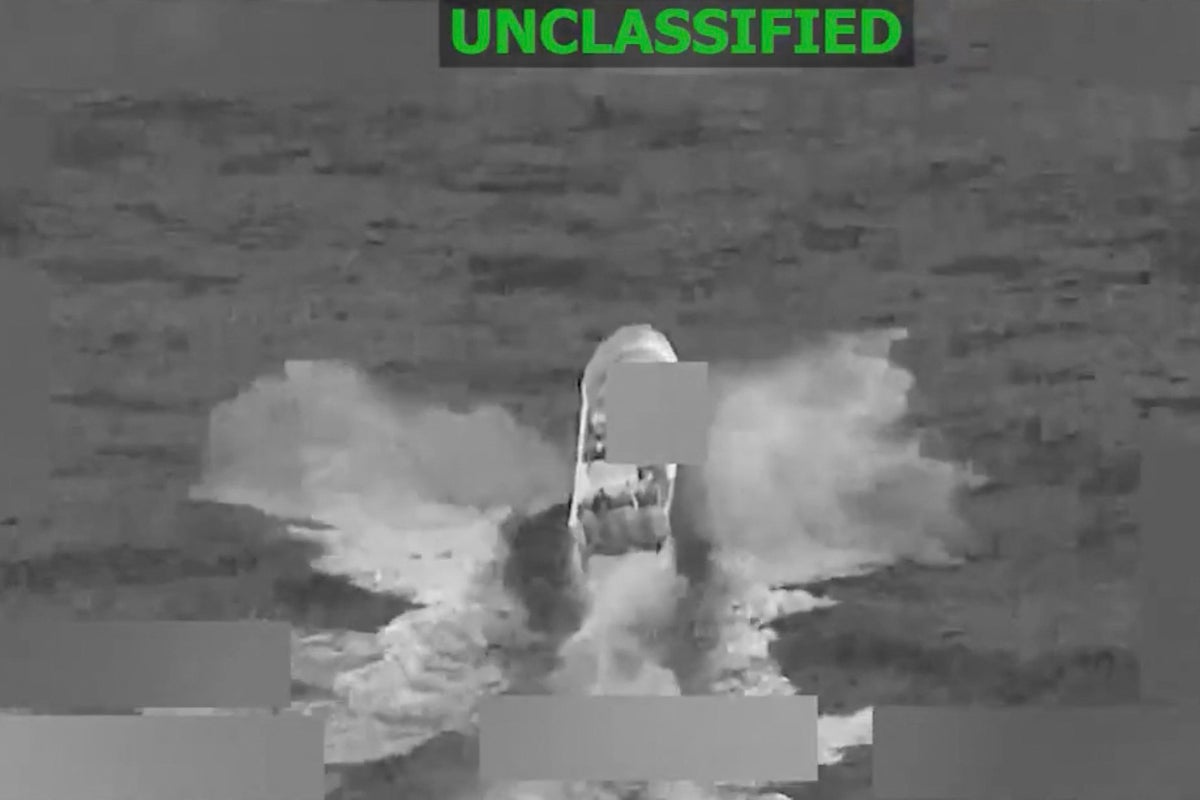
The headlines read like a carbon copy of a report from 1994. "Three dead in latest US military strike on drug boat." We are conditioned to view these reports as tactical victories—minor skirmishes in a perpetual war where the good guys occasionally have to pull the trigger to keep the streets clean. It is a comforting narrative. It is also a lie.
The recent engagement in the Caribbean, where a U.S. Navy vessel intercepted a low-profile craft resulting in three fatalities, isn't a sign of "increased maritime security." It is evidence of a catastrophic failure in strategic thinking that treats high-seas kinetic action as a solution to a domestic public health crisis. We are using billion-dollar destroyers to swat flies, and we are surprised when the flies keep coming and the bill keeps rising. For another look, consider: this related article.
The Myth of the "Surgical" Interdiction
The Pentagon and the Coast Guard love the term "interdiction." It sounds clean. It sounds like a football player stepping in front of a pass. In reality, these encounters are chaotic, high-stakes gambles occurring in the dead of night, often involving non-compliant vessels designed to sink at a moment’s notice to destroy evidence.
When the U.S. military "engages" a drug boat, they aren't just stopping a shipment. They are participating in a Darwinian selection process. For forty years, maritime enforcement has successfully filtered out the amateurs. The smugglers left in the Caribbean today are the ones fast enough, quiet enough, or desperate enough to bypass the most advanced sensor arrays on the planet. By killing the "three dead" in the latest strike, we didn't dent the supply. We simply opened up a market vacancy for a more ruthless successor. Related reporting on the subject has been provided by NBC News.
The "lazy consensus" suggests that every kilo seized at sea is a kilo that doesn't reach a high schooler in the Midwest. This ignores the basic mechanics of the supply chain. In the narcotics trade, the "product" is at its cheapest and most replaceable at the point of origin. A seizure in the Caribbean is a rounding error on a cartel’s balance sheet. To the U.S. taxpayer, however, the cost of that single mission—fuel, man-hours, and the depreciation of a multi-billion dollar platform—outweighs the street value of the haul ten times over.
The Escalation Ladder Nobody Wants to Discuss
We are militarizing a police action and wondering why the body count is rising. The use of "deadly force" in these scenarios is often justified under the umbrella of self-defense or stopping a "fleeing felon" in international waters. But let’s be honest about the power dynamic.
A "low-profile craft" (LPC) is essentially a fiberglass coffin with an outboard motor. It has zero offensive capability against a modern naval vessel. When we see deaths in these encounters, it is usually the result of a "tactical maneuver" gone wrong or a decision to disable an engine that results in a fire or a capsize.
- Fact: The U.S. has poured more money into Fourth Fleet operations in the last decade than ever before.
- Result: Purity of cocaine and synthetic opioids on U.S. streets is at an all-time high, while prices remain stable or dropping.
If the goal is to reduce the harm caused by drugs, the maritime interdiction model has a 0% success rate. I’ve spoken with former Southern Command analysts who admit, off the record, that they feel like they are "emptying the ocean with a thimble." The mission continues not because it works, but because it is politically impossible to stop. No politician wants to be the one who "opened the sea lanes to the cartels."
The Economic Absurdity of Kinetic Enforcement
Let’s look at the math of this failure.
The price of a kilogram of cocaine in the jungles of Colombia or the labs of the Darien Gap is roughly $2,000. By the time it clears the Caribbean and hits a warehouse in Florida, it’s worth $25,000. The "value add" is entirely created by the risk of interdiction. By killing smugglers and seizing boats, the U.S. military is effectively acting as a price-support mechanism for the cartels.
We provide the "risk" that justifies the high prices. Without us, the product would be a cheap commodity. With us, it is a high-margin luxury good that funds insurgencies, corrupts governments, and pays for the very technology used to evade our radars.
Imagine a scenario where a legitimate business lost 20% of its inventory to "spillage" (seizures) but still maintained a 400% profit margin. That isn't a business in trouble. That is a business that has successfully priced in the cost of doing business with the government.
The Sovereignty Trap
There is a deeper, more cynical layer to these Caribbean strikes. They often happen in a legal gray zone. The "alleged drug boat" label is a convenient shield. Because these vessels are frequently stateless or "without nationality," they lack the protections of international maritime law. This allows for a level of aggression that would be unthinkable against any other type of vessel.
We are establishing a precedent where "suspicion" equals a death sentence on the high seas. While the public cheers for the "win" against the cartels, we are eroding the very rules-based order we claim to defend. When three people die in a strike, and the only evidence we have is a press release from the agency that killed them, we aren't practicing "law enforcement." We are practicing maritime execution.
Dismantling the "People Also Ask" Delusions
People often ask: "Why can't we just use drones to stop all the boats?"
The answer is that more surveillance doesn't solve the "last mile" problem. You can see a boat from a Predator drone, but you still need a physical asset—a ship and a boarding team—to stop it. The ocean is vast. There will always be more "go-fasts" than there are cutters.
Another common query: "Don't these seizures save lives by keeping drugs off the street?"
No. They don't. Market data from the DEA and UNODC consistently shows that seizures have no long-term impact on the availability of narcotics. If you seize one ton, the cartel simply sends two. They have "inventory in motion" at all times. The only lives "saved" are theoretical, while the lives lost in these kinetic engagements are very real.
The Strategy of the Sunken Cost
The U.S. military is currently trapped in a "Sunken Cost" fallacy of epic proportions. We have spent billions on the "Joint Interagency Task Force South" (JIATF-S). We have built specialized ships like the Littoral Combat Ship (LCS) that, despite their myriad mechanical failures, are now being marketed as the "perfect drug hunters."
We are doubling down on a strategy that hasn't moved the needle since the days of the Miami Vice era. The insistence on "striking" these boats is a performance for a domestic audience. It provides "B-roll" footage for evening news segments—grainy infrared video of a boat exploding or a pile of white bales on a deck. It creates the illusion of action.
But while we are focused on three guys in a fiberglass boat in the Caribbean, the real "war" has already moved. Fentanyl and synthetic precursors aren't coming in low-profile vessels across the sea. They are coming in legal shipping containers, through mail facilities, and across land borders in quantities that make a "drug boat" look like a child’s lemonade stand.
The Caribbean strike is a nostalgic throwback to a war we already lost. It is a distraction from the fact that we have no plan for the synthetic era. We are using 20th-century naval tactics to fight a 21st-century chemical reality.
The Brutal Reality of "Collateral Damage"
When we talk about "three dead," we rarely talk about who they were. In the hierarchy of the cartels, the people on the boats are the most expendable. They are often impoverished fishermen from coastal villages in Ecuador or Colombia, recruited with the promise of a year's wages for a single trip. They are not the kingpins. They are the "cannon fodder."
By focusing our kinetic energy on these individuals, we are targeting the symptoms of global inequality, not the mechanics of the drug trade. Killing a "mule" at sea is as effective as arresting a delivery driver to shut down Amazon.
The "nuance" the mainstream media misses is that these strikes are a sign of desperation, not strength. A confident, effective policy would focus on the financial systems that launder the billions, or the domestic demand that fuels the entire engine. Instead, we settle for "three dead" because it’s easier to shoot a boat than it is to fix a society.
Stop Treating the Caribbean Like a Shooting Gallery
If we were serious about regional security, we would stop the theater. We would admit that the U.S. Navy has better things to do than act as a high-priced maritime police force for a failed prohibition policy. We would move the funding from "kinetic interdiction" to "port integrity" and "intelligence-led disruptions" of the money trail.
But that doesn't produce "strikes." It doesn't produce a body count that can be touted as progress.
The next time you see a headline about a "successful strike" at sea, ask yourself: Did the price of drugs go up? Did the overdose rate go down? Did the cartels lose a single night of sleep?
The answer is no. We are just paying for the privilege of watching a tragedy on repeat.
The sea is a big place, and we are remarkably small for thinking a few more bodies will ever turn the tide. Stop celebrating the "strike." Start questioning why we are still playing a game where the only guaranteed outcome is more of the same.