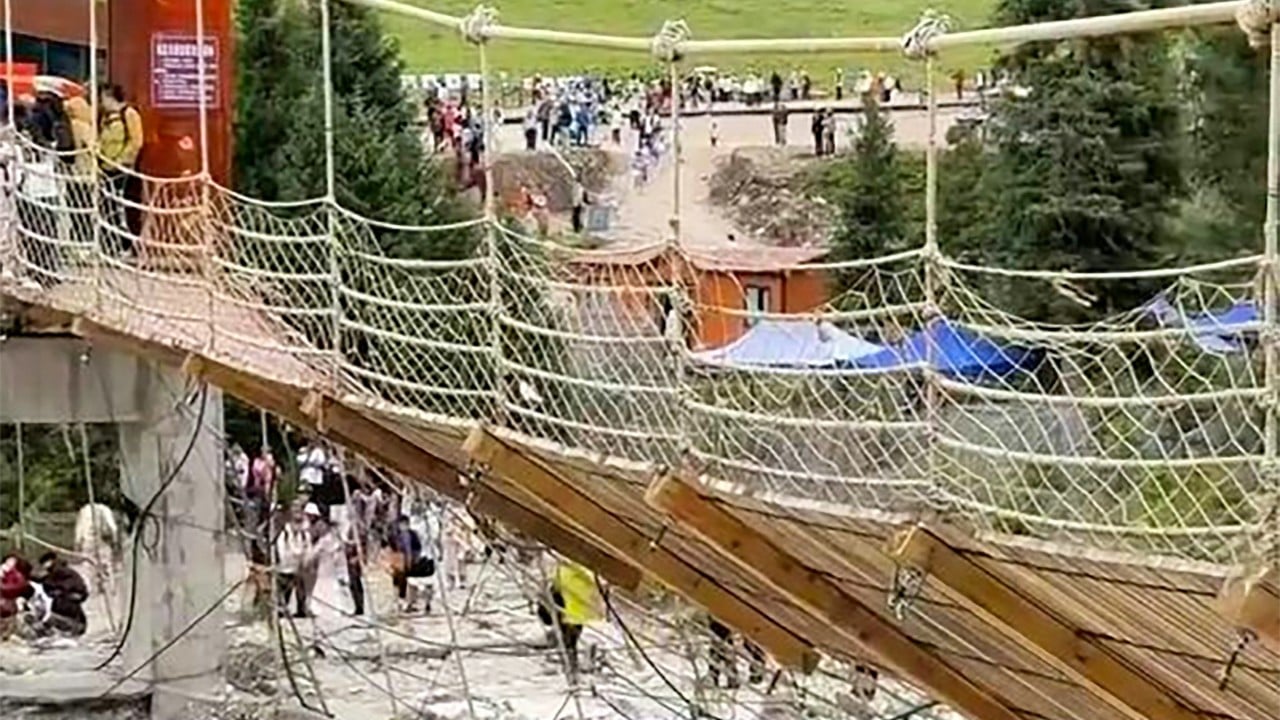
The collapse of the bridge in Xinjiang’s Bachu County is a textbook case of latent systemic failure being misattributed to proximate triggers. Initial public discourse focused on "jumping tourists" as the primary catalyst for the disaster, an explanation that fails the most basic tests of civil engineering physics. A bridge designed for public use must withstand live loads and harmonic resonance far exceeding the rhythmic movement of a small group of people. The investigative findings shift the focus from the victims' behavior to a catastrophic degradation of the structure’s Factor of Safety (FoS), specifically through environmental erosion and substandard construction quality.
The failure is not an anomaly of human behavior but a predictable outcome of the Critical Path of Infrastructure Decay. When the operational capacity of a structure is compromised by internal defects, the specific event that triggers the collapse—whether it is a gust of wind, a heavy vehicle, or people jumping—is mathematically irrelevant. The structure was already in a state of metastable equilibrium, where any minor input could initiate a total system failure.
The Three Pillars of Structural Failure in Bachu
To understand why the Xinjiang bridge collapsed, we must move beyond the superficial narrative of "external load" and analyze the three specific vectors that converged to destroy the structure’s load-bearing capacity.
1. Material Substandardization and Quality Variance
The investigation points to fundamental flaws in the initial construction phase. In any reinforced concrete or steel-dependent structure, the Design Strength ($f'_c$) is the benchmark. However, if the materials used deviate from the procurement specifications, the actual load capacity becomes a variable rather than a constant.
- Bond Failure: If the cement-to-aggregate ratio is incorrect, or if the water used contains high salinity—a common issue in the arid, mineral-rich regions of Xinjiang—the chemical bond between the rebar and the concrete weakens.
- Tensile Deficit: Bridges of this type rely on the tensile strength of steel to counteract gravity. If the steel grade was lower than specified, the bridge's ability to handle Moment Forces (bending) was compromised from the day of installation.
2. Environmental Degradation and "Alkali-Aggregate Reaction"
Xinjiang’s geography presents a brutal environment for infrastructure. The bridge was subjected to extreme temperature fluctuations and a soil chemistry that is often aggressive toward concrete.
- Thermal Expansion Cycles: The rapid shifting between extreme heat and freezing temperatures creates micro-fissures in the concrete. Once these fissures appear, moisture enters, leading to a freeze-thaw cycle that expands the cracks from the inside out.
- Chemical Spalling: The presence of sulfates or alkalis in the local environment triggers a chemical reaction within the concrete matrix. This results in "spalling," where the outer layers of the concrete flake away, exposing the internal rebar to rapid oxidation (rusting). Once the rebar loses cross-sectional area to rust, it can no longer support the weight it was designed for.
3. Maintenance Lacunae and Inspection Gaps
Infrastructure is not a "set-and-forget" asset. It requires a rigorous Life Cycle Management (LCM) protocol. The report indicates that the bridge’s defects were not new; they were pre-existing conditions that had reached a terminal state.
- Inspection Frequency: There is a direct correlation between the age of a structure and the required frequency of non-destructive testing (NDT). If the authorities were using visual inspections alone, they likely missed the internal delamination of the concrete.
- The Sunk Cost of Maintenance: In many rural development projects, budgets are prioritized for new construction rather than the preservation of existing assets. This creates a "maintenance debt" that eventually compounds into a total loss of the asset and, in this case, human life.
The Harmonic Resonance Fallacy
One of the most persistent myths in the wake of this tragedy is that the "jumping" of tourists created a Harmonic Frequency that shattered the bridge. While it is true that rhythmic movement can collapse a bridge (as seen in the famous 1831 Broughton Suspension Bridge collapse), the scale required to achieve this on a modern reinforced structure is immense.
For a group of tourists to induce resonance-based failure, their movement would need to match the Natural Frequency ($f_n$) of the bridge exactly. Modern bridge design specifically accounts for this by introducing "damping" mechanisms and ensuring the structure's natural frequency is far removed from the frequency of human footsteps (typically 1.5 Hz to 2.5 Hz).
The fact that the bridge failed under such a minor dynamic load proves that the Structural Redundancy had already been eroded to zero. In engineering terms, the bridge was no longer a "structure"; it was a collection of independent components barely held together by friction and habit.
Quantifying the Cost of Infrastructure Neglect
The economic and social cost of this collapse extends far beyond the immediate casualties. We can categorize these impacts through the Post-Disaster Economic Friction model.
Direct Costs
- Asset Replacement: The cost of rebuilding the bridge under modern, more stringent oversight will be significantly higher than the original cost.
- Liability and Compensation: The state or the managing entity faces immediate financial outflows to the families of the victims.
Indirect Costs (The "Trust Tax")
- Tourism Deterrence: Xinjiang’s tourism industry relies on the perception of safety in its remote attractions. A high-profile bridge collapse creates a "Trust Tax," where potential visitors divert their spending to regions with perceived higher safety standards.
- Operational Friction: All similar bridges in the region must now undergo emergency inspections. This disrupts traffic flow and diverts engineering resources from productive new projects to reactive, defensive maintenance.
Identifying the Red Flags: A Framework for Future Prevention
The Bachu incident serves as a grim template for identifying high-risk infrastructure before failure occurs. Analysts and regional planners should employ a Risk Matrix based on the following indicators:
- Efflorescence and Leaching: White, powdery deposits on the surface of the concrete indicate that water is moving through the structure and leaching out essential minerals. This is an early warning of internal rot.
- Exposed Rebar: Any visible steel is a sign of terminal failure in the concrete cover. Once steel is exposed to the atmosphere, the rate of structural decay increases exponentially.
- Vibration Sensitivity: If a bridge exhibits noticeable "bounce" or sway under normal pedestrian loads, it suggests that the Stiffness Matrix of the structure has been compromised. This is often due to the failure of connection points or the loss of tension in supporting cables.
The Failure of the "Proximate Cause" Logic
Legal and administrative bodies often look for a "proximate cause"—a single event to blame. In the Xinjiang case, blaming the tourists serves as a convenient distraction from the Root Cause Failure Analysis (RCFA). By focusing on the "jumping," the conversation shifts from systemic corruption or negligence in construction to individual behavior.
This is a dangerous analytical error. If a bridge is so fragile that people jumping on it can cause it to collapse, the bridge was already a failure. The "jumping" was merely the data point that confirmed the structure's status as a hazard. In the hierarchy of safety, the burden of performance lies entirely with the engineers and the oversight bodies, not the end-users.
Strategic Imperatives for Regional Infrastructure
To prevent a recurrence of the Bachu disaster, the following structural changes must be implemented within the regional engineering and oversight departments.
Standardized Procurement and Material Verification
The introduction of Third-Party Material Audits is non-negotiable. Contractors must be required to provide certified test results for every batch of concrete and steel used in public works. These results should be cross-referenced against independent lab tests to eliminate the possibility of "grade-swapping" for profit.
Digital Twin Monitoring for High-Risk Assets
For bridges located in geographically volatile areas like Xinjiang, the implementation of Structural Health Monitoring (SHM) sensors is a cost-effective long-term solution. These sensors measure:
- Strain and deformation in real-time.
- Seismic response.
- Acoustic emissions (which can detect internal cracking before it is visible).
This data creates a "Digital Twin" of the bridge, allowing engineers to predict failure weeks or months before it occurs.
Decoupling Inspection from Construction
A fundamental conflict of interest exists when the same entity responsible for building a bridge is also responsible for its long-term safety inspections. The inspection mandate must be moved to an independent regulatory body with the power to shut down infrastructure immediately upon the discovery of "Grade 4" or "Grade 5" defects (structural instability).
The Xinjiang bridge collapse was not an accident; it was a mathematical certainty. When a structure is built with substandard materials and left to rot in a harsh environment without adequate oversight, its failure is only a matter of time. The tourists were not the cause; they were the unfortunate witnesses to a systemic collapse that began years before they ever set foot on the bridge. The focus now must remain on the audit of existing infrastructure to identify other "metastable" structures before the next trigger event occurs.