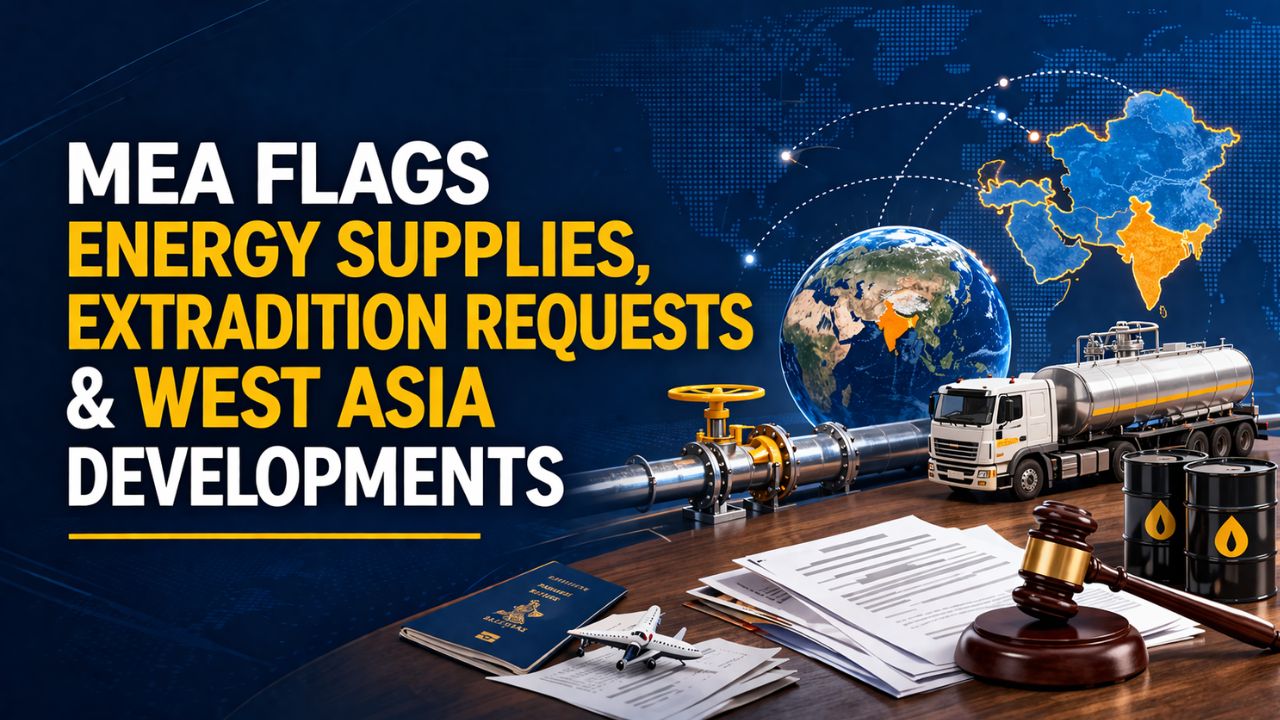
The sky over the Strait of Hormuz is a deceptive, pale blue. It looks peaceful enough from thirty thousand feet, but for the captain of a container ship carrying three thousand tons of perishable electronics, that blue is a lie. Every ripple in the water below is a question mark. Every blip on the radar is a pulse of anxiety. This is not just a trade route anymore. It is a tightrope.
When we talk about "West Asia tensions," we are talking about the price of the coffee in your hand, the security of the smartphone in your pocket, and the safety of the millions of people who call this volatile stretch of the world home. It is easy to look at a map and see lines, borders, and arrows. It is much harder to see the invisible threads of stability that keep the whole thing from unravelling.
India has decided to become one of those threads.
For decades, the standard operating procedure for a rising power was to pick a side, arm it, and hope for the best. You leaned West or you leaned East. You backed one capital city against another. But the Ministry of External Affairs in New Delhi is currently attempting something far more complex and significantly more dangerous. They are positioning India as a regional stabilizer. Not a policeman. Not an empire. A stabilizer.
The Mathematics of a Crisis
Consider a hypothetical merchant sailor named Elias. He is thirty-four, has two daughters in Kochi, and hasn't seen dry land in six weeks. When a drone swarm darkens the horizon or a ballistic missile is launched from a nearby coastline, Elias does not care about the grand geopolitical theories of the 20th century. He cares about the "No-Fly Zone" and whether his radio will find a friendly voice on the other end.
India’s role in this theater is increasingly defined by the presence of its naval assets. This isn't about posturing or "projecting power" in the old, colonial sense. It is about the brutal reality of maritime security. When the Red Sea turned into a shooting gallery, the Indian Navy didn't just issue a statement. They sent the destroyers. They sent the frigates. They became the first responders for ships under fire, regardless of the flag flying from the mast.
The facts are stark. India’s energy security is tied directly to the stability of the Persian Gulf. More than 80% of its oil and a massive chunk of its natural gas flow through these waters. If the Gulf sneezes, the Indian economy catches a terminal case of pneumonia. But there is a deeper, more human layer to this math. There are nearly nine million Indian expatriates living and working in West Asia. They are the doctors in Dubai, the engineers in Doha, and the laborers in Riyadh.
To India, this region isn't a "geopolitical theater." It’s a neighborhood.
Walking the Razor’s Edge
The difficulty of being a stabilizer lies in the silence. It is the art of talking to everyone while promising nothing to nobody.
India maintains a "strategic partnership" with Israel, sharing intelligence and defense technology. Simultaneously, it holds a seat at the table with Iran, developing the Chabahar Port as a gateway to Central Asia. It signs massive economic deals with the UAE and Saudi Arabia while consistently voting for Palestinian statehood at the United Nations.
To an outsider, this looks like a contradiction. To a diplomat, it is a masterpiece of equilibrium.
The problem with picking a side is that you inherit your ally’s enemies. By refusing to join formal military blocs or narrow ideological crusades, India has carved out a space where it can act as a bridge. When a crisis breaks out, New Delhi is one of the few capitals that can pick up the phone and get an answer from both Jerusalem and Tehran.
That access is the real currency of a regional stabilizer. It’s not about how many missiles you have; it’s about how many people will listen to you when you tell them to put the missiles down.
The Invisible Stakes of Energy
We often treat "energy security" as a dry, corporate term. It sounds like something discussed in a boardroom with air conditioning and overpriced bottled water. In reality, energy security is the difference between a hospital having power for its incubators and a city falling into darkness.
West Asia is the world’s gas station, and the pumps are located in one of the most flammable areas on Earth. The MEA’s push for stability is a desperate attempt to keep the lights on for one-sixth of humanity. If the conflict between regional powers escalates into a full-scale maritime blockade, the global supply chain doesn't just slow down. It breaks.
Imagine the ripple effect. A factory in Chennai shuts down because its components are stuck behind a naval blockade. A family in a rural village sees the price of cooking gas double overnight. The stabilizer’s job is to prevent this cascade. They do this by providing a "security net" that allows trade to continue even when the rhetoric on land is screaming for blood.
The Ethics of the Middle Path
There is a certain loneliness in being the voice of moderation. In a world of "with us or against us," the stabilizer is often viewed with suspicion by both sides. Critics argue that India is being transactional, or that it is trying to have its cake and eat it too.
But look at the alternative.
If India were to retreat into isolationism, the vacuum would be filled by powers with far more aggressive agendas. If India were to choose a side, the regional balance would tilt, perhaps permanently, toward a wider war. The "Middle Path" isn't an easy exit. It is a grueling, daily labor of nuance. It requires a thick skin and a long memory.
The stakes are not just economic. They are existential. The MEA has signaled that it views the stability of West Asia as an extension of India's own domestic peace. Radicalization and instability in the Gulf have a way of traveling. They cross borders on digital waves and in the hearts of the displaced. By acting as a regional anchor, India is essentially trying to prevent the storm from reaching its own shores.
The Human Toll of Hesitation
Behind every diplomatic communique is a real person waiting for news.
Take the case of the Indian crew members aboard ships seized in regional waters over the last year. These aren't combatants. They are civilians caught in a game of high-stakes chess played by people who will never know their names.
A regional stabilizer’s true value is measured in these moments. It is measured in the quiet negotiations that lead to a release. It is measured in the naval helicopter that drops supplies to a stranded vessel. It is measured in the reassurance that the sea lanes remain open for the thousands of "Eliases" who are just trying to get home to their families.
The world is currently witnessing a shift in the gravity of global influence. The old anchors are dragging. The old alliances are fraying under the pressure of 21st-century warfare, where drones cost a thousand dollars and can sink a billion-dollar ship. In this new, chaotic reality, the most valuable asset isn't firepower. It’s trust.
India is betting that it can build enough trust to keep the region from tipping over the edge. It is a massive, high-stakes gamble. If it works, the world stays powered, the ships keep moving, and the "blue" of the Strait of Hormuz remains just a sky, not a warning.
If it fails, the consequences will be felt far beyond the borders of West Asia.
The ship continues its journey. The captain watches the horizon. Somewhere, hundreds of miles away, a diplomat in New Delhi is on a late-night call, smoothing over a misunderstanding that could have turned into a disaster. No one will ever read about that call in the morning papers. There will be no medals for the crisis that didn't happen.
That is the burden of the stabilizer. To be the reason why the world stayed quiet for one more day.
The silence is the success.