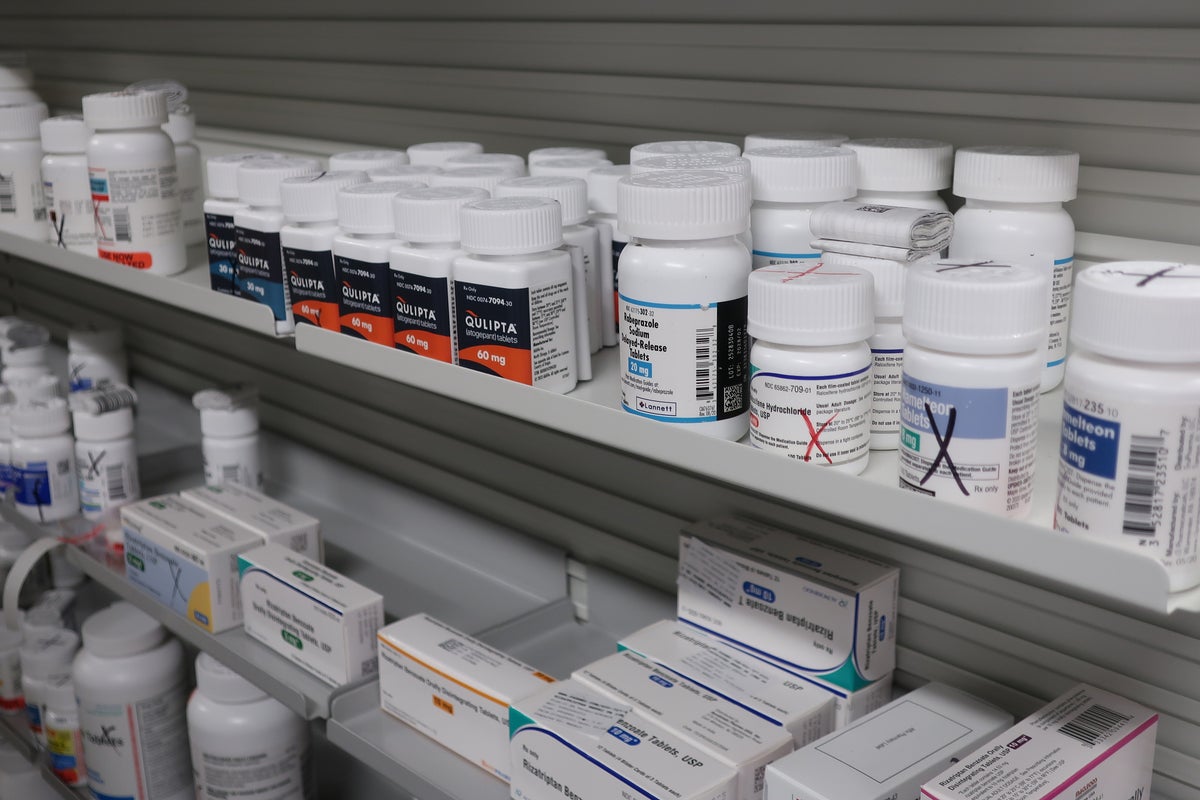
Elena stood at the pharmacy counter, her fingers tracing the worn edge of her insurance card. Behind the plexiglass, the technician wouldn't look her in the eye. That was the first sign. When the number finally flashed on the little digital screen facing the register, Elena felt a familiar, cold drop in her stomach.
Four hundred and twelve dollars. For a thirty-day supply. Don't forget to check out our previous article on this related article.
Six months ago, the exact same prescription cost forty-five dollars. Elena’s health insurance hadn't changed. Her doctor hadn't changed. The little white pills inside the plastic bottle were identical to the ones she had taken for three years to keep her autoimmune flare-ups at bay.
"Is there a generic?" Elena asked, her voice dropping to a whisper so the man waiting behind her wouldn't hear. To read more about the context of this, WebMD provides an in-depth breakdown.
"This is the generic," the technician replied, finally looking up with a sympathetic, exhausted shrug. "Your insurance updated their formulary. They don't cover this manufacturer anymore."
Elena left without the medicine. She drove home in silence, trying to calculate which utility bill she could delay to afford the chemical compounds keeping her body from attacking itself.
Scenarios like Elena's play out thousands of times every single day in every state across the nation. For years, the public narrative around skyrocketing healthcare costs has focused on a simple cast of villains: greedy pharmaceutical companies charging too much for research, or insurance conglomerates raising premiums to satisfy Wall Street. But there is a shadow cast over the pharmacy counter that most Americans never see.
The real architecture of modern drug pricing is determined by corporations whose names rarely appear on a bottle of medicine or a health insurance card. They are Pharmacy Benefit Managers, or PBMs.
To understand how a life-saving drug becomes an unaffordable luxury, you have to look into the opaque machinery that sits squarely between the factory where a drug is made and the hand that swallows it.
The Invisible Architects
Pharmacy Benefit Managers began with a simple, noble mandate decades ago: manage prescription drug benefits for health insurance plans to keep costs low. They were supposed to be the ultimate negotiators. By representing millions of patients, a PBM could go to a drug manufacturer and demand a massive discount. If the manufacturer refused, the PBM would simply leave that drug off the insurance plan’s approved list—the formulary.
It sounds like a triumph of free-market capitalism. It isn't.
Over time, through a series of massive corporate mergers, the PBM industry consolidated into a towering triumvirate. Today, just three companies—CVS Caremark, Express Scripts, and OptumRx—control roughly eighty percent of the prescription drug market in the United States. These corporate giants are no longer independent middlemen. They are vertically integrated behemoths owned by or tethered to the nation’s largest health insurance companies and retail pharmacy chains.
This consolidation flipped the incentives entirely upside down.
When a middleman is paid based on a percentage of a drug’s list price, a dangerous mathematical reality emerges. The middleman no longer wants the cheapest drug. They want the most expensive drug with the highest secret rebate.
Consider a hypothetical scenario to illustrate how this upside-down world operates. Imagine a pharmaceutical company manufactures a vital heart medication. They offer to sell it for one hundred dollars. But they also offer a second version, identical in every way, with a sticker price of five hundred dollars, accompanied by a secret three-hundred-dollar "rebate" paid directly back to the PBM after the sale.
In a rational market, the PBM would choose the one-hundred-dollar option to save the patient money. In our actual healthcare system, the PBM frequently selects the five-hundred-dollar option. The PBM pockets the three-hundred-dollar rebate as profit or uses it to sweeten its contract with the corporate insurer. Meanwhile, the patient at the counter—whose deductible or co-insurance is calculated based on that artificially inflated five-hundred-dollar sticker price—pays through the nose.
The patient pays more so the middleman can make more.
The Battle of the States
For years, this system operated in total obscurity, shielded by complex contracts and strict non-disclosure agreements that kept the public, and even employers buying health plans, completely blind to the true cost of care. But the financial strain on everyday citizens has reached a breaking point, forcing state capitols into an unprecedented war against the pharmaceutical status quo.
Lawmakers from both sides of the political aisle are realizing that waiting for federal intervention is a luxury their constituents cannot afford.
State legislators are targeting the core mechanisms of PBM profitability. Chief among these is a practice known as "spread pricing." This occurs when a PBM charges a health plan a high price for a generic drug, pays the local independent pharmacy a fraction of that amount to dispense it, and pockets the vast difference—the spread—as pure profit.
In Ohio, a state audit revealed that PBMs were pocketing more than two hundred million dollars annually through spread pricing within the state’s Medicaid program alone. Money meant for the healthcare of vulnerable citizens was instead padding corporate bottom lines. Ohio responded by tearing up its traditional PBM contracts and moving to a single, transparent model.
Other states are following suit with aggressive legislative packages. From New York to Texas, bills are passing that force PBMs to pass one hundred percent of manufacturer rebates directly down to the consumer or the health plan. Other laws ban "gag clauses"—contractual rules that legally prohibited local pharmacists from telling a patient that a drug would actually be cheaper if they paid cash out-of-pocket rather than using their insurance.
Think about that for a moment. A professional pharmacist could have been sued or kicked out of an insurance network simply for telling a struggling mother that her child's antibiotics cost twenty dollars in cash but forty dollars through her insurance card.
The Crushing of the Local Pharmacy
The consequences of this system extend far beyond individual bank accounts. They are actively erasing the healthcare infrastructure of rural and urban communities alike.
Independent, family-owned pharmacies have long been the frontline of American medicine. They are the places where the pharmacist knows your name, remembers your allergies, and notices when your new blood pressure medication might interact poorly with your arthritis pills. But these small businesses are dying.
Every time a PBM slashes the reimbursement rate to a pharmacy for dispensing a drug, the local business takes a hit. Often, PBMs reimburse independent pharmacies at a rate lower than the actual cost the pharmacy paid to buy the drug from the wholesaler.
Imagine running a grocery store where a massive corporate conglomerate forces you to sell milk for two dollars a gallon, even though it cost you three dollars to buy it from the dairy. You lose a dollar on every carton. How long could you stay open?
This isn't an academic exercise. It is an existential crisis for neighborhoods. When an independent pharmacy closes in a small Midwestern town or a neglected urban neighborhood, that community enters a pharmacy desert. Elderly patients who don't drive are suddenly forced to travel thirty miles to a corporate chain store, or rely on mail-order pharmacies that frequently leave temperature-sensitive medications sitting in hot delivery trucks or freezing mailboxes.
The PBMs argue that mail-order options and corporate pharmacy networks increase efficiency and lower costs for employers. But if you ask the residents of towns where the main street pharmacy now stands empty, with dark windows and a locked door, they will tell you a very different story about the true cost of efficiency.
The Myth of the Free Market
Defenders of the current PBM system warn that state regulations will disrupt the delicate balance of healthcare economics, leading to higher premiums for everyone. They claim that tying the hands of these negotiators will remove the only check against the raw pricing power of global pharmaceutical companies.
But a system built on secrecy cannot be called a free market.
True markets require transparency. They require a clear line of sight between the buyer, the seller, and the value of the product being exchanged. When a patient cannot find out the true price of a life-saving medication until they reach the cash register, and when their doctor has no idea which drugs are affordable when writing a prescription, the market isn't working. It is broken.
The pushback from states is an attempt to introduce a foreign concept into this ecosystem: sunlight.
By demanding to see the receipts, auditing the secret rebates, and banning predatory pricing practices, state governments are asserting a fundamental truth. Healthcare is not an ordinary commodity. The rules that govern the sale of televisions or airline seats cannot be applied blindly to the molecules that keep human hearts beating.
The momentum is shifting, but the corporate entities holding the strings are not retreating quietly. Millions of dollars are pouring into lobbying efforts to weaken state bills, to insert loopholes, and to tie up new regulations in lengthy court battles.
The View from the Counter
The legislative debates in state houses can feel distant, dry, and wrapped in impenetrable jargon. Terms like "fiduciary duty," "maximum allowable cost lists," and "clawbacks" tend to make eyes glaze over.
But none of this is abstract.
It is entirely concrete for the father choosing between his own insulin and his daughter’s school clothes. It is concrete for the grandmother cutting her pills in half to make the prescription stretch through the end of the month, playing a dangerous game of Russian roulette with her own bloodstream.
We have built a system that treats the management of disease as a high-stakes shell game, where the player who moves the cups the fastest wins, and the patient always loses. The states stepping into this fight are finally recognizing that the dignity of human life must outweigh the profit margins of the entities managing the paperwork.
Elena eventually found a workaround. Her doctor spent three hours on the phone fighting for a prior authorization, navigating a labyrinth of automated phone menus and corporate denials until a bureaucrat finally relented. She got her medication, this time.
But as she walked away from the pharmacy counter, her bottle of pills tucked safely into her purse, she couldn't shake the realization of how fragile her security was. Her health wasn't just dependent on medicine or science. It was at the mercy of a hidden ledger, managed by an invisible hand, somewhere far away, that cared nothing for her name.