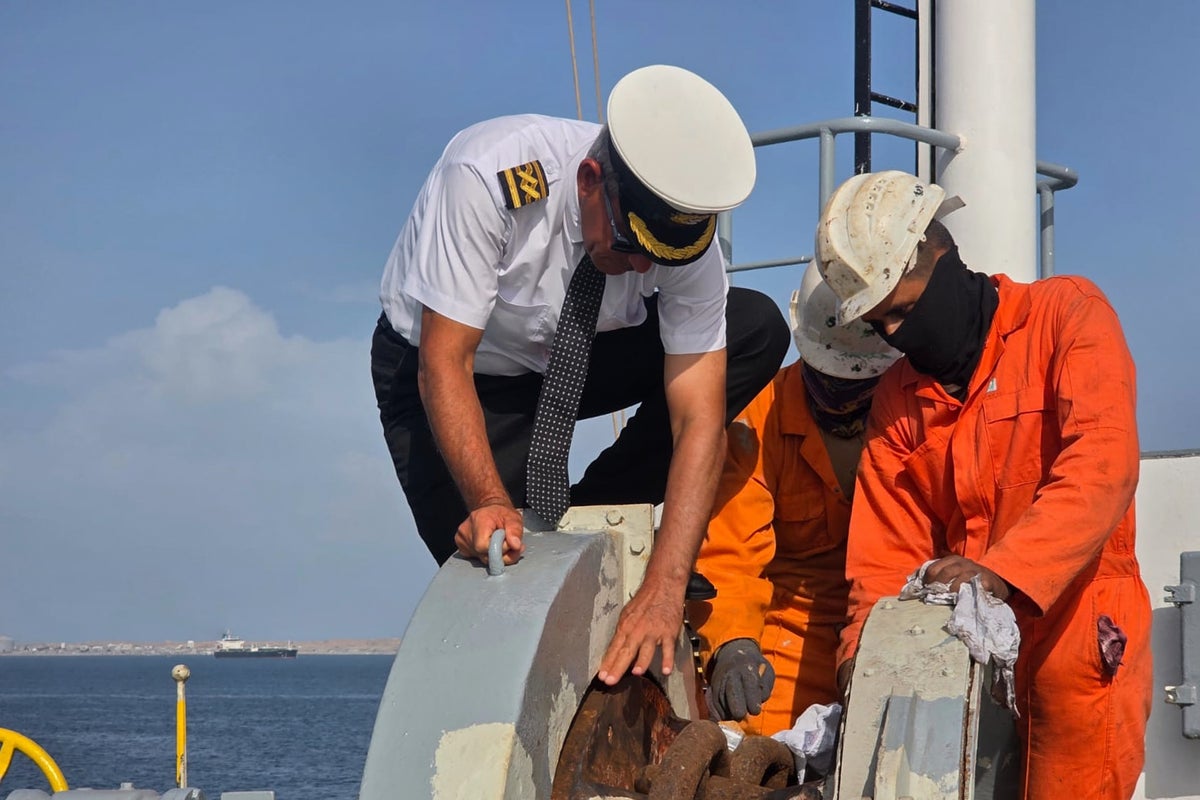
The coffee in the captain’s mug is never truly still. Even when the Persian Gulf looks like a sheet of hammered silver, flat and deceptively calm, the liquid ripples. It is a tiny, vibrating record of the massive engines below and the tension radiating from the bridge. For a man commanding a Vessel of nearly 300,000 tons, the vibration isn’t just mechanical. It is the pulse of a geopolitical fault line.
Captain Elias (a name we’ll use to represent the lived reality of those currently helming VLCCs—Very Large Crude Carriers) doesn’t look at the water for beauty. He looks for anomalies. A fast-moving wake where there should be none. A skiff that ignores radio hails. The silhouette of a drone against the hazy horizon. In the Strait of Hormuz, the distance between a routine Tuesday and an international incident is measured in yards.
The Two-Mile Tightrope
The Strait is a geographical bottleneck that defies the vastness of the ocean. At its narrowest, the shipping lanes are only two miles wide. Through this throat passes roughly twenty percent of the world’s petroleum. If you have ever pumped gas in a coastal city or felt the warmth of a heater in a cold winter, you are tethered to this specific, volatile patch of blue.
When tensions between Washington and Tehran spike, the Strait doesn’t just become a workplace; it becomes a chessboard. For Elias, the "news" isn't a headline on a smartphone. It is the sudden appearance of a gray-hulled naval frigate or the frantic crackle of the VHF radio. He isn't a soldier, yet he operates in a theater of war. He is a logistics expert tasked with navigating a bomb the size of an skyscraper through a room full of people flicking matches.
Consider the math of a mistake. A single Suezmax tanker can carry one million barrels of oil. If a stray mine or a targeted strike breaches that hull, the environmental disaster is only the first layer of the tragedy. The second is the immediate seizure of the global economy. Within hours of a confirmed attack, insurance premiums for every ship in the region skyrocket. These aren't abstract numbers on a spreadsheet. They are costs that filter down to the price of milk, the cost of a plane ticket, and the stability of national budgets.
The Psychology of the Steel Box
Living on a tanker during a period of high alert is an exercise in managed anxiety. The ship is a closed system. You eat, sleep, and work within the same steel walls for months. When the threat level rises, the isolation intensifies.
"You don't think about the fire until you see the smoke," Elias might say. But that isn’t quite true. You think about the fire constantly. You think about it during the safety drills that feel a little too real. You think about it when you see the "armed guards" on the deck—men hired to do a job that shouldn't exist in civil commerce.
The sheer scale of these vessels makes them feel invincible, but they are fragile. They are designed to withstand the crushing weight of the sea, not the focused heat of a shaped charge. The crew knows this. They know that if something goes wrong, there is no "running away." You are on a floating island of fuel.
The Hidden Mechanics of Risk
Why do they do it? Why does any crew agree to sail into a zone where "seizure" is a common vocabulary word?
The answer is the brutal, uncompromising reality of global demand. The world does not stop because a few politicians are locked in a standoff. The refineries in Asia need the crude. The factories in Europe need the power. The maritime industry operates on a "just-in-time" philosophy that leaves zero room for caution. If the tankers stop, the world grinds to a halt within weeks.
This creates a strange, unspoken contract between the captains and the powers that be. The US Navy provides a "security umbrella," a term that sounds comforting until you realize an umbrella cannot stop a thunderstorm; it can only keep you slightly drier. The presence of the Fifth Fleet is a deterrent, but it is also a magnet for friction.
Every time a US destroyer shadows a tanker, the stakes are raised. It is a dance of giants, and the merchant mariners are the grass being stepped on.
The Weight of the Silence
Night is the hardest time. In the darkness, the Gulf loses its color and becomes a void. The radar screen is the only eyes the ship has. Every blip is a question. Is that a fishing dhow? Is it a patrol boat?
The silence on the bridge is heavy. Elias watches the GPS coordinates crawl. They are moving at fifteen knots—a walking pace in the context of the vast distances they travel, yet too fast to stop if something appears in their path. The inertia of a loaded tanker is terrifying. It takes miles to bring the beast to a halt. In the narrow lanes of the Strait, there is no room for a change of heart.
We often talk about "geopolitics" as if it is a game played with plastic pieces on a map. We discuss "sanctions" and "projections of power" in air-conditioned rooms. But for the men and women on the water, geopolitics is the smell of salt spray mixed with diesel. It is the way your heart hammers when a helicopter circles too low. It is the realization that you are a very small part of a very large, very dangerous argument.
The Cost of Looking Away
We have become experts at ignoring the origins of our comforts. We want the cheap fuel, but we don't want to see the razor wire on the railings of the ships that bring it to us. We want the stability of the global market, but we don't want to think about the captain who hasn't slept in thirty-six hours because his ship is being shadowed by a foreign navy.
This isn't just about oil. It is about the fragility of the threads that hold our modern lives together. Every time a tanker clears the Strait of Hormuz and enters the open Indian Ocean, a collective breath is held and then released.
The crisis doesn't end with a treaty or a de-escalation. It just goes quiet for a while. The tension remains in the water, waiting for the next spark, the next tweet, or the next misunderstood maneuver.
As Elias finally moves out into the deep water, leaving the volatile coast behind, he finally takes a sip of his coffee. It is cold. He doesn't mind. The liquid is still. For now, the world is moving exactly as it should, and the invisible crisis remains just that—invisible to everyone but the people currently standing on the edge of the horizon.
The horizon is a line that moves as you approach it. You never quite reach safety; you only earn the right to keep moving.