The mathematics of urban collapse leave little room for grief. When an entire residential square in Gaza City’s Sabra neighborhood vanished beneath the weight of an Israeli airstrike in November 2023, the arithmetic of survival immediately took over. Families did not weep; they ran. They searched with bare hands until the dust settled into a permanent concrete crust, sealing away 308 human beings in a multi-story tomb of twisted rebar and pulverized cement.
Nearly three years later, civil defense crews finally punched through that subterranean maze. They exhumed 112 bodies—members of the extended Hassayna and Abu Sharia clans—setting the stage for a mass funeral that exposed the grim mechanics of war recovery in a pulverized enclave. This was not merely a ceremonial parting. It was an autopsy of infrastructural failure, chronicling how modern siege warfare creates structural tombs that remain inaccessible to rescue teams for years.
The Logistics of the Unrecoverable
Heavy machinery does not exist here. Heavy fuel does not exist here. When international bodies talk about the humanitarian catastrophe in the Gaza Strip, they frequently overlook the sheer mechanical barrier of extraction.
Consider a hypothetical civilian defense unit equipped only with hand shovels, rusty crowbars, and kitchen knives. When a five-story concrete slab pancakes onto a basement shelter, it creates a hydraulic press effect. The floors compress into sandwich layers of aggregate and steel mesh. Without hydraulic spreaders, heavy cranes, or structural engineers to map load paths, digging through these sites is an exercise in agonizing slowness.
For 136 continuous hours, civil defense workers clawed at the Sabra district debris. What they pulled out were not bodies in the traditional sense, but remnants preserved by the anaerobic environment of the collapsed ruin. Among the 112 recovered were 40 children and 30 women. Their identities were verified not through pristine documentation, but through scraps of clothing, identity cards fused to pocket linings, and familiar rings.
The Israel Defense Forces historically maintained that operations in dense urban environments target military infrastructure, attributing civilian mortality to the adversary's embedding tactics. Yet, from an investigative standpoint, the strategic reality on the ground points to a secondary crisis: the institutional impossibility of post-strike rescue. When an entire neighborhood is rendered off-limits by active combat zones, shifting front lines, and fuel blockades, the dead remain trapped in architectural limbo. They become structural fixtures.
The Bureaucracy of the Missing
Numbers in this conflict carry a heavy, shifting weight. Official records maintained by local health ministries place total casualties past seventy thousand, but this metric fails to capture the category of the permanently unverified. Thousands more remain missing beneath the rubble, neither officially declared dead nor accounted for in hospital rosters.
This bureaucratic vacuum creates a unique psychological and legal torment for surviving relatives. In civil law, a missing person creates complex administrative hurdles regarding property, inheritance, and family support. In a war zone, the absence of a body transforms into an open-ended trauma. Families cannot complete the fundamental rituals of closure because the state infrastructure required to issue death certificates has been flattened alongside the municipalities.
Local emergency committees function on makeshift logistics. During the early phases of the conflict, bodies were frequently buried in hasty mass graves near hospital courtyards simply because transport to functional cemeteries was a death sentence for the drivers. As front lines shifted back and forth across Gaza City through the subsequent years, these temporary burial sites were sometimes churned up by armor, or conversely, left marooned behind military cordons.
The Sabra neighborhood exhumation stands out precisely because it represents a rare victory of excavation over time. Most families never get the chance to hold a collective prayer over rows of flag-draped shrouds. They wait in temporary tents, watching civil defense bulletins for news that an excavator has finally reached their specific sector of the map.
The Anatomy of an Open-Air Necropolis
To understand the landscape of modern urban warfare, one must look at how cities digest their own destruction. Gaza City is no longer organized by neighborhoods; it is organized by strata of ruin.
When residential blocks collapse inward, they form a dense matrix of pulverized drywall, shattered brick, and furniture. Over months, windblown dust and rain cement these materials into a dense conglomerate. The bodies trapped inside undergo rapid decomposition followed by mummification or advanced skeletal degradation, depending on moisture pockets within the collapsed basements.
When recovery teams finally breach these crypts, they face severe biological hazards. Without protective suits, industrial respirators, or proper refrigeration units, forensic recovery is dangerous. Yet, the work persists because the cultural imperative for proper burial overrides sanitary warnings.
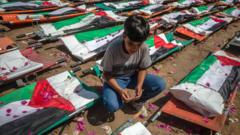
Mahmoud Basal, the spokesperson for Gaza’s Civil Defense, stood before the rows of white shrouds at the recent mass funeral and posed a question to an indifferent international audience. It was a question born of profound fatigue. The diplomatic machinery of the outside world focuses heavily on high-level ceasefires, trade routes through maritime choke points like the Strait of Hormuz, and hostage negotiations. Meanwhile, local operators are left fighting gravity and concrete with bare hands.
The tragedy of the 112 dead from the Hassayna and Abu Sharia clans is not an isolated historical anomaly. It is a preview of what will occur across the enclave for decades. Long after the active bombardment ceases, the architectural graveyards will continue to yield their contents. Every time a new alleyway is cleared or a collapsed foundation is finally lifted, another layer of the ledger will open, revealing the true, delayed cost of urban annihilation.
The rows of graves in Gaza City were filled by midday, but the heavy earth movers remain parked at the edge of the next collapsed block, waiting for fuel, waiting for clearance, waiting for the silence to hold long enough to dig.