More than 1.5 million people have already poured into Saudi Arabia. They aren't there for a vacation. They're there for the Hajj, the spiritual peak of a Muslim’s life. Even with the Middle East feeling like a powderkeg, the sheer scale of this gathering is staggering. People often ask if it's safe to travel to the region right now. The answer isn't a simple yes or no, but the million-plus pilgrims on the ground in Mecca right now have clearly made up their minds. Faith, for them, outweighs the geopolitical noise.
The logistics are a nightmare that the Saudi government manages with military precision. You've got crowds that could fill a dozen Super Bowls moving in unison. This year, the heat is the immediate enemy. Temperatures are hitting 45 degrees Celsius. That’s roughly 113 degrees Fahrenheit. It’s brutal. The Saudi authorities have deployed thousands of medics and installed massive cooling systems, but the physical toll is real. You don't just "show up" for Hajj. You prepare for months, or years, for a test of endurance that happens to be a religious requirement.
Why 1.5 Million People Ignored the War Drums
The headlines are full of talk about regional conflict. Tensions between Israel, Hamas, and the shadow of Iran loom over every diplomatic meeting in the world. Yet, the numbers for the Hajj haven't plummeted. Why? Because the Hajj is a "once in a lifetime" obligation for those who are physically and financially able. If you’ve saved for ten years and finally got your visa, a headline about a drone strike 500 miles away isn't going to stop you.
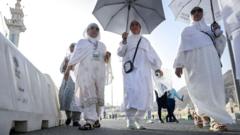
I've seen how these crowds move. It’s a sea of white cloth. Every man wears the same simple two-piece garment. Every woman wears modest dress. The goal is total equality. Wealthy CEOs stand shoulder-to-shoulder with subsistence farmers from Indonesia. This year, the presence of over 1.5 million foreign pilgrims shows that the desire for spiritual connection remains stronger than the fear of political instability. Saudi Arabia has a massive stake in keeping this safe. The Hajj is a matter of national prestige and a cornerstone of their "Vision 2030" plan to diversify their economy. They can't afford a security lapse.
Security Measures and the Iran Factor
There’s always a subtext when Iran and Saudi Arabia are mentioned in the same breath. Historically, protests during the Hajj have led to tragic outcomes. In 1987, hundreds died during clashes. But the vibe in 2026 is different. There’s a fragile, cold peace between Riyadh and Tehran. Both sides seem to realize that turning a pilgrimage into a political battlefield helps nobody.
Saudi security forces aren't taking chances. They use advanced AI surveillance and crowd-control algorithms to prevent the deadly stampedes that have happened in the past. You’ll see security officers everywhere. They aren't just there to catch "bad guys." They’re mostly there to direct the flow of people and keep the lines moving toward the Kaaba. The government has also cracked down on "unauthorized" pilgrims. If you don't have the right permit, you aren't getting in. This isn't just about bureaucracy. It’s about knowing exactly how many bodies are in a specific space so people don't get crushed.
Staying Safe in the Meccan Heat
If you're following the news, the political stuff sounds scary. But if you're on the ground, the sun is the real threat. The Saudi Ministry of Health has been blunt about it. Stay hydrated. Carry an umbrella. Don't exert yourself during the peak sun hours between 11 am and 4 pm.
- Water stations are everywhere, providing chilled Zamzam water.
- Misting fans line the walking paths to drop the ambient temperature by a few degrees.
- Mobile clinics are stationed at every major ritual site.
Most pilgrims who get into trouble do so because they push themselves too hard. They want to finish every ritual quickly. They forget that Islam allows for flexibility if your health is at risk.
The Economic Reality of the Pilgrimage
The Hajj isn't just a religious event. It’s a massive economic engine. For Saudi Arabia, this brings in billions of dollars. But for the pilgrims, it’s a massive expense. In 2026, the cost of Hajj packages has climbed in almost every country. Inflation hit the travel sector hard. From airfare to hotel stays in Mecca and Medina, the prices are steep.
Despite the costs, the demand is relentless. Countries like Pakistan, India, and Indonesia have massive waiting lists. Some people wait twenty years for their turn. This tells you everything you need to know about the "war fears" mentioned in the media. When you've waited two decades for a permit, you don't cancel because of a regional skirmish. You go. You pray for peace. You hope for the best.
What Happens Next in the Rituals
The journey is just beginning. Over the next few days, this massive crowd will move from Mecca to Mina. Then they’ll head to the Plain of Arafat. This is the most critical day. Standing on Arafat in the heat, praying for forgiveness, is the core of the Hajj. After that, it’s back to Muzdalifah to collect pebbles for the symbolic "stoning of the devil."
It’s a grueling schedule. If you’re watching from home, understand that this is a feat of human endurance. The Saudi government has spent billions on the "Mashaer Railway" and improved pedestrian tunnels to make these transitions smoother. They’ve even introduced "smart cards" that contain every pilgrim’s medical and travel info. It’s a high-tech solution to an ancient tradition.
If you’re planning for a future Hajj or Umrah, start your health prep now. Physical fitness is the most underrated part of the journey. You’ll walk miles every day in intense conditions. Don't wait until you get your visa to start walking. Get your body ready. Make sure your finances are in a dedicated, high-yield account so the rising costs don't bite as hard when your name finally comes up on the list.
The world looks at the Middle East and sees conflict. The pilgrims look at Mecca and see home. That’s the disconnect. While the diplomats talk, 1.5 million people are proving that life, and faith, goes on regardless of the headlines. Focus on your health, secure your permits through official channels like the Nusuk platform, and keep your eye on the local weather reports rather than just the political talk.