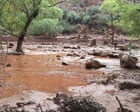
The desert lies silent until it doesn't.
Rain falls fifty miles away, completely out of sight. A wall of water barrels down a narrow canyon, transforming a dry wash into a raging torrent in mere seconds. If you aren't paying attention, Grand Canyon flash flooding gives you zero time to react.
People die out here because they misunderstand how the desert works. They look up at a patch of blue sky above the rim, assume everything is fine, and walk straight into a hydraulic trap. It is a fatal mistake made every single year by visitors who underestimate the sheer geographic scale and brutal mechanics of monsoon season.
The Brutal Physics of Slot Canyons
Water does not care about your itinerary. When torrential downpours hit the high plateaus, the hard-baked desert soil refuses to absorb the moisture. Instead, the liquid rushes downward, funneled entirely into narrow slot canyons and dry washes.
You can be standing in brilliant sunshine while a wall of water four feet high comes screaming around the bend. There is no warning rumble that gives you minutes to scramble up a cliff face. You get seconds.
Park rangers deal with this reality constantly. Rescuers pull stranded hikers from canyon walls, recover bodies from debris piles, and shake their heads at the sheer predictability of it all. Most victims didn't check the weather twenty miles upstream. They only looked straight up.
- The drainage basin might be massive.
- The rainfall might happen miles away.
- The escape routes are often non-existent once you are deep inside.
If you are planning a backcountry trek, you have to treat a clear sky overhead as a total illusion.
Monsoon Season Realities
Summer brings ferocious weather patterns to the American Southwest. Monsoons dump massive amounts of water in localized bursts, turning dry dirt roads into mud pits and dry creeks into violent rapids.
Hikers often get caught because they treat a desert hike like a stroll through an urban park. They pack a single bottle of water, wear sneakers with zero traction, and ignore the park service warnings posted right at the trailhead. When the sky turns dark over the North Rim, the danger clock starts ticking instantly.
Statistically, fatalities spike during these exact months. At least two dead after catastrophic Grand Canyon flooding remains a grim headline that repeats itself because human habits refuse to change. People roll the dice with nature. Nature always wins.
"The water moves faster than an Olympic sprinter, and it carries boulders, trees, and mud that will crush anything in its path."
You cannot outrun a flash flood in a narrow gorge. You cannot swim against the current. The only defense is total avoidance when the forecast looks suspicious.
How to Stay Alive Out There
Survival comes down to absolute paranoia about weather patterns you cannot see. Stop trusting what you can spot with your own eyes from the canyon floor.
Check the regional weather forecasts before stepping foot on any trail that involves a wash or a slot canyon. If there is even a thirty percent chance of rain anywhere in the watershed, change your plans. Period. Do not risk it for a photo or a tick on a bucket list.
- Camp on high ground well above the high-water mark of any nearby wash.
- Know your escape routes before you enter narrow sections.
- Turn around immediately if clouds start building over the distant plateaus.
When you hear a roar that sounds like a freight train echoing down the gorge, do not look to see what it is. Drop your gear, scramble up the steepest rock face you can find, and climb until your fingers bleed.
The canyon will still be there tomorrow. You might not be.