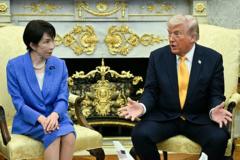
The air inside the Akasaka Palace usually smells of old cedar and the peculiar, sterile silence of high-stakes diplomacy. It is a place where history is handled with silk gloves. But when the motorcade from Washington pulls up, the silence doesn’t just break; it shatters. There is a specific kind of tension that exists when the leader of the world’s largest military sits across from the leader of a nation whose constitution literally forbids the act of war. It is the tension of a shared, bloody past trying to masquerade as a polite future.
Donald Trump does not do "polite" in the traditional Japanese sense. He does not do the slow, agonizingly precise rituals of the reidō. He does the hard sell. And in this particular room, surrounded by the gold leaf and the heavy drapes of Tokyo’s state guest house, he decided to reach back eighty years to find a metaphor.
He invoked Pearl Harbor.
To understand the weight of that moment, you have to look past the headlines and into the eyes of the career diplomats standing in the wings. They are the ones who have spent decades smoothing the jagged edges of the U.S.-Japan relationship. When the President compared a potential strike on Iran—a modern, messy, geopolitical chess move—to the "day of infamy" that launched the Pacific War, the oxygen seemed to leave the room.
It wasn't just a historical reference. It was a collision of worlds.
The Weight of the Word
Imagine being Shigeru, a hypothetical but very real mid-level official in the Japanese Foreign Ministry. Shigeru grew up in the shadow of a grandfather who never talked about the war, a man who carried the silence of the 1940s like a physical weight. For Shigeru, "Pearl Harbor" isn't a line in a textbook or a movie starring Ben Affleck. It is the starting gun for the destruction of his heritage. It is the reason his country rebuilt itself from ash.
Now, he stands against a wall, notebook in hand, hearing that name used as a casual point of comparison for a drone strike or a naval skirmish in the Strait of Hormuz.
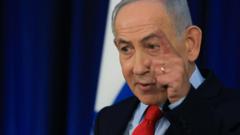
The President’s logic was blunt. He was framing the threat of Iran not as a regional nuisance, but as a sneak attack in the making, an existential threat that justifies a preemptive, overwhelming response. But history is a fickle tool. When you use it as a hammer, you tend to break the things you’re trying to build. By invoking the very event that turned the United States and Japan into mortal enemies, Trump wasn't just talking about Iran. He was reminding his host, Prime Minister Shinzo Abe, exactly who held the power in the room.
The Architecture of an Alliance
The relationship between the U.S. and Japan is often described as a "cornerstone." That is a dry word for a vibrant, terrifyingly complex reality. It is a marriage born of a funeral.
Japan relies on the American nuclear umbrella. In exchange, the U.S. gets a permanent, strategic foothold in the backyard of its greatest rivals. It is a deal written in the blood of the mid-century, and it requires a very specific kind of theater to maintain. Japan provides the quiet, steady reliability; America provides the loud, muscular protection.
But what happens when the protector starts rewriting the script?
During the meeting, the atmosphere wasn't just about trade deficits or regional security. It was about the fundamental nature of memory. Abe, a man who has spent his entire career trying to normalize Japan’s military standing, found himself in a linguistic trap. To agree with the Pearl Harbor comparison would be to validate a version of history that remains deeply sensitive in Tokyo. To disagree would be to insult the man holding the umbrella.
He chose the third option: a polite, inscrutable mask.
The "invisible stakes" here aren't just about whether the U.S. goes to war with Iran. They are about the stability of the Pacific. Every time an American president invokes the specter of World War II while standing on Japanese soil, he isn't just making a point about current events. He is tugging on the stitches of a wound that hasn't fully healed.
The Iran Problem in a Tokyo Mirror
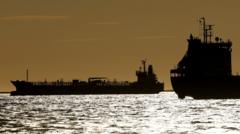
The actual facts of the Iran situation are cold and sharp. Tensions in the Persian Gulf had reached a boiling point. Tankers were being harassed. Drones were being swatted out of the sky. To the White House, this looked like a precursor to a larger catastrophe. To the Japanese, who get the vast majority of their oil from that very region, it looked like a threat to their literal survival.
Japan is a nation of few natural resources. It lives and dies by the sea lanes. If the Strait of Hormuz closes, the lights in Tokyo start to flicker within weeks.
Trump’s comparison was designed to elicit a specific emotion: urgency. He wanted Abe to feel the breath of the predator on his neck. He wanted to bypass the slow, grinding gears of international law and get straight to the gut instinct of defense.
"They’re looking for a Pearl Harbor," the President suggested, referring to the Iranian leadership.
The irony was thick enough to choke on. Here was the leader of the nation that dropped the atomic bombs, sitting in the heart of the nation that received them, using the catalyst of that entire tragedy to justify a new conflict. It was a masterclass in cognitive dissonance.
The Human Cost of Hyperbole
We tend to think of these summits as dry exchanges of memos. We forget that they are inhabited by people who have to go home and explain these things to their children.
Consider the "Security Mom" in a suburb of Osaka. She hears the news. She hears the word "War." She hears "Pearl Harbor." To her, these aren't geopolitical maneuvers. They are signals of a changing world where the rules no longer apply. For seventy years, Japan has been the "Peace Nation." It has built its entire modern identity on the idea that the horrors of the 1940s will never, ever be repeated.
When the U.S. President uses that history as a rhetorical flourish, he isn't just talking to the Prime Minister. He is talking to her. He is telling her that the peace is conditional. He is telling her that the ghosts aren't gone; they’re just waiting for a reason to come back.
The rhetoric creates a ripple effect. It changes how a businessman in Nagoya thinks about his investments in the Middle East. It changes how a student in Kyoto views the American bases on Okinawa. It shifts the tectonic plates of public opinion, moving them away from the "ironclad alliance" and toward a wary, self-protective skepticism.
The Language of the Unspoken
In Japanese culture, there is a concept called kuuki wo yomu—reading the air. It’s the ability to understand what is being said through what is being left out.
In that meeting, the "air" was heavy with things Trump didn't say. He didn't mention the nuance of the Iran nuclear deal that his administration had scrapped. He didn't mention the decades of Japanese diplomacy in Tehran that were now being undermined. He didn't mention that for Japan, war is not a metaphor; it is a scar.
Instead, he leaned into the narrative of the "Great Attack."
It is a seductive narrative. It simplifies the world into heroes and villains, into surprises and retaliations. It removes the gray areas where diplomacy lives. But Japan is the kingdom of gray areas. Its entire survival depends on navigating the space between China’s rise and America’s unpredictability.
The comparison to Pearl Harbor wasn't just a factual reach; it was a cultural deafness. It assumed that the emotional resonance of that event is the same in Tokyo as it is in Washington. It isn't. In Washington, it’s a rally cry. In Tokyo, it’s a mourning cry.
The Mirror of History
The real tragedy of the modern political narrative is the death of context. We live in an era of the "Instant Historical Parallel." Everything is the new 1938. Every adversary is the new Hitler. Every tension is the new Pearl Harbor.
But when we do this, we lose the ability to see the actual problem in front of us. Iran is not Imperial Japan. The Persian Gulf is not the Pacific in 1941. By forcing the present into the mold of the past, we ensure that we will repeat the mistakes of the past—not because we've forgotten them, but because we've become obsessed with them.
As the cameras clicked and the two leaders stood for their handshake, the contrast was absolute. One man was tall, expansive, and loud, using history like a weapon. The other was shorter, contained, and quiet, holding history like a fragile glass.
The motorcade eventually roared away, leaving the Akasaka Palace to its cedar-scented silence. But the words stayed behind. They hung in the air long after the diplomats had tucked their notebooks away and the translators had finished their grueling work.
Somewhere in the city, a grandfather sits on a bench, watching the neon lights of the Ginza district flicker to life. He doesn't know the specifics of the Iran briefing. He doesn't know the latest polling data from the American Midwest. But he knows the sound of that name. He knows what happens when the men in the gilded rooms start talking about 1941.
He knows that when the powerful start invoking the ghosts of the past, it’s usually because they’re looking for new bodies to fill the graves of the future.
The silence returned to the palace, but it was different now. It was heavier. It was the silence of a guest who had forgotten that in this house, the walls still have ears, and the ears still have memories.