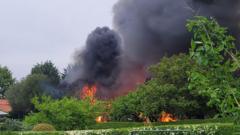
A 91-year-old man loses his life in a converted garage fire. The neighbors hear "explosions." The media frames it as a freak accident or a localized tragedy. They are wrong. This is not an isolated incident of bad luck; it is the inevitable outcome of a housing market that encourages the creation of death traps under the guise of "innovative" urban living. We call them garden suites or granny flats to make them sound cozy. In reality, they are often unventilated, illegally wired Tinderboxes that we’ve normalized because the alternative—admitting our infrastructure is broken—is too uncomfortable.
The lazy consensus treats these fires as technical failures. A faulty heater. A gas canister left near a spark. While those are the immediate catalysts, the root cause is a systemic failure of safety standards and the quiet acceptance of "bungalow" conversions that were never designed for human habitation. We are building a suburban sprawl of informal housing that lacks the fire-suppression logic of a mid-rise apartment or the structural integrity of a traditional home.
The Garage Conversion Myth
We love the narrative of the self-sufficient senior living in a "bungalow" conversion. It feels like a solution to the loneliness epidemic and the rising cost of care. But look at the physics of a garage. Most residential garages are designed to store non-combustible or low-combustible items in a space separated from the main living area by fire-rated drywall.
When you flip that space into a primary residence, you are often working with a structure that lacks:
- Multiple Egress Points: Most garages have one big door and maybe a side entry. If a fire starts near that door—which is usually where the utility connections are—the occupant is trapped.
- Thermal Mass: Garages are thin-skinned. They lose heat fast, forcing residents to use portable electric heaters or, worse, propane heaters.
- Advanced Wiring: Dragging a 240V line out to a shed to power a kitchen, a heater, and medical equipment is a recipe for an electrical arc.
I have walked through dozens of these "ADUs" (Accessory Dwelling Units) across various municipalities. The "explosions" neighbors report aren't usually a Bond-villain plot. They are the sound of pressurized canisters or even standard lithium-ion batteries failing in an environment that reached flashover temperatures in under three minutes. In a standard house, you might have ten minutes to get out. In a converted timber-frame garage? You have seconds.
Stop Blaming the Victim
The media loves to focus on the age of the victim. "Man, 91, dies." This subtly shifts the blame onto the individual's frailty. It suggests that if he were younger, he would have escaped. This is a dangerous distraction.
The fire doesn't care about your age. It cares about oxygen, fuel, and heat. The problem isn't that the resident was 91; the problem is that we allowed a 91-year-old to live in a structure where the margin for error is zero. We’ve created a "shadow" housing sector where the poor and the elderly are relegated to secondary structures that bypass the rigorous fire inspections required for multi-family dwellings.
If this fire had happened in a registered nursing home, there would be an immediate inquiry into sprinkler systems and fire-warden ratios. Because it happened in a "garage bungalow," we shrug and call it a tragedy of old age. That is intellectual laziness.
The Engineering of a Death Trap
Imagine a scenario where you take a concrete slab, wrap it in cheap plywood, add some insulation that may or may not be fire-rated, and then stuff it with the accumulated possessions of nine decades. You have essentially created a kiln.
Most people don't understand the "Chimney Effect" in small, poorly ventilated conversions. Because these spaces are often cramped, the heat from a small fire has nowhere to dissipate. It hits the ceiling, radiates back down, and causes "flashover"—the point where every flammable object in the room ignites simultaneously—much faster than in a room with high ceilings and proper ventilation.
Common Misunderstandings of Fire Safety in Small Spaces:
- Smoke Detectors are Enough: They aren't. In a space as small as a garage, by the time the alarm sounds, the air temperature at head height is likely already lethal.
- "It’s Just a Small Space": Small spaces actually burn faster. The concentration of fuel (furniture, clothes) relative to the volume of air means the fire reaches extreme temperatures rapidly.
- Electric Heaters are Safe: Cheap space heaters are the leading cause of home fires in the winter. In a conversion, where the electrical system is often an afterthought or an extension of the main house’s circuit, they are a ticking clock.
The Professional Hypocrisy of Zoning
City planners and local councils are currently obsessed with "densification." They want more units on existing lots. On paper, it looks great. It solves the housing crisis without building skyscrapers. But they are ignoring the E-E-A-T (Experience, Expertise, Authoritativeness, Trustworthiness) of the fire service.
I’ve spoken with fire marshals who are terrified of the "hidden density" in their neighborhoods. They go to a call for a single-family home and find three separate dwellings in the backyard, none of which are on their maps. They don't know where the gas shut-offs are. They don't know if the structures are stable.
We are sacrificing safety for the sake of "units." We are telling seniors that a converted shed is a "luxury bungalow" when it is actually a high-risk environment. We need to stop calling these spaces "bungalows." A bungalow is a specific architectural type with foundations and fire breaks. A garage with a rug on the floor is a garage.
The Brutal Truth About "Explosions"
When news reports mention "explosions," they are usually describing the physical manifestation of our reliance on portable energy. In these informal dwellings, residents often use:
- Propane Tanks: For cooking or supplementary heat when the main power fails.
- Oxygen Concentrators: Common for the elderly, which turn a small flame into an inferno.
- Aerosols: Standard household items that become shrapnel in high-heat environments.
In a regulated apartment, these items are managed through building codes and inspections. In a garage, there is no oversight. The neighbor hears a "bang," and the media reports it as a mystery. It isn't a mystery. It’s physics.
The Unconventional Solution
If we actually want to stop 91-year-olds from dying in "explosions," we have to stop the romanticization of the tiny-house-as-senior-living movement.
- Mandatory Sprinkler Retrofits: Any garage conversion intended for human habitation must have a dedicated, hard-piped sprinkler system connected to the main water line. No exceptions.
- Structural Fire-Rating: We need to treat these units as high-risk structures. This means five-eighths-inch Type X drywall on all interior surfaces and fire-rated doors that open outward.
- Power Audits: A separate electrical panel for the unit, inspected annually. If you’re running a space heater on a 15-amp circuit shared with the main house’s refrigerator, you are inviting a fire.
Admitting this would be expensive. It would make many of these "affordable" units illegal. It would force families to face the reality that they cannot safely house their aging parents in the backyard without a massive capital investment.
But the alternative is what we saw here: a man who survived nine decades only to be taken out by a structure that wasn't built to keep him safe.
The tragedy isn't that he was old. The tragedy is that we’ve decided that "good enough" housing is acceptable for the people who have the least ability to escape when the "good enough" wiring finally fails. Stop calling it a bungalow. Call it what it is: a failure of our collective responsibility to ensure that every "home"—no matter how small—is actually a sanctuary, not a cage.
The next time you see a "charming" garage conversion for rent or for a family member, don't look at the paint or the IKEA cabinets. Look at the exits. Look at the heater. Ask yourself if you could get out in sixty seconds in total darkness. If the answer is "maybe," then you aren't looking at a home. You're looking at a funeral pyre.