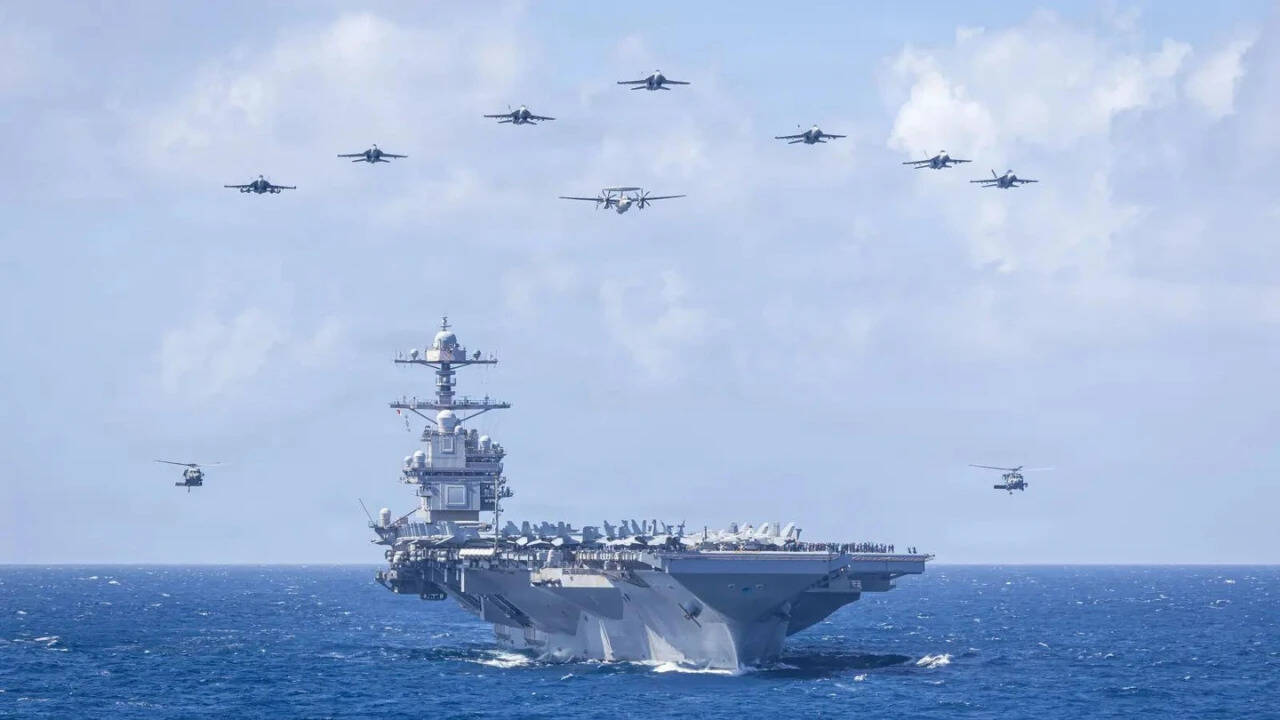
The issuance of a final warning by United States naval assets to Iranian-aligned forces represents more than a tactical exchange; it is a manifestation of the Kinetic Threshold, the precise point where verbal signaling transitions into physical engagement. When the US Navy broadcasts the intent to "use force," they are not merely threatening violence but are executing a standardized escalation protocol designed to manage risk while maintaining maritime dominance. To understand the gravity of these audio captures, one must dissect the operational mechanics of Rules of Engagement (ROE) and the geopolitical cost functions that dictate behavior in the Persian Gulf and surrounding chokepoints.
The Triad of Maritime Deterrence
Deterrence in a contested maritime environment rests on three specific pillars. If any of these pillars weaken, the probability of miscalculation leading to open conflict increases exponentially.
- Credibility of Intent: The adversary must believe the threat of force is backed by both the political will and the immediate physical capability to execute it.
- Communication Clarity: Signals must be transmitted on open frequencies (such as Bridge-to-Bridge Channel 16) to ensure no ambiguity exists regarding the boundary being crossed.
- Proportionality of Response: The escalation must be calibrated to ensure the response does not trigger an uncontrolled regional war while still neutralizing the immediate threat.
In the captured audio, the transition from "vessel standing by" to "will use force" indicates that the US Navy's internal decision matrix has moved from the Observation Phase to the Action Phase. This shift is governed by the assessment of "Hostile Intent," a legal and operational standard that allows a commander to strike first if they believe an attack is imminent.
Tactical Geometry of the Blockade
A blockade is rarely a static line in the water. It is a fluid zone of influence characterized by "Engagement Envelopes." The US Navy utilizes a layered defense strategy to protect merchant shipping from Iranian fast-attack craft (FAC) and unmanned surface vessels (USV).
The Inner Guard Zone
Within 500 yards, any unauthorized approach is categorized as an immediate threat. At this range, the time-to-impact for modern anti-ship missiles or suicide drones is measured in seconds, leaving zero margin for diplomatic negotiation.
The Warning Envelope
Extending from 1,000 to 2,000 yards, this is the region where verbal warnings and "non-lethal" deterrents, such as Long Range Acoustic Devices (LRAD) or laser dazzlers, are deployed. The audio captures recently circulated represent the verbal peak of this envelope.
The Surveillance Perimeter
Beyond 5,000 yards, the objective is tracking and identification. The US Navy utilizes the Aegis Combat System to monitor hundreds of surface and air contacts simultaneously, assigning a threat profile to each based on speed, trajectory, and electronic signatures.
Economic Asymmetry and the Cost of Interdiction
The strategic tension in the region is driven by a fundamental economic asymmetry. Iran and its proxies utilize low-cost "attrition assets"—cheap drones and small boats—to challenge high-value "capital assets," such as a billion-dollar Arleigh Burke-class destroyer.
- Interceptor Economics: A single SM-2 or RIM-162 ESSM interceptor missile costs between $1 million and $2 million.
- Adversary Expenditure: The drone or FAC being targeted may cost as little as $20,000 to $50,000.
This creates a negative cost-exchange ratio for the US Navy. The objective of the Iranian blockade strategy is not necessarily to sink a US warship, but to "bleed" the defensive magazine of the fleet and disrupt the flow of global commerce. Every day a tanker is diverted around the Cape of Good Hope adds approximately $1 million in fuel costs and 10 to 14 days of transit time, causing a ripple effect through global supply chains and energy markets.
The Logic of Bridge-to-Bridge Communication
The use of unencrypted radio for these warnings serves a dual purpose. While tactical operations usually occur on classified frequencies, the "Final Warning" is broadcasted on international maritime channels to create a public record.
- Legal Justification: By broadcasting the warning, the US Navy establishes a legal "paper trail" under international law, proving they attempted to de-escalate before resorting to force.
- Psychological Signaling: These broadcasts are heard by every civilian and military vessel in the vicinity. It reinforces the role of the US Navy as the guarantor of the "Freedom of Navigation" (FON) doctrine.
The specific phrasing used—"You are standing into danger"—is not accidental. It is standardized maritime terminology derived from the International Regulations for Preventing Collisions at Sea (COLREGs). By using this specific language, the Navy frames its potential use of force as a necessary safety measure rather than an act of unprovoked aggression.
Information Warfare and the Audio Leak
The release or capture of these audio files functions as a component of modern "Grey Zone" warfare. In the Grey Zone, the space between peace and total war, perception is as critical as firepower.
The Iranian side utilizes these encounters to demonstrate "defiance" to a domestic audience and regional allies. Conversely, the US side utilizes the audio to demonstrate "restraint and resolve" to the international community. The risk of this transparency is the "Echo Chamber Effect," where both sides feel pressured by their respective public narratives to avoid backing down, even when a tactical withdrawal would be the most logical choice.
Structural Vulnerabilities in Global Chokepoints
The current situation highlights a systemic fragility in global trade. The Strait of Hormuz and the Bab el-Mandeb are "Geographic Bottlenecks" where the physical constraints of the waterway negate many of the advantages of a modern blue-water navy.
- Reduced Maneuver Space: In narrow straits, large warships cannot easily use their speed to evade incoming threats.
- Cluttered Environment: Thousands of civilian dhows and fishing boats provide "visual noise," allowing hostile actors to hide in plain sight until the moment of attack.
- Shore-Based Proximity: Naval assets are constantly within the range of shore-based anti-ship cruise missiles (ASCMs), which can be hidden in rugged coastal terrain.
The shift toward "Will Use Force" indicates that the US military has determined that the "Cluttered Environment" has become too dangerous to permit further encroachment.
Strategic Trajectory of Maritime Contestation
The transition from verbal warnings to kinetic action follows a predictable decay function. The more frequently these warnings are issued without follow-through, the less effective they become as a deterrent. This leads to "Deterrence Decay," where the adversary gradually pushes the boundary further to test the actual breaking point.
To restore the efficacy of the warning, a "Kinetic Correction" is often required—a limited, high-impact strike designed to reset the adversary's risk assessment. The audio captures suggest that the US Navy is currently at the outer edge of its patience, moving toward a phase where the next unauthorized approach will result in the immediate destruction of the intruding craft.
The operational focus must now shift toward autonomous detection systems. By integrating AI-driven visual recognition with radar data, the Navy can reduce the "Decision Latency"—the time between detecting a threat and issuing a command—thereby increasing the safety buffer for its sailors.
The primary strategic move for naval commanders is the implementation of a "Zero-Trust Buffer." This involves the automated deployment of non-kinetic barriers (such as entanglement nets or high-intensity sound) at the 2,000-yard mark, followed by an immediate kinetic strike at 1,000 yards, regardless of verbal response. This removes the ambiguity of the "Final Warning" and replaces it with a hard physical reality that the adversary cannot ignore.