The intersection of national semiotics and monetary policy reaches a rare inflection point with the announcement that President Donald Trump’s signature will appear on U.S. currency to mark the 250th anniversary of American independence. While public discourse often focuses on the aesthetic or political dimensions of currency design, an analytical deconstruction reveals a complex interplay between the Department of the Treasury’s Bureau of Engraving and Printing (BEP), the legal frameworks of the Semi-Quincentennial, and the mechanics of physical currency circulation. The introduction of a commemorative signature on the Federal Reserve Note is not merely a symbolic gesture; it is a deployment of the state's most ubiquitous medium to codify a specific historical milestone.
The Tri-Partite Framework of Currency Authority
To understand how a presidential signature migrates onto a dollar bill, one must examine the hierarchical chain of command governing U.S. tender. The production of paper money is dictated by three primary constraints:
- Legal Mandate: Under 31 U.S.C. § 5114, the Secretary of the Treasury holds the authority to "engrave and print" United States currency. While the Secretary and the Treasurer of the United States are the standard signatories, the executive branch retains broad discretionary power over commemorative features during designated national observances.
- Security Architecture: Any modification to the plate must pass through the Advanced Counterfeit Deterrence (ACD) Committee. This body, comprising officials from the Treasury, the Secret Service, and the Federal Reserve, ensures that commemorative elements—such as a specific signature or seal—do not compromise the intricate "lifelife" of the bill, including the microprinting and color-shifting ink.
- Logistical Lifecycle: The Federal Reserve determines the volume of new notes based on the destruction rate of "unfit" currency and the projected demand for physical cash. For the 250th anniversary, the integration of a new signature requires a synchronization of the printing cycle with the national celebration timeline, ensuring that the velocity of circulation aligns with the 2026 anniversary.
The Mechanism of the Commemorative Signature
The presence of a President’s signature on currency, while historically associated with the Secretary of the Treasury (who is an executive appointee), serves as a distinct deviation from standard operating procedure. This shift functions as a "Proof of Era." In numismatic terms, the signature acts as a temporal anchor.
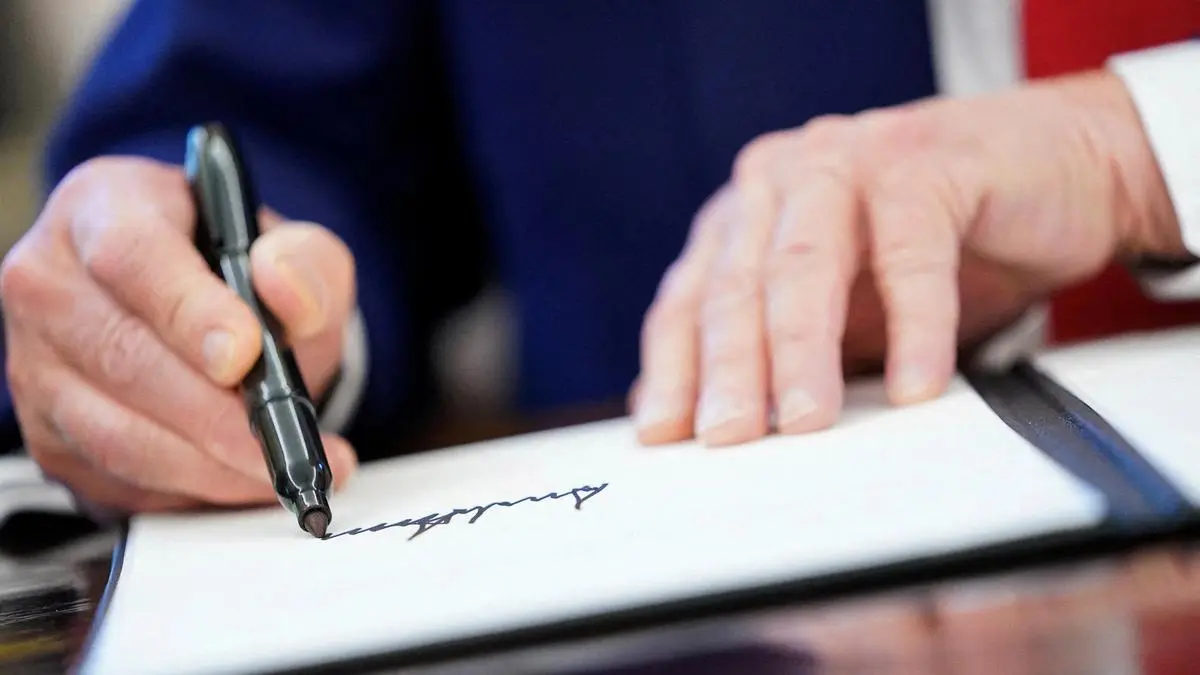
The technical process involves translating a handwritten signature into a high-resolution digital master, which is then transferred to a steel engraving plate. This plate is used in the intaglio printing process, where 20,000 pounds of pressure per square inch force the paper into the recessed lines of the plate to create the distinct tactile feel of a genuine bill. The inclusion of the President's signature for the Semi-Quincentennial specifically utilizes the currency as a distributed ledger of national identity, reaching every point of sale in the global economy.
Economic Signaling and the Velocity of Commemoration
The decision to modify the $1, $5, $10, or $20 notes—the workhorses of daily commerce—creates a specific economic phenomenon known as "hoarding leakage." When a currency design undergoes a significant commemorative change:
- Circulation Deceleration: A segment of the population removes the notes from active circulation to keep as souvenirs. This effectively acts as a microscopic contraction of the money supply, though it is usually offset by the Fed’s increased print orders.
- Seigniorage Profitability: The difference between the face value of the note and the cost of production (roughly 6 cents for a $1 bill and 14 cents for a $100 bill) results in a profit for the government. Increased demand for commemorative notes for non-transactional purposes—collecting—maximizes this seigniorage.
- Symbolic Stability: In periods of high inflation or geopolitical volatility, the physical rebranding of the currency with a landmark anniversary signature is designed to reinforce the perceived "permanence" of the sovereign.
Structural Challenges in Numismatic Transitions
The transition to a commemorative signature is not without friction. The BEP operates on a multi-year lead time. The 250th-anniversary redesign involves more than just a signature update; it likely includes the integration of the "Catalyst" series security features.
The primary bottleneck is the Plate-to-Press Transition. Each denomination requires hundreds of unique plates to be etched. If the signature is to be applied across multiple denominations simultaneously, the BEP must manage a massive surge in engraving labor. Furthermore, the Federal Reserve’s armored carrier network must coordinate the "New Note" release to prevent localized shortages of older denominations as the market reacts to the novelty of the new design.
The Geopolitical Dimension of Federal Reserve Notes
The U.S. dollar serves as the world’s primary reserve currency. Approximately 60% of $100 bills and nearly $2 trillion in total U.S. currency circulate outside the United States. When the signature of the sitting President is applied to mark 250 years of independence, it serves as a high-visibility signal of institutional longevity to international markets.
The signature functions as a "Soft Power" instrument. Unlike a digital update to a central bank digital currency (CBDC), the physical printing of a signature on a cotton-linen blend note provides a tangible, un-hackable artifact of statehood. It reaffirms the link between the executive branch and the fiscal machinery of the state at a time when digital transactions are increasingly abstracting the concept of money.
Strategic Execution for the 250th Anniversary Rollout
To maximize the impact of this currency redesign, the administration must navigate the "Novelty Curve." The initial release of the signature-marked bills will trigger a spike in demand that could lead to temporary premiums in secondary markets (e.g., collectors paying $5 for a specific $1 bill).
The Treasury must implement a Tiered Release Strategy:
- Low-Denomination Saturation: Release the $1 and $5 bills first to ensure maximum public penetration and "socialization" of the new design.
- High-Value Security Integration: Reserve the $20 and $100 notes for a later phase where the signature is paired with upgraded holographic and thread-based security features to prevent counterfeiters from exploiting the distraction of a new design.
- Archival Documentation: Establish a formal link between the 250th Anniversary Commission and the BEP to market the notes as part of a broader "National Heritage" series, ensuring that the signature is viewed through a historical, rather than purely political, lens.
This move effectively turns every wallet in the country into a gallery for the Semi-Quincentennial, leveraging the most fundamental tool of the American economy to cement a narrative of 250 years of continuity.
The strategic play here is the utilization of the physical dollar as a medium of "Unavoidable Messaging." While digital media is fragmented and opt-in, currency remains an opt-out system of national communication. By placing a signature on the bill for the 250th anniversary, the administration ensures that the milestone is physically handled by every citizen and international trading partner, reinforcing the concept of the "Sovereign Brand" through the most liquid asset on earth.