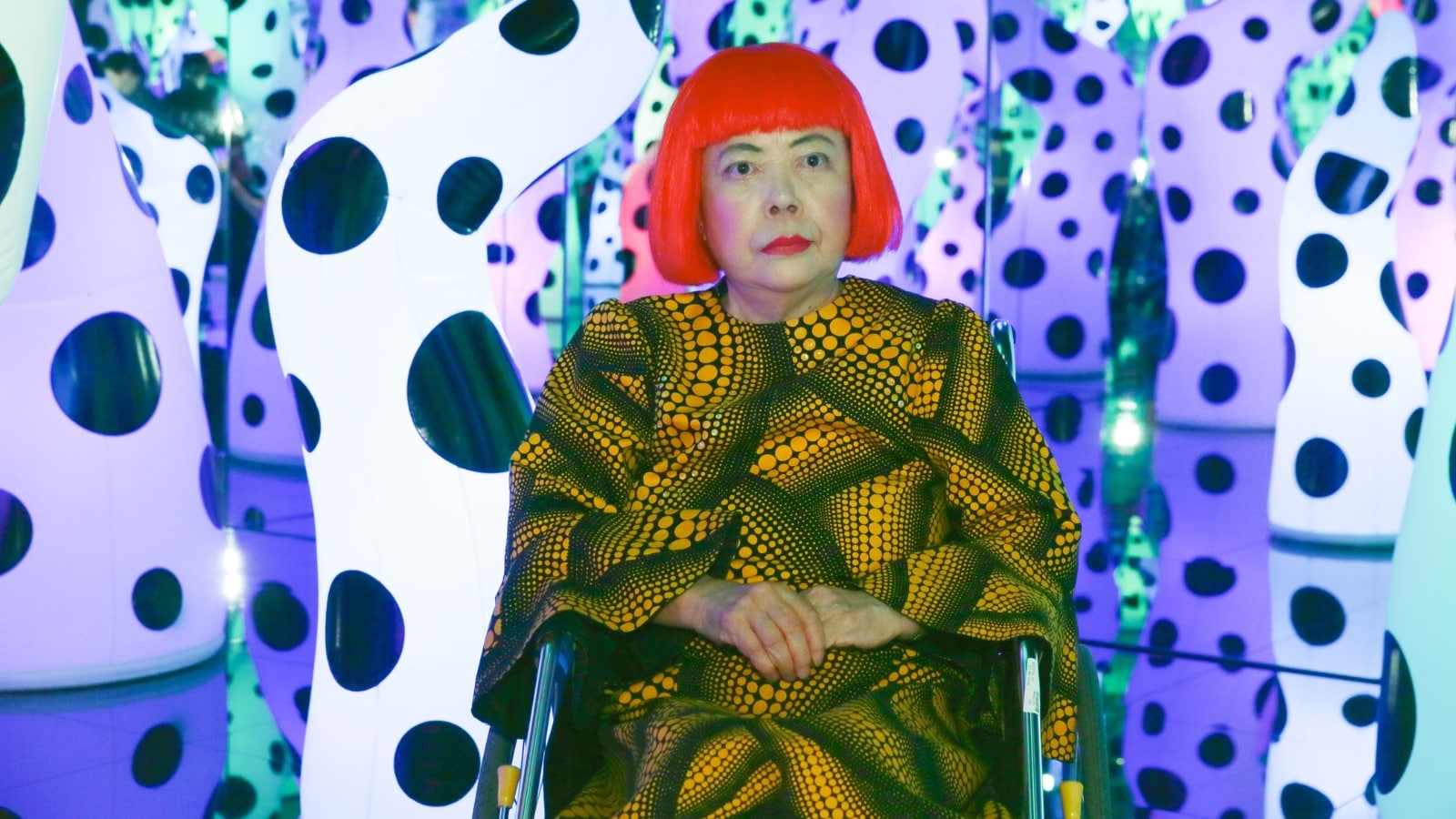
Cultural persistence is rarely an accident of raw talent. When an artist commands global attention across eight decades, maintaining commercial relevance while evolving an avant-garde aesthetic, the phenomenon demands structural analysis. The passing of Yayoi Kusama at ninety-seven closes a chapter on one of the most rigorously engineered artistic trajectories of the modern era. Understanding her ascent requires deconstructing how an artist transforms repetitive psychological compulsion into an inescapable brand equity matrix.
Most critical commentary reduces Kusama's career to a simple narrative of survival and eccentricity. This misses the underlying operational mechanics. Her output relies on three distinct pillars: scalable sensory environments, relentless thematic discipline, and an institutional symbiotic distribution model. By examining these vectors, cultural analysts can map how niche countercultural impulses scale into global economic and visual dominance.
The Scalable Sensory Architecture of Infinity Rooms
Traditional fine art operates on a scarcity model. A single painting hangs on a wall, limiting physical interaction to one viewer at a time in a controlled gallery space. Kusama bypassed this bottleneck by inventing a repeatable spatial product. The Infinity Mirror Rooms function as modular, replicable frameworks that merge minimalist sculpture with total immersion.
The economic and psychological mechanics of these installations rely on a deliberate distortion of perception. Mirrors multiply finite physical objects into endless optical regressions. Viewers transition from passive observers to active participants within the artwork itself. This shift solved a major distribution problem for modern visual art: how to manufacture an intimate, transcendent experience that converts efficiently into mass digital media consumption.
Before the advent of smartphone culture, Kusama had already locked into the human appetite for infinite visual recursion. When digital networks matured, her installations were uniquely primed for viral distribution. Every visitor became a fractional distributor, generating billions of impressions across social platforms without institutional advertising spend. The physical architecture of the work served as its own amplification engine.
The Repetitive Compulsion Loop as Brand Equity
Branding theory dictates that recognition requires consistency, repetition, and immediate visual cues. Kusama achieved this not through corporate focus groups, but through the systematization of her lifelong hallucinations. The polka dot and the soft sculpture net were not stylistic choices that varied by collection or phase; they were fixed variables applied universally across canvases, clothing lines, pumpkins, luxury collaborations, and public squares.
This absolute adherence to a constrained motif creates a powerful cognitive shortcut. When an audience encounters a polka-dotted surface anywhere in the world, brand attribution is instantaneous. By converting her psychological vulnerabilities into a proprietary visual language, she insulated her career against shifting aesthetic trends. While other avant-garde artists of the mid-twentieth century faded as movements evolved, Kusama remained insulated because her visual vocabulary was entirely self-referential.
This strategy introduces a fascinating economic model for artistic output. The marginal cost of applying her signature motif to a new medium was low, while the perceived value multiplication was exponential. Whether applied to a canvas priced in the millions or a collaborative retail product, the core asset remained identical.
The Institutional and Commercial Feedback Loop
A common failure mode for visionary artists is the inability to bridge the gap between radical creation and institutional validation. Kusama's trajectory demonstrates a masterclass in managing the feedback loop between museums, commercial galleries, and global luxury brands.
Her career timeline reveals a deliberate oscillation between high-art institutional retrospectives and accessible commercial interventions. Museums provided intellectual legitimacy and historical anchoring. High-profile brand partnerships, such as those with major fashion houses, provided capital liquidity and introduced her work to demographics outside traditional art-world gatekeepers.
This dual-track distribution model protected her enterprise from market volatility. When the primary art market faced contractions, her brand footprint across consumer goods maintained revenue velocity and cultural visibility. The interplay between massive retrospective attendance numbers and commercial retail availability created a self-reinforcing cycle where each sector drove demand into the other.
The Long-Term Impact on Contemporary Spatial Design
Evaluating Kusama's legacy requires looking past biographical milestones and examining how she permanently altered consumer expectations of space. Modern retail design, experiential marketing, and interactive museum installations all operate within the blueprint she refined. The era of the Instagram-optimized installation exists because Kusama proved that audiences do not just want to look at objects; they want to inhabit them.
Future creators operating in physical media must study this synthesis of psychological obsession and structural scalability. Longevity at the apex of the cultural economy is secured not by adapting to every passing wave, but by constructing a system so visually distinct and operationally repeatable that the culture is forced to adapt to it.
Execute the next portfolio acquisition strategy by identifying creators whose core motifs can be cleanly decoupled from a single medium and translated into immersive, scalable spatial formats.