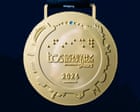
The blister on Sarah’s heel had popped somewhere around the thirty-kilometer mark. By the time she hit the final stretch toward the finish line, pain wasn’t a sensation anymore; it was a loud, persistent roommate living inside her skull. Months of cold winter mornings spent running alone under streetlamps, miles of accumulated sweat, the missed Saturday breakfasts with her children, the quiet self-doubt whispering that she was simply too old, too slow, too ordinary to call herself a marathoner—all of it collapsed into the rhythmic, thunderous roar of the Sydney crowd.
She crossed the mat. Her arms shot upward.
For forty-two point one nine five kilometers, the world narrowed to survival, and then, instantly, widened into grace. When the heavy metal disk was placed over her head, resting damply against her racing singlet, she didn’t look at it right away. She just breathed. She wept. She became someone who had done a hard thing.
Later that evening, sitting in a crowded hotel lobby with her aching legs propped up on a cheap plastic chair, Sarah finally turned the medal over in her calloused hands. She traced the metal ridges with her thumb, looking for the triumphant silhouette of the Sydney Opera House or the sweeping arc of the Harbour Bridge.
Instead, she stared at Munich.
Not Sydney. Not the Southern Hemisphere. Not the proud Australian landmark she had bled for across the asphalt. The gleaming architectural wonder pressed into the heavy alloy was the Olympiapark in Munich, thousands of miles and an entire hemisphere away.
Errors happen. Spreadsheets get corrupted. Design files get swapped in the hurried twilight of a production deadline. But a marathon finisher’s medal is not a receipt. It is not an administrative clerical error stamped on a piece of office paper. For twenty-six point two miles of human suffering and triumph, that metal disk is the physical proxy for dignity. It is the tangible proof of an invisible struggle.
When the Sydney Marathon organizers later admitted to an unfortunate error, calling it a mistake on the finisher's medal, the official statements arrived wrapped in corporate polish. They spoke of quality control, of corrective measures, of supplier miscommunication.
Language like that misses the heartbeat.
Consider what a medal actually represents to the runner who earns it. It is a time capsule of agony. When a runner looks at that piece of metal years later, they do not remember the weather report. They remember the exact moment at thirty-eight kilometers when their hamstrings locked up. They remember the stranger who handed them a paper cup of water like it was holy water. They remember the specific shape of the skyline they conquered. To stamp a European stadium onto a Sydney achievement is to quietly erase the geographic poetry of the runner's specific, personal war.
Picture Marcus, a hypothetical runner whose experience mirrors thousands who laced up that morning. Marcus had deferred his entry twice—first for a knee surgery that threatened to end his running life entirely, and then to care for his aging father through his final autumn. When Marcus finally stood at the start line in Sydney, he wasn't just running a race. He was running against time, against decay, against the heavy gravity of middle age.
When Marcus received his medal, he didn't notice the mistake immediately either. He was too busy calling his mother on a cracked phone screen, his voice cracking with a mix of exhaustion and fierce, unfiltered pride. Days later, when the news broke online about the architectural mix-up, Marcus looked down at his mantelpiece.
The stadium was wrong. But the blisters on his feet were real.
That is the strange dissonance of the situation. The error belongs to a graphic designer thousands of miles away who dragged the wrong vector file into a production queue. But the weight of the metal belongs entirely to the runner. It creates a peculiar psychological friction. How do you reconcile a profound personal milestone with a manufactured geographical blunder?
For most runners, the answer is remarkably pragmatic, born of the same resilience that carried them through the race itself. Runners are experts at dealing with bad conditions, unexpected headwinds, and poorly placed aid stations. They adapt. They endure.
Some laughed. Social media quickly filled with wry jokes about an unexpected European vacation, runners holding up their medals against the Sydney skyline with sarcastic captions about German architecture down under. Humor is the runner’s default shock absorber. When your body is broken down to raw nerves, you learn to laugh at the absurdity of physical existence.
Others felt a quiet, lingering sting. Not because they loved German stadiums any less, but because identity matters. When you run a marathon in Sydney, you are claiming a piece of that city's soul, and in return, you want that city to bear witness to your effort. A medal is a handshake between the municipality and the mortal. A mix-up breaks that silent contract, if only for a moment, reminding the runner that to the global machine of mass-participation sports events, they might just be a barcode in a processing queue.
Yet, looking closer at the phenomenon of the flawed medal reveals something enduring about human ambition. The value of the race was never trapped in the zinc alloy anyway.
If you melted down Marcus’s medal, it would just be base metal. If you scrubbed the image of the Munich stadium off the surface, the miles he ran would not shrink by a single yard. The lungs that burned in the coastal wind still expanded. The heart that pounded against his ribs still did its heavy, beautiful work.
The organizers promised replacement ribbons or corrected inserts for those who wanted them. Some runners will file for the fix, carefully swapping out the flawed piece for the corrected version to preserve historical accuracy in their trophy cases. Others will leave the Munich stadium right where it is, letting it stand as a bizarre, humorous footnote to the hardest day of their lives.
Because perfection is overrated, and life rarely hands us a clean, unblemished finish line. There is almost always a wrong turn, a missed cue, a detail that gets fumbled in the dark.
Sarah placed her medal back on the shelf next to a faded race bib and a pair of running shoes so worn the rubber soles were peeling away at the toe. She looked at the foreign stadium stamped into the metal, then down at her still-tender feet.
The stadium on the medal belonged to Germany. But the victory belonged entirely to her. And no administrative oversight, no design mix-up, and no corporate apology could ever run fast enough to catch her and take that away.