The salt burns first.
Before you even reach the water of the Naf River, before you hear the distant crack of rifles echoing off the hills of Rakhine State, the air itself tastes of ash and wet earth. Consider, for a moment, a hypothetical mother standing on that muddy bank in August 2017—let us call her Amina. She is holding a plastic bundle wrapped in a faded lungi, containing three handfuls of dry rice and a laminated identity card that her own government insists means nothing. Behind her, the wooden stilts of her village are collapsing into black smoke. Ahead of her lies a mile of dark, swollen current separating Myanmar from Bangladesh.
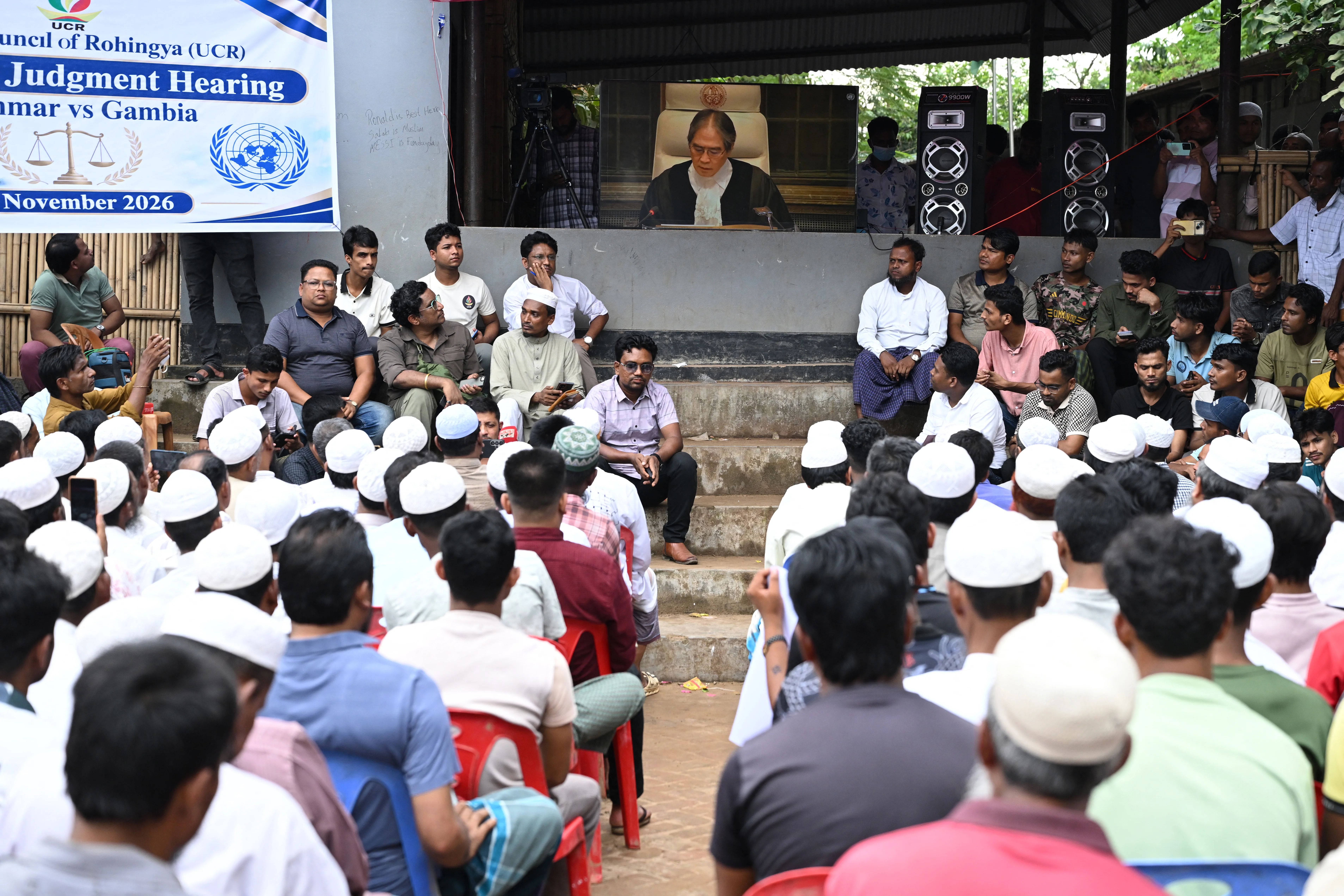
When the International Court of Justice in The Hague finally handed down its historic ruling—declaring that Myanmar committed genocide against the Rohingya—the headlines read like sterile legal dispatches. Judges in black robes read from thick binders. Lawyers adjusted their spectacles. Analysts debated jurisdiction and treaty articles.
For Amina, and for the more than seven hundred thousand people who ran toward that river in 2017, the verdict was not an abstract triumph of international law. It was the end of a decade-long gaslighting campaign. It was the moment the world finally agreed to call a fire a fire.
The Architecture of Erasure
To understand why a single word from a court in the Netherlands carries the weight of a mountain, you have to understand how genocide actually works. Most of us picture it as a sudden, chaotic explosion of violence—a storm that breaks without warning.
History tells a colder story.
Genocide is rarely spontaneous. Think of it instead like the slow, deliberate demolition of a house from the foundation up. First, you strip the paint. Then you pry out the floorboards. By the time you swing the wrecking ball at the walls, the structure is already hollow, and the neighbors have grown accustomed to seeing it empty.
In Myanmar, the demolition began generations ago. The Rohingya—a predominantly Muslim ethnic minority living largely in coastal Rakhine State—did not suddenly become outsiders overnight. In 1982, the military junta passed a citizenship law that quietly erased them from the nation’s official roster of 135 recognized ethnic groups. Overnight, people whose families had farmed the valleys of Arakan for centuries became "illegal immigrants" in their own bedrooms.
Imagine waking up tomorrow to find that your birth certificate is void, your marriage requires state permission that never arrives, and your children are barred from universities simply because of the syllables in your family name. You cannot travel to the next town without paying a bribe at a checkpoint. You cannot repair a leaking roof without a permit.
Living under those conditions teaches you to shrink. You learn to lower your eyes when a uniform passes. You learn to speak in whispers. You carry your entire existence in a waterproof pouch tied around your waist, because you know—deep in your ribs—that permanence is an illusion reserved for citizens.
August 2017 and the Sound of Clearing Operations
By the late summer of 2017, the foundation was gone. All that remained was the wrecking ball.
Following attacks by a small Rohingya insurgent group on police posts on August 25, 2017, the Myanmar military—known as the Tatmadaw—launched what it termed "clearance operations." The phrase sounds clinical, almost sanitary, like sweeping dust from a porch.
On the ground, there was nothing clinical about it.
Satellite imagery captured in the weeks that followed revealed nearly four hundred villages burned to gray scars across northern Rakhine State. Notice the precision of the destruction: neighboring non-Rohingya villages stood completely untouched, green trees shading intact roofs just yards away from blackened ash. The fire knew which houses to eat.
Survivors who made it across the border to Cox’s Bazar in Bangladesh carried memories that defied ordinary language. They spoke of soldiers encircling villages at dawn, separating men and boys from women and children, and firing into crowds as people ran toward the rice paddies. Independent United Nations fact-finding missions later documented widespread sexual violence, the burning of families inside their homes, and the systematic destruction of food stocks and livestock so that no one could return to survive.
Within months, over 700,000 Rohingya had fled into Bangladesh, joining hundreds of thousands already displaced by earlier waves of violence in 1978, 1991, and 2012. Overnight, a quiet stretch of forested hills near Cox’s Bazar transformed into Kutupalong—the largest refugee camp on Earth, a sprawling city of bamboo, tarpaulin, and mud housing roughly a million souls.
Yet even as the camps swelled, the officials in Naypyidaw denied everything. They claimed the Rohingya had burned their own homes to win international sympathy. They insisted the military was merely fighting terrorists.
And for years, the world hesitated to use the G-word.
Why the Law Moves Like a Glacier
If you have ever waited on a test result in a cold hospital hallway, you know how time stretches when your life hangs in the balance. Now stretch that hallway across years, and pack a million stateless people into it.
Why did it take so long for the United Nations' top court to rule? Why couldn't the world simply look at the satellite photos of burning villages and declare genocide on day one?
Here is where the machinery of international justice becomes frustrating, confusing, and deeply human. Under the 1948 Genocide Convention—drafted in the ashes of the Holocaust—mass killing alone does not legally constitute genocide. To prove genocide in court, prosecutors must prove dolus specialis: specific intent. They must prove beyond a reasonable doubt that the perpetrators acted not merely to drive a population out, or to crush a rebellion, but with the calculated intent to destroy a national, ethnical, racial, or religious group, in whole or in part.
Proving what sits inside a general’s head is notoriously difficult. Commanders rarely sign memos titled Plan for Genocide. Instead, lawyers must assemble a mosaic out of thousands of fragments: hate speech broadcast on state-backed channels, coordinated military deployments, patterns of sexual violence designed to prevent future births, and the deliberate starvation of trapped communities.
In November 2019, a tiny West African nation stepped forward to force that reckoning. The Gambia—a country thousands of miles away from Southeast Asia, with a population smaller than many major cities—filed a landmark case against Myanmar at the International Court of Justice. Having recently emerged from its own brutal dictatorship, The Gambia argued that every signatory to the Genocide Convention has a moral and legal duty to stop genocide wherever it occurs, even if none of its own citizens are among the victims.
The sight of Myanmar’s civilian leader at the time, Nobel Peace Prize laureate Aung San Suu Kyi, standing before the judges in The Hague in December 2019 to defend the military’s actions stunned the world. Watching a former icon of human rights dismiss accounts of mass atrocities as "incomplete and misleading" felt like watching a trusted compass spin wildly off north.
A few years later, in February 2021, that very same military overthrew Aung San Suu Kyi’s government in a coup, plunging Myanmar into a nationwide civil war and proving to the world what the Rohingya had been screaming for decades: the generals answered to no one.
Inside the Bamboo Cities
While lawyers in Europe filed thousands of pages of memorials and counter-memorials, life in Cox’s Bazar settled into a grinding, precarious limbo.
Walk through the narrow, winding footpaths of Kutupalong during the monsoon season, and the stakes of that distant courtroom become visceral. Heavy rain turns the red clay hills into slick chutes. Landslides regularly swallow bamboo shelters whole. Because the Bangladeshi government—already straining under the weight of hosting a million refugees—prohibits permanent structures, every home is made of thin bamboo poles and blue plastic sheeting that shreds in cyclone winds.
Refugees cannot legally work outside the camps. Formal education was restricted for years, leaving an entire generation of children growing up without accredited schools, without passports, and without any legal standing anywhere on Earth.
Consider what happens next: despair becomes its own kind of weather. Armed gangs prowl the camp alleys at night. Desperate families pay human traffickers to load their teenagers onto rickety wooden boats bound for Malaysia or Indonesia—vessels that frequently drift for months without food or water, becoming floating coffins in the Andaman Sea.
When people ask, Does a court ruling in The Hague actually put food on a table in Kutupalong? the honest, uncomfortable answer is no. Not immediately. The International Court of Justice has no army. It cannot dispatch peacekeepers to Rakhine State or arrest a general in Naypyidaw.
So why does this verdict matter so profoundly?
The Power of an Undeniable Record
Think about what happens when a crime goes unnamed.
Without an authoritative legal finding, history remains open to revision. Apologists can argue that the violence was a "complex internal conflict." Diplomatic partners can quietly resume trade deals and weapons sales under the cover of ambiguity. Future generations are left arguing over whether the smoke they saw was a house fire or a controlled burn.
By ruling that Myanmar committed genocide against the Rohingya, the UN’s highest court closed the door on denial.
First, it establishes an immutable historical record. The testimony of survivors—the mothers who watched their infants thrown into fires, the village elders who buried neighbors in mass graves under the cover of darkness—is no longer merely "alleged." It is inscribed into the permanent jurisprudence of humanity.
Second, it triggers legal and diplomatic consequences far beyond the courtroom walls. Under the Genocide Convention, every single state that has ratified the treaty is now legally bound to prevent and punish genocide. Governments that continue to supply aviation fuel, weapons, or financial lifelines to Myanmar’s military junta can no longer claim ignorance. The ruling strengthens the hand of prosecutors pursuing individual military leaders at the International Criminal Court and under universal jurisdiction laws around the globe.
Third, and perhaps most critically, it anchors any future repatriation. Myanmar’s generals have repeatedly floated hollow plans to "welcome back" small batches of Rohingya refugees into fenced transit camps—essentially trading open-air limbo in Bangladesh for prison-like detention in Rakhine State. The ICJ ruling makes clear that safe, dignified return is impossible without restoring full citizenship, property rights, and legal protections to the Rohingya people. You cannot send survivors back into the custody of an unrepentant perpetrator without dismantling the machinery that targeted them in the first place.
What Remains After the Gavel Falls
Still, honesty demands admitting what remains uncertain.
Myanmar remains fractured by brutal internal conflict, with the military junta losing territory to resistance forces across the country while continuing airstrikes on civilian populations. International attention is divided among multiple global crises, and humanitarian funding for the Rohingya camps in Bangladesh has steadily declined, forcing aid agencies to slash monthly food rations to mere dollars per person.
A legal victory does not automatically rebuild burned mosques, replant flooded rice paddies, or erase the trauma etched into a child’s memory. Justice, in the real world, rarely arrives as a clean curtain call. It arrives in fragments—a court decision here, a targeted sanction there, a generation of young Rohingya poets, journalists, and legal scholars documenting their own history so no one can ever write them out of it again.
Back on the edge of the Naf River, the water still flows south toward the Bay of Bengal, indifferent to borders drawn on maps or rulings bound in leather. In the camps of Cox’s Bazar, Amina—and hundreds of thousands like her—still keeps her laminated papers wrapped tightly in plastic against the monsoon damp, waiting for the day she can walk home not as a ghost, not as a trespasser, but as a citizen whose name the world finally knows.