Silence.
That is the first thing you notice right before the impact, because unlike a crow that caws a warning or a hawk that screeches down from the thermal currents, an owl moves through the air with the acoustic footprint of a falling handkerchief, its serrated primary feathers breaking up the turbulence so completely that your brain registers the shadow only a fraction of a second before the talons sink into your scalp.
You do not hear it coming. You just feel a sudden, violent thud against the back of your neck, like someone swung a wet leather boot out of the dark, followed immediately by the warm, metallic trickle of blood running down beneath your shirt collar.
Across suburban neighborhoods and wooded running trails in the United States, dozens of joggers, dog walkers, and evening commuters have learned this lesson the hard way. Local news outlets love to slap sensational labels on the phenomenon—calling the culprit an "evil owl" or claiming a rogue predator is "terrorizing" a state—because panic sells clicks, and the image of a nocturnal bird ambushing unsuspecting citizens feels ripped straight from a Hitchcock screenplay.
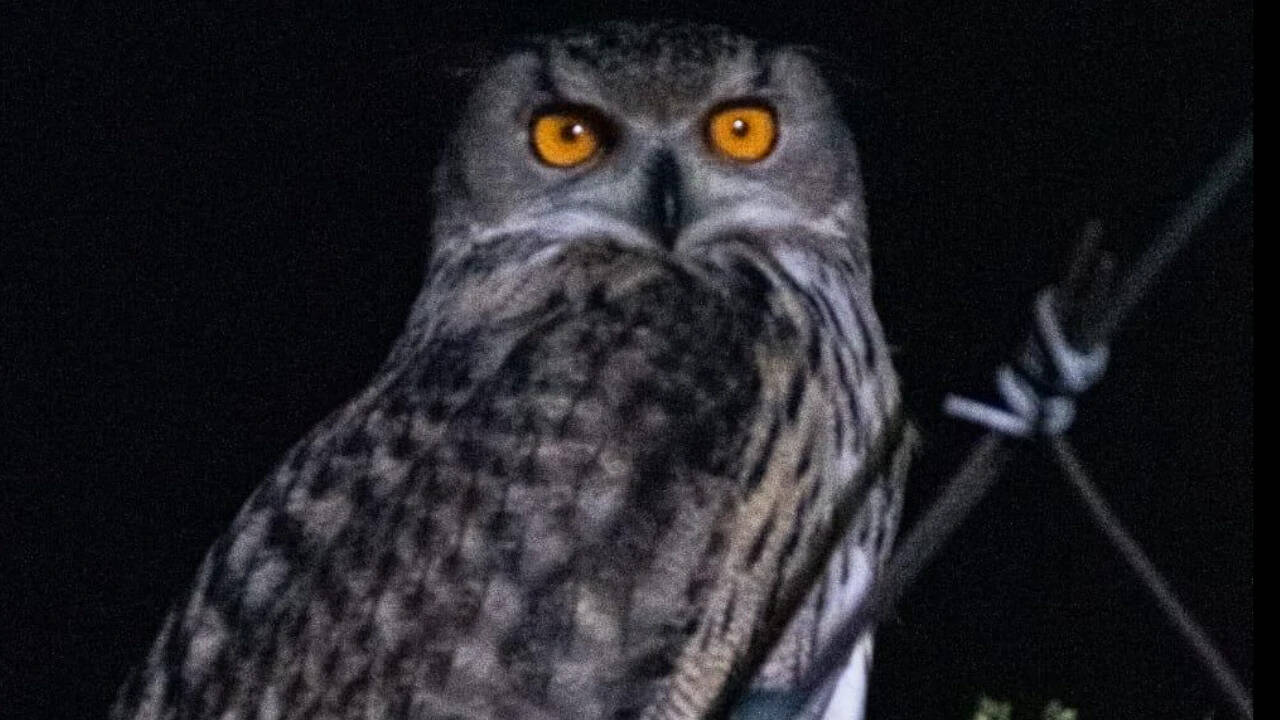
Consider a hypothetical runner—let’s call her Elena—lacing up her shoes at dusk on a paved greenway in the Pacific Northwest or New England, places where barred owls and great horned owls thrive right alongside cul-de-sacs and coffee shops. She wears a ponytail. She listens to a podcast. She thinks she is alone in the cooling twilight, completely unaware that thirty feet above her, perched on a moss-draped oak branch, a two-pound avian dinosaur with a four-foot wingspan has locked onto the rhythmic bobbing of her hair.
To Elena, the strike is unprovoked malice. To the owl, it is Tuesday.
The Architecture of a Silent Ambush
To understand why these encounters feel so deeply unsettling, you have to strip away our modern, climate-controlled assumptions about who actually owns the outdoors once the sun drops below the treeline. We pave a path through a forest, install a few solar-powered bollard lights, and suddenly convince ourselves that the woods have been domesticated into an extension of our living rooms.
They have not.
When wildlife biologists investigate reports of aggressive owls—most commonly barred owls (Strix varia) and great horned owls (Bubo virginianus)—they rarely find a rabid, bloodthirsty monster. Instead, they find a fiercely territorial parent operating on millions of years of evolutionary programming, trying to solve a spatial problem in a shrinking habitat.
Think of an owl’s nesting territory like a heavily guarded bank vault where the alarm system has no "warn" setting—only "detonate." During late winter and spring, when eggs are incubating or fragile, downy owlets are taking their first clumsy hops onto branches near the forest floor, the adult birds enter a state of hyper-vigilance. Their world shrinks to a strict perimeter around that nest. Anything that enters that invisible bubble at twilight—when owls transition from groggy daytime roosting to active hunting—is categorized immediately as a threat.
Why the back of the head?
Biology offers a blunt, almost comical answer. From an owl’s perspective thirty feet up in the canopy, a runner’s bobbing ponytail or a hiker’s knit beanie looks remarkably similar to a squirrel, a rabbit, or a rival bird scurrying along the forest floor. Owls are strike-from-behind predators. They do not square up for a fair fight; they target the base of the skull to sever the spinal cord of their prey instantly. When an owl swoops down and rakes its talons across a jogger's neck or steals a fleece hat right off a commuter's head, it is often executing either a botched hunting strike on a confusing target or a warning shot designed to drive a perceived giant away from its young.
I still remember the first time a barred owl buzzed my own head on a wooded trail just outside town. It was November, crisp and gray, right around 4:45 in the afternoon when the light goes flat and shadows lose their edges. I didn't hear wings. I felt a rush of displaced air so close to my left ear that it ruffled my hair, followed by the sharp clack of a beak snapping shut inches from my temple. My heart hammered against my ribs so hard I felt dizzy. For three days afterward, every rustle of dry oak leaves behind me made me flinch and duck my shoulders, a primal, humiliating reminder that at the top of the neighborhood food chain, I was slow, blind, and entirely outmatched.
Why Suburban Sprawl Turns Neighbors into Targets
If you look at the map of where these "owl attacks" cluster—from Salem, Oregon, where a barred owl famously became a local folk villain after repeatedly snagging joggers' hats in Bush’s Pasture Park, to wooded suburbs in Massachusetts, Washington, and North Carolina—a clear pattern emerges. These incidents do not happen deep in the untouched wilderness, where trails are sparse and wildlife avoids human scent. They happen in the jagged borderlands where subdivisions collide with greenbelts.
We have built our neighborhoods directly inside the hunting grounds of apex nocturnal birds, and in doing so, we have accidentally rolled out a buffet.
Suburban backyards are ecological magnets for rodents. Bird feeders drop sunflower seeds onto the grass, attracting mice and chipmunks. Compost bins, pet food bowls left on patios, and manicured lawns bordering dense woods create the highest density of small mammals an owl could ever dream of finding. Barred owls, which historically lived mostly in the eastern United States before expanding westward across the continent over the last century, are remarkably adaptable generalists. Unlike the reclusive spotted owl, which requires old-growth forests to survive, barred owls are the raccoons of the raptor world—bold, opportunistic, and completely unbothered by streetlamps or passing sedans.
When a pair of barred owls raises three chicks in a hollow maple tree twenty yards behind a cul-de-sac, those birds lose their innate fear of human silhouettes. They watch people walk dogs every morning. They watch kids ride bikes every afternoon. Familiarity breeds contempt, and when nesting hormones surge, that lack of fear turns into offensive defense.
The invisible stakes here are higher than a few scratched scalps and viral local news segments. Every time a headline screams about an "evil owl" terrorizing a community, wildlife agencies get flooded with calls demanding that the bird be trapped, relocated, or euthanized.
Here is the hard truth that wildlife rehabilitators wish every resident understood: relocating an aggressive territorial owl is almost always a death sentence.
Owls are deeply bound to their specific territories. If you trap a great horned owl in a suburban park and drive it thirty miles away into an unfamiliar forest, you are dropping it directly into the established territory of another breeding pair. The resident owls will fight the intruder relentlessly, often to the death, while the displaced bird starves because it does not know where the water sources or rodent runs are located. Worse, if the captured bird was feeding chicks back in that suburban park, the nestlings starve within days. Under the federal Migratory Bird Treaty Act, it is strictly illegal for private citizens to harm, trap, or harass native owls—not out of bureaucratic stubbornness, but because top-level predators keep suburban rodent populations from exploding out of control.
What Actually Happens When Talons Meet Skin
Let’s step away from the dramatic headlines and look at the reality of the injuries, because fear thrives in vagueness.
An adult great horned owl weighs only about three to four pounds—roughly the weight of a half-gallon of milk—yet its grip strength exerts roughly 300 to 500 pounds per square inch of crushing pressure. That is comparable to the bite force of a large guard dog, concentrated into eight needle-sharp, curved talons. A barred owl is slightly smaller, weighing around one and a half to two pounds, with proportionately smaller feet, yet its claws are still razor-sharp surgical instruments designed to pierce thick fur and hide.
When an owl strikes a human head, the damage is rarely life-threatening, though it looks like a crime scene. The human scalp is extraordinarily vascular, packed with tiny blood vessels right beneath thin skin. Even a shallow half-inch scratch from a talon will bleed profusely, soaking hair and staining jackets within seconds. The real danger isn't the trauma of the strike itself; it is secondary bacterial infection. Owls eat raw rodents, snakes, and birds, meaning their talons carry bacteria like Pasteurella and Staphylococcus straight into puncture wounds. Anyone scratched by a wild raptor needs immediate soap-and-water irrigation and a prompt checkup with a doctor for antibiotics and a tetanus booster.
Knowing that doesn't make the experience less terrifying when you are walking from your car to your front door in the dark.
People often feel foolish admitting they are afraid of a two-pound bird. We live in an era where we track packages to the exact minute, control our thermostats from across the globe, and navigate unfamiliar cities with a glowing blue dot on a glass screen. Being ambushed by an unseen creature from the trees shatters that illusion of total control. It forces you to crane your neck upward, scanning dark branches like an early hominid crossing the savanna at nightfall. That vulnerability is real, and pretending it isn't scary only makes people act recklessly—either by swinging sticks at protected wildlife or by abandoning outdoor exercise altogether for months.
How to Outsmart a Predator Without Harming It
You do not have to surrender your neighborhood trails, and wildlife officers do not have to euthanize a bird just for doing what evolution built it to do. Because owl attacks are driven by predictable sensory cues—specifically silhouettes, movement, and surprise—small, almost absurdly simple adjustments completely neutralize the threat.
Consider what happens next when you change the visual math for a bird watching you from above.
An owl relies entirely on the element of surprise; if it believes its target sees it coming, it will almost always abort a strike to protect its fragile hollow bones and flight feathers from injury. This is why wildlife biologists recommend a trick that looks ridiculous in a mirror and works wonders on a dark trail: put eyes on the back of your head.
In forestry regions across India and Southeast Asia, woodcutters have worn plastic masks on the backs of their heads for decades to deter Bengal tigers, which also ambush exclusively from behind. The exact same biological hack works on barred and great horned owls. Sticking two large, contrasting googly eyes or painting two bold white-and-black eye spots onto the back of a baseball cap, bike helmet, or knit beanie disrupts the owl’s predatory calculus. When the bird looks down from its perch and sees two large eyes staring straight back at it, its brain registers a front-facing threat rather than vulnerable prey.
Timing and posture matter just as much as visual deterrence.
Most owl strikes occur during the "crepuscular" windows—the forty-five minutes right around dawn and dusk—when owls are actively patrolling their borders before and after dark. Shifting a run or dog walk an hour earlier into full daylight drops the odds of an encounter near zero. If you have to walk through a wooded corridor after dark, ditch the high ponytail—which mimics a bouncing squirrel tail with uncanny accuracy—and tuck your hair under a hat.
And if you ever hear that signature silent whoosh or feel a feather brush your shoulders? Do not run. Running triggers the exact chase reflex you are trying to shut down. Instead, stop immediately, wave both arms slowly over your head to make yourself look impossibly tall and wide, shout firmly to break the bird's focus, and back steadily out of the area while facing the canopy. You are signaling that you are a giant, loud, front-facing obstacle—not dinner.
Sharing the Edge of the Dark
Eventually, the season turns. By late summer, the downy chicks perched clumsily on low branches have grown into sleek, independent hunters. The breeding hormones subside, the invisible perimeter around that hollow oak tree dissolves, and the "evil owl" that terrorized the local news cycle goes back to quietly eating field mice in the dark, completely ignoring the joggers passing thirty feet below.
We spend so much energy trying to sand down the rough edges of the natural world until it fits neatly around our schedules and aesthetics. We want the picturesque trees, the chorus of songbirds at breakfast, and the crisp autumn air, without any of the messy, tooth-and-claw friction that keeps an ecosystem alive.
Next time you step outside at twilight and hear the deep, rhythmic cadence of a barred owl asking Who cooks for you? Who cooks for you-all? from the top of a dark pine, pause for a second before you reach for your phone or pull up your hood. Look up into the branches, tilt your head back, and let the bird know you see it—because out there under the streetlights, you are just a guest walking through someone else’s living room.