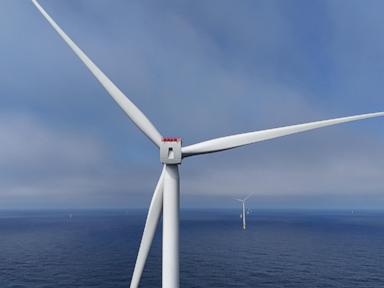
The steel is cold. It is three in the morning off the coast of Rhode Island, and the salt spray does not care about political cycles. For a technician like Elias, hanging five hundred feet above the Atlantic, the debate over offshore wind is not a campaign slogan. It is a physical reality made of grease, grit, and the low, rhythmic hum of a machine that weighs more than a navy destroyer.
Down on the shoreline, the lights of coastal towns glimmer like scattered embers. To some, those lights represent a way of life that must be protected from the "visual blight" of spinning blades. To Elias, they represent the sheer, unyielding demand of a grid that never sleeps.
The offshore wind industry is currently caught in a gale. In the United States, the momentum is colliding head-on with a changing political guard that has vowed to scrap the sector entirely. But to understand the stakes, we have to look past the podiums and toward the horizon.
The Weight of the Blade
Think of a single offshore wind turbine as a skyscraper that floats. The blades are often longer than a football field. When they spin, the tips move at speeds exceeding 180 miles per hour. This is not the "windmill" of a Dutch postcard; it is a marvel of heavy industry that has quietly become a cornerstone of the global energy transition.
The numbers are staggering. Europe leads the charge, with the United Kingdom and Germany currently boasting thousands of megawatts of capacity. China, however, has sprinted past everyone, installing more offshore wind in a single year than most nations have in a decade.
But the U.S. remains the great, untapped frontier.
Imagine a gold mine that only exists when the sun goes down or the temperature drops. That is the Atlantic Outer Continental Shelf. The winds there are faster, more consistent, and closer to major population centers than almost any other renewable resource. For years, the promise was simple: we would build a "steel in the water" economy that would revitalize dying port cities and provide a steady stream of carbon-free power to cities like New York and Boston.
Then the economics shifted.
The Invisible Friction
Inflation is a quiet killer. In 2023 and 2024, the industry faced a brutal reality. The cost of steel skyrocketed. Interest rates climbed, making the massive upfront loans required to build these projects much more expensive. Several major developers, including Orsted and Equinor, were forced to cancel contracts or pay massive penalties to walk away.
It was a moment of profound vulnerability. Critics pounced. They argued that if these projects couldn't survive a spike in interest rates, they weren't viable.
But consider the alternative.
Building a coal or gas plant is a known quantity with a predictable, albeit dirty, outcome. Building an offshore wind farm is like inventing a new form of logistics in real-time. You need specialized ships—vessels so rare and expensive that there are only a handful in the world capable of carrying these massive components. Under the Jones Act, a century-old law, these ships must be built and crewed by Americans to move goods between U.S. ports.
We are trying to build an entire maritime industry from scratch while the rules of the game are being rewritten.
The Whale in the Room
Walk onto any beach in New Jersey or Virginia lately, and you might see a protest sign featuring a whale. There is a persistent, emotional narrative that the sonar used to map the seafloor for wind farms is killing marine life.
It is a powerful image. It pits "big green" against the wonders of the natural world.
Scientifically, the link is tenuous at best. Federal agencies like NOAA have repeatedly stated there is no evidence connecting offshore wind activities to the recent "unusual mortality events" of whales. Instead, they point to a much more mundane and tragic culprit: ship strikes from cargo vessels and entanglement in fishing gear, exacerbated by climate change pushing whale prey into new, busier shipping lanes.
Yet, the narrative persists because it feels true. It taps into a deep-seated fear that in our rush to save the planet, we might destroy the very things we are trying to protect.
For someone like Elias, the irony is thick. From his vantage point, he sees the ocean as a workspace, not a museum. He sees the foundations of the turbines becoming artificial reefs, teeming with mussels and black sea bass. He sees the possibility of a blue economy where a fisherman’s son can get a job as a high-tech turbine technician making six figures without a four-year degree.
The Political Sudden Stop
Now, the industry faces its most daunting obstacle: a stroke of a pen.
President Donald Trump has made his disdain for wind power a central theme of his energy platform. He has called them "bird killers" and "monsters." More importantly, he has signaled an intent to use executive orders to halt all new leasing and permitting for offshore wind.
If this happens, it won't just stop the turbines from spinning. It will freeze billions of dollars in planned investment.
Think about the ripple effect. A factory in South Carolina that was supposed to manufacture subsea cables suddenly loses its only domestic customer. A shipyard in Louisiana, which spent years pivoting from oil rigs to wind-installation vessels, sees its order book vanish.
This is the human element that gets lost in the "renewables vs. fossil fuels" shouting match. We are talking about thousands of workers who have already retrained. We are talking about coastal communities that have bet their entire 20-year economic plans on being "wind hubs."
The Global Tug-of-War
While the U.S. debates whether offshore wind is a scam or a savior, the rest of the world is moving on.
Denmark is building "energy islands" that will act as massive hubs for offshore power, connecting multiple countries' grids. China is deploying turbines so large they can power a small city with a single rotation.
If the U.S. exits the stage, we don't just lose the energy. We lose the intellectual property. We lose the manufacturing lead. We become a customer of the world instead of a leader.
The technical challenges are real. The salt water corrodes everything it touches. The vibrations of the blades require constant monitoring. The sheer scale of the engineering is enough to make any project manager lose sleep.
But humans have always conquered the sea when the prize was worth it. We did it for whales in the 1800s. We did it for oil in the 1900s.
The Silent Revolution
Back on the turbine, Elias finishes his inspection. He secures his harness and looks out across the water. The sun is beginning to peek over the edge of the world, turning the Atlantic into a sheet of hammered gold.
The blades begin to turn.
There is no roar of an engine. There is no plume of smoke. There is only a low, rhythmic "whoosh" that sounds like the breathing of a giant.
In that moment, the politics feel small. The tweets, the lawsuits, and the campaign speeches are all drowned out by the sheer, terrifying power of the wind.
We can choose to ignore this force. We can choose to tear down the steel and go back to the fuels that built the last century. But the wind will keep blowing regardless of who sits in the Oval Office. The ocean will continue its slow, steady rise against our shores.
The question isn't whether offshore wind is perfect. No energy source is. The question is whether we are willing to let a once-in-a-generation industrial revolution pass us by because we were too afraid of how the horizon looked.
Elias unhooks his carabiner and begins the long climb down. Below him, the grid is waiting. Millions of toasters, hospitals, server farms, and streetlights are demanding their due.
The machine turns. The lights stay on. For now.