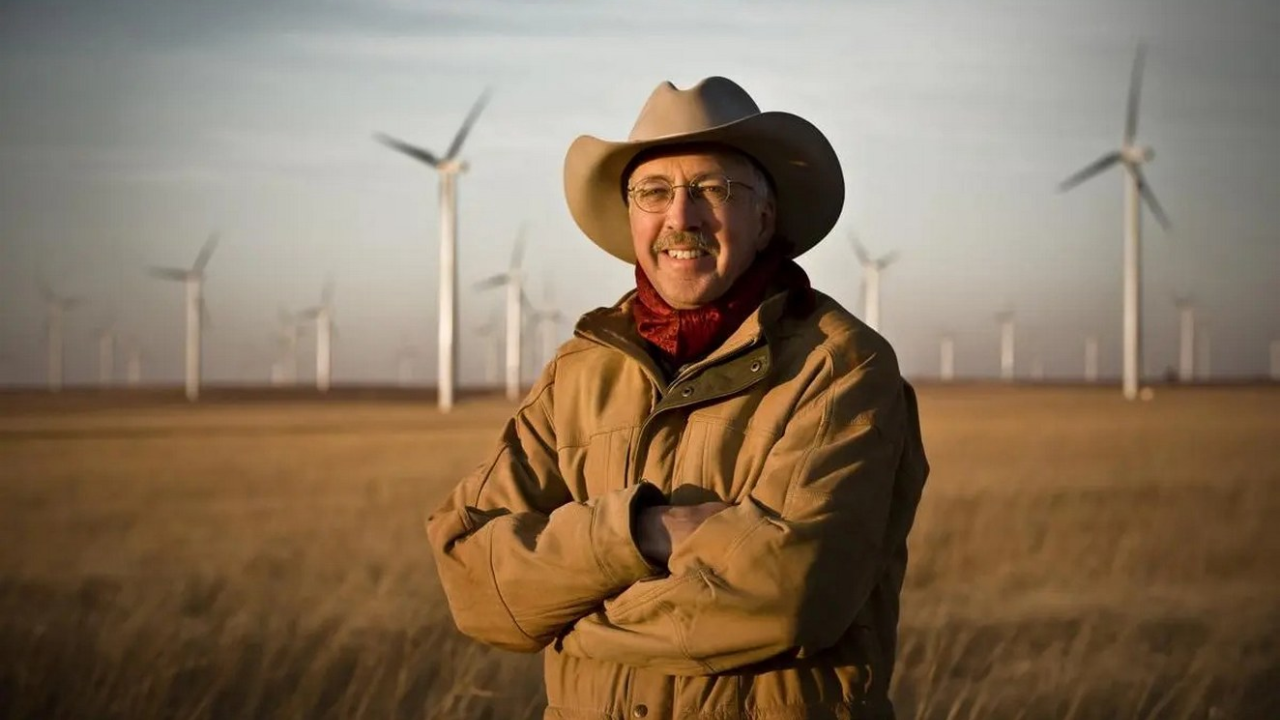
Farming and ranching have always meant staring at the sky and praying for rain. It is a brutal financial gamble. But a quiet revolution has swept across the Great Plains, and it has nothing to do with beef prices or wheat futures. On thousands of acres of Kansas grassland, the most lucrative crop isn't growing out of the dirt. It is being harvested straight out of the sky by towering steel blades.
Take the real-world economics of modern agriculture in the Midwest. While traditional operations struggle with shifting feed costs and drought, landowners who leased their property to wind energy developers are seeing completely different financial realities. We are talking about operations where wind turbines generate roughly half of a rancher's total annual income. That kind of steady cash flow changes everything about generational landownership. Read more on a similar issue: this related article.
Let's look at how this actually works on the ground, why traditional ranching economics forced this shift, and what you need to know if you think wind energy is an overnight fix for rural debt.
The Brutal Math of Traditional Ranching
If you have never managed a cattle ranch, the financial volatility is hard to overstate. You buy feed when prices spike. You sell cattle when market dips hit. You pray your well water does not run dry during a July heatwave. Most family ranches operate on razor-thin margins. A bad year can wipe out a decade of savings. Additional journalism by Business Insider delves into similar perspectives on the subject.
Land is expensive to hold. Property taxes do not care if your calves fetched a good price at auction. Because of this, rural landowners have spent decades looking for supplemental income streams. Oil and gas leases have historically filled that gap, but those wells eventually run dry and leave behind environmental liabilities.
Wind, on the other hand, keeps blowing.
When energy companies started looking at the windy expanse of western and central Kansas, they saw prime real estate for utility-scale wind farms. For a rancher sitting on five thousand acres of scrub and pasture, a wind lease represents a total transformation of risk.
How Wind Leases Actually Pay Out
Do not imagine a wind turbine as a small backyard windmill that powers a single water pump. These are massive industrial structures. A single modern commercial wind turbine can stand over four hundred feet tall, with blades sweeping an area wider than a passenger jet.
Developers do not buy the land outright in most cases. Instead, they sign long-term lease agreements—often spanning thirty to fifty years. The payment structure usually includes a few distinct phases:
- Development and Testing Phase: Ranchers receive modest annual payments while the company tests wind speeds, studies local bird populations, and secures permits.
- Construction Phase: Payments bump up significantly while heavy equipment tears up access roads and pours concrete foundations.
- Operational Phase: This is where the real money flows. Landowners typically receive a percentage of the gross revenue generated by the electricity produced, or a fixed annual payment per turbine, whichever ends up being higher.
When a ranch hosts dozens of these turbines—say, fifty or more across a massive multi-section ranch—the annual royalties skyrocket. We are talking about fixed, inflation-adjusted revenue streams that land in the bank account every single month, regardless of whether beef prices are up or down.
The Catch Nobody Talks About
Before you assume every Kansas rancher is trading their pickup truck for a luxury sports car, we need to talk about the downsides. Wind energy is not free money, and it comes with real compromises.
First, construction is messy. Building a wind farm requires heavy industrial activity. You get concrete mixers, flatbed trucks hauling massive blade segments, and cranes tearing up pasture roads. Even after construction finishes, maintenance trucks run daily routes across your property.
Second, you have to share your land. While cattle can graze right up to the base of a turbine—and they often do, treating the giant towers as scratching posts—the physical footprint of the access roads and pads cuts into usable pasture.
Third, legal contracts are brutal. Energy companies hire sharp lawyers. If you sign a lease without understanding setback requirements, decommissioning liabilities, or transmission line easements, you can trap your family in a bad deal for generations. Who pays to remove the concrete foundation when the turbine reaches the end of its lifespan? If it is not spelled out in the contract, the landowner could be left holding the bag.
Why This Shifts the Power Dynamic in Rural America
For generations, rural communities watched wealth drain toward the cities. Young people left because farming did not pay enough to justify the backbreaking labor. Agribusiness conglomerates bought up family homesteads for pennies on the dollar when farmers went bankrupt.
Wind energy has thrown a wrench into that decline.
When a rancher pulls in steady revenue from wind royalties, they can afford to keep the ranch intact. They do not have to sell off a parcel of pasture to pay estate taxes or cover a bad drought year. It keeps land in family hands.
Furthermore, local tax revenues explode. Counties that previously struggled to fund public schools or patch paved roads suddenly find themselves flush with property taxes paid by energy corporations. It changes the economic baseline of entire counties.
What to Watch Next in the Renewable Ag Space
The energy landscape is not standing still. As battery storage technology improves and transmission lines get upgraded, the economics of wind-hosting ranches will only shift further.
We are also seeing agrivoltaics—combining solar panels with livestock grazing—start to compete with wind in certain regions. But wind remains the king of the open plains because it leaves the vast majority of the surface area open for traditional ranching operations. You can run cattle under a wind turbine. You cannot easily run cattle under a dense grid of traditional solar panels without specialized elevated mounting systems.
If you are looking at the future of rural land ownership, the lesson is clear. The most successful ranchers are no longer just agricultural producers. They are energy landlords. They have diversified their income away from the whims of weather and global meat markets, securing a financial baseline that protects their land for the next fifty years.