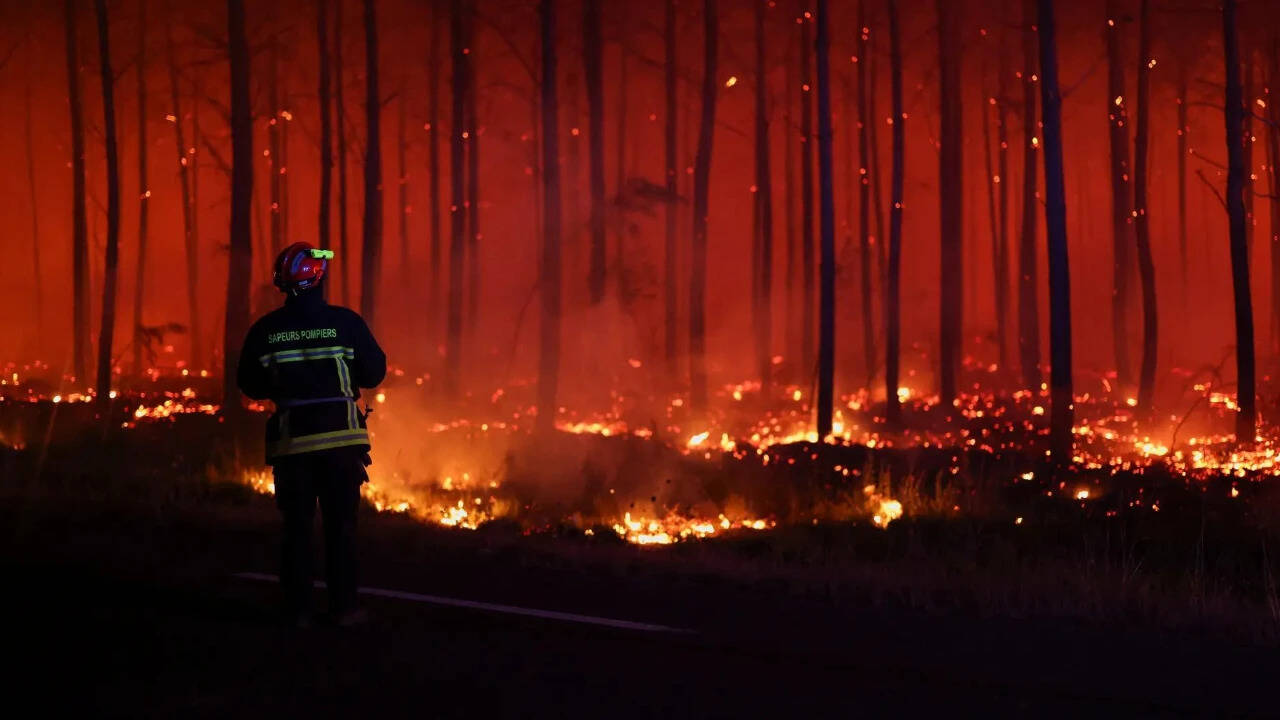
The current wave of wildfires across southwestern Europe functions as an inevitable consequence of a specific hydroclimatic sequence rather than a series of disconnected environmental accidents. With over 250,000 people displaced and fire fronts threatening infrastructure in both France and Spain, the crisis reveals a failure to manage the transition from wet spring vegetation growth to midsummer drying. The fundamental driver of this intensity is the hydroclimatic rebound effect, which creates a dangerous surplus of biomass that desiccates rapidly under persistent high-pressure systems.
The Hydroclimatic Rebound Mechanism
The catastrophic fire behavior observed in July 2026 relies on three structural factors:
- Fuel Accumulation: A period of above-average precipitation during the winter and spring months stimulated significant vegetative growth. This biomass serves as the potential energy reservoir for the current fire season. Rural depopulation across the Mediterranean basin has further exacerbated this, as abandoned land facilitates the growth of continuous, unmanaged scrubland and forest cover.
- Desiccation Dynamics: Following the growth phase, a sustained transition to extreme heat and low humidity created the necessary conditions to convert living biomass into highly flammable fuel. The rate of drying has exceeded historical averages, resulting in Fuel Moisture Code values in the 96th–98th percentile range.
- Atmospheric Forcing: Extreme temperature spikes, often exceeding 40°C, increase the atmospheric evaporative demand. This draws moisture from both soil and vegetation at an accelerated rate, ensuring that even minor ignition events translate into high-intensity, rapidly spreading fire fronts.
The Problem Of Continuity
Wildfire intensity is less a function of specific vegetation species and more a result of spatial connectivity. The existing landscape architecture in Gironde and central Spain features high fuel continuity, allowing fire to propagate without natural or artificial buffers.
Current fire suppression models are increasingly overwhelmed because the fire intensity—driven by the sheer volume of accumulated, dried biomass—exceeds the mechanical capability of standard aerial and ground-based suppression tools. When a fire front reaches a certain energy threshold, flame retardants and water drops become largely ineffective against the fire's convective heat.
This creates a structural bottleneck in emergency response. When civil protection resources, such as those diverted from the Tour de France, are tasked with containment in areas of high fuel continuity, the probability of successful suppression drops significantly. The fire moves faster than the redeployment capacity of emergency personnel.
Infrastructure And Urban Interface Risk
The threat to residential zones, such as the areas near Bordeaux and the outskirts of Madrid, stems from the poorly managed transition zone between wildland and urban developments. These areas represent a "hard target" because they contain combustible infrastructure mixed with high-density, unmanaged vegetation.
- Ignition Potential: Residential items, such as untreated wooden decks or overhanging vegetation, provide direct conduits for fire into the built environment.
- Containment Obstructions: Narrow access routes in rural-urban transition zones restrict the maneuverability of heavy firefighting machinery, limiting the efficacy of defensive measures.
Strategic Adjustments For Fire Resilience
The current approach of relying primarily on reactive suppression is fundamentally incompatible with the changing hydroclimatic regime. Moving forward, authorities must shift toward structural landscape modification:
- Strategic Fuel Discontinuity: Implementation of "mosaic landscapes" is the only proven method for lowering fire intensity. This requires the deliberate introduction of fire-resistant zones—agricultural breaks, grazed land, and managed woodlands—that act as circuit breakers, forcing a drop in flame height and heat output.
- National Managed Containment Corridors: Rather than attempting to suppress all fires, resources should be prioritized to maintain specific, pre-identified containment corridors. These corridors function as tactical fallback positions when fire intensity surpasses local suppression capabilities.
- Active Biomass Regulation: Agricultural policy must prioritize the re-introduction of managed land use in depopulated areas. The objective is to replace unmanaged, high-density scrubland with active, low-fuel-load systems. This is not an environmental choice but a necessary operational requirement for regional safety.
The current crisis confirms that environmental policy cannot remain separate from fire management strategy. Without the aggressive, systematic reduction of biomass density in critical zones, extreme summer weather will continue to result in catastrophic fire events that exceed the limits of current emergency response systems. The transition from reactive fire fighting to proactive landscape engineering is the required operational evolution.