The marble beneath their knees did not care about the weight of history. It was cold, uncompromising, and indifferent to the fact that the two men kneeling upon it represented nearly two millennia of fractured Christendom. One wore the white of Rome; the other, the dark cassock of Canterbury.
For centuries, the distance between these two men was measured not in miles, but in blood, fire, and the jagged edges of broken communion. When Justin Welby knelt beside Pope Francis, they weren't just two elderly men sharing a moment of silence. They were attempting to bridge a canyon that opened in the 16th century, a rift that once sent martyrs to the stake and shaped the very map of the modern world.
The air in the room was thick with the scent of old wood and beeswax. Silence in Rome has a different quality than silence anywhere else. It is heavy. It is layered. It carries the echoes of a thousand prayers and the ghosts of a dozen schisms.
The Ghost of 1534
To understand why a simple prayer in a private chapel matters, you have to look at the scars. We often think of religious history as a series of dusty dates in a textbook, but for the people living through the English Reformation, it was a visceral, terrifying upheaval.
Imagine a village in 1530. The church was the center of the universe. The liturgy was the heartbeat of the community. Then, suddenly, the King in London decides that the Pope in Rome no longer holds sway. The Latin is gone. The statues are smashed. The world is turned upside down. This wasn't just a policy change; it was a soul-deep fracture.
For five hundred years, that fracture remained the status quo. We grew used to the division. We built our identities around not being "the other." The Church of England and the Roman Catholic Church became like siblings who stopped speaking after a bitter inheritance dispute, eventually forgetting why they were angry but refusing to sit at the same table anyway.
When Welby and Francis met, they weren't looking at the past through the lens of a historian. They were looking at it through the lens of two leaders trying to figure out how to be relevant in a world that increasingly views their ancient squabbles as a quaint relic of a bygone era.
The Invisible Stakes
Why does this matter to someone who hasn't stepped foot in a cathedral in a decade?
Because the world is currently tearing itself apart along different lines. We are living through a period of profound tribalism. Whether it is politics, identity, or geography, we are experts at finding reasons to stand apart.
In this context, the sight of the Archbishop and the Pope praying together is a radical act of defiance against the spirit of the age. It is an admission that being right is less important than being together.
Consider the logistics of such a meeting. Behind the scenes, there are decades of "ecumenical dialogue"—which is essentially the theological version of a high-stakes trade negotiation. Civil servants in clerical collars argue over the exact meaning of words like justification and authority. They move commas and adjust adjectives. It is slow, grinding work.
But then, the talking stops. The paperwork is set aside. The men walk into a quiet space and simply exist in the presence of something larger than themselves.
The stakes aren't just about whether an Anglican priest can celebrate Mass at a Catholic altar. The stakes are about whether reconciliation is actually possible in a human heart. If these two institutions, with all their baggage and bitter history, can find a way to kneel together, then perhaps there is hope for the rest of us.
The Human Element
Justin Welby is a man who understands the cost of conflict. Before he was an Archbishop, he worked in the oil industry and later as a mediator in some of the most violent regions on earth. He knows that peace isn't a feeling; it’s a grueling, often thankless process of showing up.
Pope Francis, meanwhile, has made a career of breaking protocol. He is the Pope of the "peripheries," the man who washes the feet of prisoners and calls for a church that is a "field hospital" rather than a fortress.
When these two personalities collide, the result isn't a formal diplomatic communique. It is a shared sigh.
There is a specific kind of exhaustion that comes with leadership, especially the leadership of ancient, sprawling institutions that are resistant to change. You can see it in the way they sit. There is a weariness in the shoulders. They are both navigating the decline of traditional faith in the West, the rise of fundamentalism in the Global South, and the internal pressures of their own restive flocks.
In that room, they weren't just icons. They were two men who know exactly how lonely it is at the top of a cathedral spire.
Beyond the Handshake
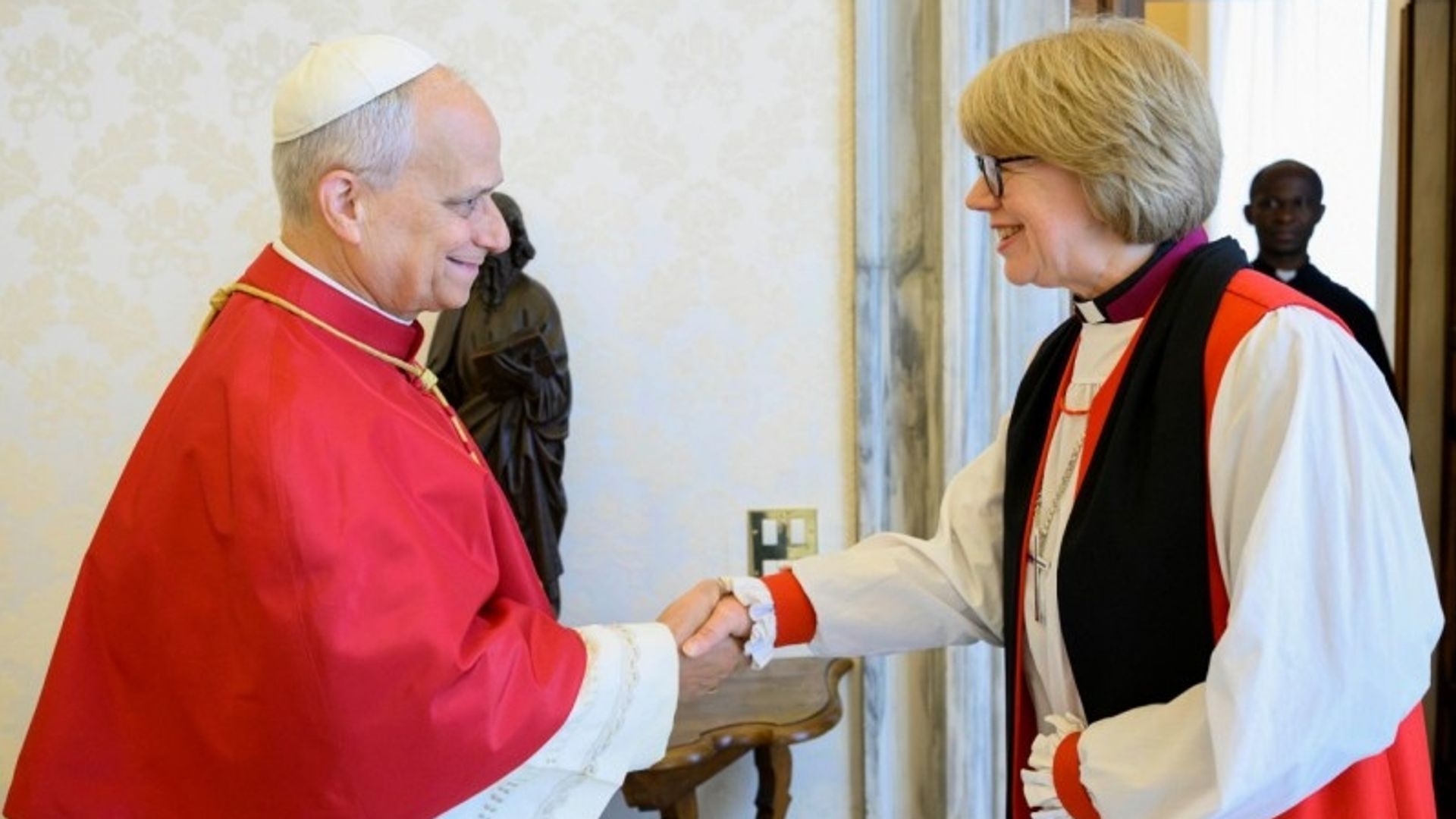
The media often treats these meetings as a photo-op. They look for the handshake, the smile, the symbolic gift. This time, it was a pectoral cross or a joint declaration. But the real story isn't the object exchanged; it’s the silence shared.
Prayer is an vulnerable act. To pray with someone is to admit that you don't have all the answers. It is a surrender of ego. For a Pope and an Archbishop, whose entire roles are defined by their authority and their "correctness," this surrender is nothing short of revolutionary.
The "historic" nature of the meeting isn't found in the headlines. It’s found in the ripple effect.
In a small parish in suburban London, a Catholic priest and an Anglican vicar might see that photo and decide to host a joint food bank. In a village in Africa, where religious tensions can lead to actual violence, the image of these two leaders together can be a literal lifesaver. This is the "lived experience" of ecumenism. It isn't about theology; it’s about the person standing next to you.
The Persistent Divide
We should not be naive. The theological hurdles remain immense. The question of the ordination of women, the role of the Papacy itself, and various social issues continue to act as high fences between the two traditions.
But there is a difference between a fence and a wall.
A wall is designed to keep people out. A fence simply marks a boundary. You can still talk over a fence. You can even reach over and shake a hand.
What we witnessed in Rome was the slow, steady dismantling of the wall. It wasn't a sudden demolition—there were no trumpets and the masonry didn't come crashing down in a single afternoon. Instead, it was the sound of two men picking at the mortar with their bare hands.
The meeting suggests that the future of faith isn't about uniformity. It’s not about everyone moving into the same house and agreeing on the color of the curtains. It’s about being "reconciled diversity." It’s about realizing that we can be different without being enemies.
The Long Walk Back
As they stood up from the marble floor, the cameras caught a moment of genuine warmth. It wasn't the practiced smile of a politician. It was the look of two people who had just shared a heavy burden and found it slightly lighter for the sharing.
The Archbishop would fly back to Lambeth Palace. The Pope would return to his modest apartment in the Casa Santa Marta. The world would go on spinning, obsessed with its latest scandals and its newest divisions.
But something in the atmosphere had shifted.
The history of the last five centuries has been a story of walking away. We walked away from the table, away from the altar, and eventually, away from each other.
That afternoon in Rome, two men took a few steps in the other direction.
They didn't reach the end of the journey. Not even close. But they turned around. They looked at the long, dusty road of the last five hundred years and decided they didn't want to walk it alone anymore.
The marble floor is still cold. The history is still heavy. But for a few minutes in a quiet chapel, the weight of two crowns didn't seem quite so unbearable.
The real test of the meeting won't be found in the official records or the Vatican archives. It will be found in the way we look at our neighbors, the ones we’ve spent lifetimes disagreeing with. It will be found in whether we are brave enough to kneel on the cold stone ourselves, without knowing if the person beside us is going to pray the same words.
Hope is a quiet thing. It doesn't scream. It doesn't demand the front page. Sometimes, it just looks like two old men, side by side, closing their eyes and breathing in the same stale, sacred air.