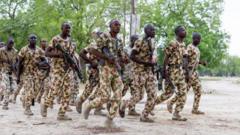
The dust on the boots of a junior soldier in Nigeria does not settle easily. It clings to the fabric, mixes with the sweat of endless patrols under a punishing sun, and settles deep into the quiet anxieties of a life lived on the precipice. Every month, thousands of young men and women lace up boots that have seen better days, step onto the asphalt of volatile highways or the dense brush of troubled frontiers, and carry a burden that most citizens only ever glimpse through the flickering lens of a television screen.
They do not ask for much. They ask for a chance to provide. They ask for dignity.
When the news broke across the nation that the presidency had authorized an eighty percent salary increase for junior soldiers, the immediate reaction in most newsrooms was clinical. Percentages were calculated. Budgets were weighed against national deficits. Economists nodded or frowned, depending on their allegiance to fiscal conservatism. But numbers on a spreadsheet fail to capture the reality of what it means to hold the line when the ground beneath you is shaking.
Consider a hypothetical private stationed in the outskirts of Borno State. Let us call him Musa. Musa is twenty-four years old. He sends a portion of his meager monthly pay back home to his mother in Kano, funding a fraction of his younger sister's school fees and buying bags of grain that never seem to last quite as long as they used to. Inflation does not care about military rank. The cost of rice, fuel, and medicine rises for everyone, but it bites hardest at the bottom of the food chain. Before this directive, Musa walked the perimeter with a radio in one hand and arithmetic in his head, calculating whether his salary would stretch far enough to cover both a packet of malaria medication and rent.
Doubt is a corrosive element. When those tasked with defending the sovereignty of a nation are consumed by the daily humiliation of financial scarcity, the cracks begin to show. A distracted soldier is vulnerable. A demoralized barracks breeds quiet desperation.
Leadership, at its core, is the art of recognizing invisible fractures before they shatter the whole structure.
The decision to lift the compensation floor for the rank and file was not merely an administrative adjustment. It was an acknowledgment. For too long, the foot soldiers of the Nigerian military bore the heaviest physical risks while receiving the thinnest financial cushions. Generals make strategy, but privates and corporals absorb the impact. To shift the financial baseline by such a staggering margin is to send an unambiguous signal to the barracks: your sacrifice is seen.
Money changes the geometry of survival. For Musa, that eighty percent bump transforms the daily emergency into a manageable routine. It means the difference between choosing which family member gets medical care and being able to afford care for all of them. It means the uniform feels less like a costume of poverty and more like a badge of honor.
Critics will point to the wider macroeconomic strain. They will argue that public expenditure must be guarded jealously, that every naira redirected toward defense payrolls is a naira pulled away from crumbling schools or neglected clinics. That argument holds weight in a vacuum. But a nation cannot build schools if the foundations are burning. Security is the absolute prerequisite for development. You cannot teach a child mathematics if an insurgency is knocking at the classroom door. And you cannot maintain a loyal, motivated defense force if those carrying the rifles cannot afford to feed their children.
History provides a stern teacher on this very point. Armies do not collapse solely from superior enemy firepower; they rot from the inside when the social contract between the state and the soldier is broken. When a soldier feels abandoned by the system they protect, allegiance frays. By proactively addressing the welfare of junior ranks, the administration took a necessary step toward fortifying the internal cohesion of the armed forces.
Yet, policy changes in executive chambers take time to ripple down to the dusty parade grounds. Bureaucracy is a slow beast. Implementation requires vigilance to ensure that the funds earmarked for the lowest ranks actually reach their intended destination without vanishing into the labyrinth of administrative bottlenecks. Transparency must match generosity.
The sun sets over the barracks, casting long shadows across the concrete blocks. The evening muster is called. Boots click against the earth in unison. Musa stands shoulder-to-shoulder with his comrades, his rifle cradled in his arms. The threats facing the country have not vanished overnight. The roads are still long, the nights are still dark, and the challenges remain formidable.
The weight on his shoulders is still heavy. But tonight, for the first time in a very long time, the ground beneath his feet feels just a little bit firmer.