Sarah stands in the center of her living room, a space that should be a sanctuary but currently feels like a physical manifestation of a debt she forgot to pay. The air is heavy. It isn't just the pollen drifting through the April light; it is the sediment of a year lived at full tilt. There is a stack of mail on the sideboard that has developed its own gravitational pull. A coat hangs over the banister, a relic of a winter that stayed too long. She feels an inexplicable tightness in her chest, a phantom pressure that whispers she is falling behind.
We call it spring cleaning. We treat it like a chore, a seasonal box to check between the thaw and the first heatwave. But that framing misses the point entirely.
Cleaning is not about hygiene. It is about reclaiming the sovereignty of your own mind.
The Archaeology of the Shelf
When we talk about deep cleaning, we usually focus on the "how." How do you get red wine out of a rug? How do you sanitize a dishwasher? These are tactical questions with chemical answers. But the "why" is far more interesting. Every object in your home is a silent commitment. That bread maker you bought in a fit of sourdough-fueled optimism in 2020? It’s not just taking up counter space; it’s a tiny, metallic monument to a version of yourself you haven't become.
Consider the "junk drawer." Most of us have one. It is a purgatory for the miscellaneous—dead batteries, soy sauce packets, keys to locks that no longer exist. To clean that drawer is to perform a small act of archaeology. You are digging through the strata of your own life, deciding what still has value and what has become a ghost.
Psychologically, our environments act as an external hard drive for our stress. When your physical space is fractured, your cognitive load increases. Your brain has to work harder to ignore the pile of laundry or the dusty baseboards. It is a slow, constant drain on your mental battery. To clear the space is to stop the leak.
The Chemistry of Renewal
Let’s move past the sentiment and look at the grit. Spring cleaning is often viewed as a superficial exercise, but the biological reality is startling. Over the winter, homes become airtight vaults for indoor pollutants. Dust is not just dirt; it is a complex cocktail of skin cells, pet dander, lint, and microplastics. In a hypothetical scenario where a family of four spends six months with the windows shut, the concentration of these particles can be five times higher than the air outside.
The strategy for a true purge must be systematic. You don't start with a mop; you start with a bin.
- The Categorical Cull: Do not clean room by room. Clean by category. If you tackle "books," you see the sheer volume of what you own. If you just clean the "living room," you move a book to the bedroom and call it progress. You are merely shuffling the weight.
- The Vertical Descent: Gravity is your only collaborator. Start at the ceiling fans and work your way down to the floorboards. To do otherwise is to spend your afternoon chasing the same dust bunnies in a circle.
- The Hidden Organs: We focus on the skin of the house—the counters, the floors. But the organs are what keep it alive. Vacuum the coils behind your refrigerator. Change the furnace filter. Clean the dryer vent. These are the places where the house breathes.
Sarah starts with the windows. It seems small, but as the grime of a city winter vanishes, the light changes. It is sharper now. It doesn't just illuminate the room; it exposes the work that remains.
The Emotional Cost of Keeping
There is a specific kind of pain associated with letting go. We have been conditioned to believe that more is better, that abundance is a shield against the uncertainty of the future. But abundance can easily become a cage.
Think of the "maybe" pile. You know the one. These are the items you hold in your hand, pause, and then put back because "I might need this someday." This is a fear-based decision. It assumes a future version of you that is lacking, a version of you that cannot provide. By keeping the broken toaster or the jeans that haven't fit since the Bush administration, you are tethering yourself to a past identity.
The truth is, most of what we keep is a burden disguised as a resource.
When Sarah finally tackles the hall closet, she finds a box of old cables. USB-A, proprietary chargers for phones that burned out a decade ago, tangled knots of black plastic. She realizes she has been guarding a graveyard. As she drops them into a recycling bin, she feels a literal lightness in her shoulders. It isn't magic; it's the removal of a micro-stressor. Each item removed is one less thing her brain has to track.
The Microscopic War
We must address the invisible. While we obsess over the visible clutter, the real health hazards are microscopic. Spring is the season of the dust mite. These creatures thrive in the warmth of our mattresses and the fibers of our carpets. A standard pillow can double its weight over several years due to the accumulation of these organisms and their waste.
This is where the standard "answered questions" of a typical cleaning guide fall short. They tell you to wash your sheets. They don't tell you that you need to strip the bed entirely and vacuum the mattress with a HEPA-filter attachment. They don't mention that your curtains are essentially giant air filters that have been trapping pollutants for months.
- Steam is your best friend: High-heat steam kills 99% of bacteria and dust mites without the need for harsh chemicals that linger in your air.
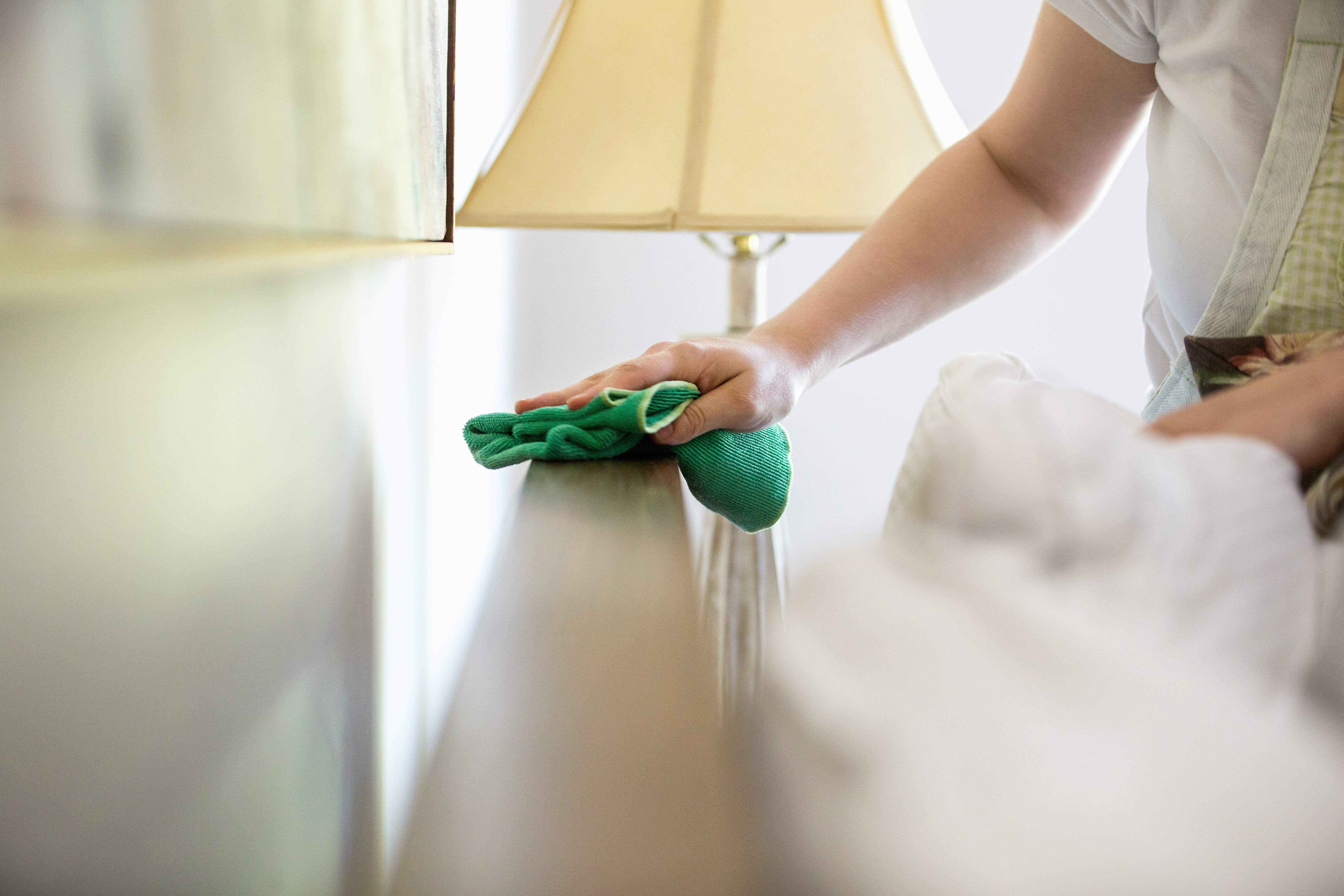
- The Microfiber Myth: Not all cloths are created equal. Cheap rags just push dirt around. High-quality microfiber with a high "denier" count actually lifts and traps particles through a slight static charge.
- The Vinegar Fallacy: While vinegar is great for glass and some scales, it is an acid. Using it on stone countertops or certain wood finishes is a recipe for permanent damage. Understanding the pH of your cleaning agents is the difference between a clean home and a ruined one.
The Rhythm of the Ritual
Cleaning is a performance. It requires a soundtrack, a specific energy, and an acceptance that things will get worse before they get better. There is a point in every deep clean—usually about three hours in—where the house looks like a disaster zone. Stuff is everywhere. The drawers are empty, the floors are covered in sorted piles, and you feel a wave of regret.
This is the "messy middle." It is the moment where the old order has been destroyed but the new order hasn't yet taken hold. Most people quit here. They shove everything back into the cabinets and promise to finish next weekend.
But if you push through, something shifts.
The chaos begins to resolve. The piles disappear into their new, intentional homes. The air starts to smell different—not like artificial "lemon" or "mountain breeze" chemicals, but like nothing at all. Clean air has no scent. It is just a neutral, cool presence.
Sarah finishes as the sun begins to set. Her hands are dry, and her back ached an hour ago, but the ache is different from the heaviness she felt this morning. That was a weight of stagnation. This is the fatigue of accomplishment.
She sits on the sofa, looking at the room. The sideboard is clear. The light from the streetlamp hits the window and doesn't struggle through a film of grey. She realizes that she didn't just clean her house; she reset her baseline. The ghosts of the winter have been exorcised, and for the first time in months, there is room for something new to grow.
The house is finally empty enough to be full.