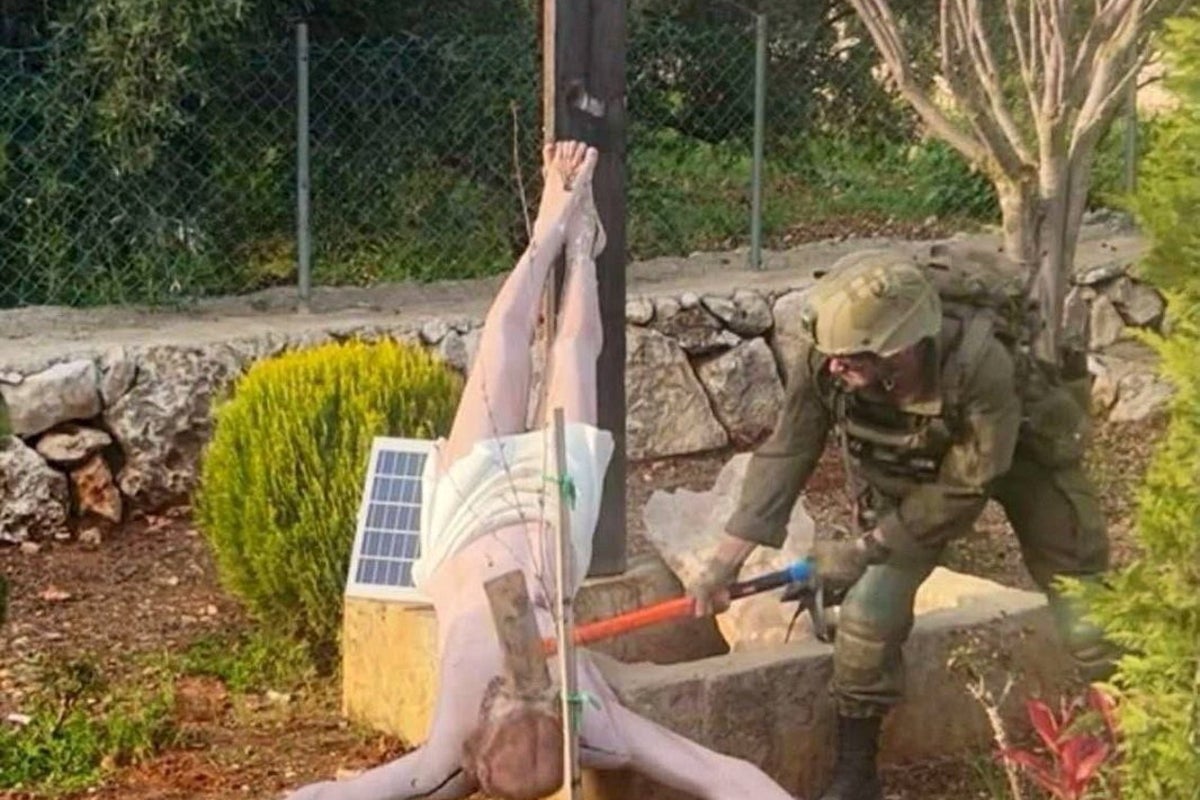
The air in South Lebanon doesn’t just carry the scent of cedar and dust. It carries the weight of centuries. Here, history isn’t found in textbooks; it’s etched into the limestone of hillsides and the cool, shadowed interiors of shrines that have seen empires rise and fall like the tide. When a village is abandoned under the shadow of war, it isn't just people who remain. The statues remain. The icons remain. They stand as silent sentinels of a culture’s soul, waiting for a return that feels increasingly distant.
Then comes the sound of steel meeting stone.
It isn’t the thunder of an airstrike or the sharp rattle of gunfire. It is rhythmic. Deliberate. The sound of an axe swinging through the humid air to find a target that cannot strike back. Recently, a video surfaced from the borderlands, captured on a phone and shared across the digital ether. It shows an Israeli soldier, clad in olive drab and tactical gear, standing before a statue of Jesus. He isn't clearing a line of sight. He isn't searching for a hidden cache. He is swinging an axe into the face of the figure.
The stone chips away. Shards fly.
The Anatomy of an Image
In the modern theater of war, images are more than documentation; they are ammunition. But this specific clip feels different from the grainy thermal footage of a drone strike. It is intimate. We see the physical effort behind the swing. We see the repetition. The act of destroying a religious symbol in a combat zone isn't a strategic necessity. It is a message.
For the people of South Lebanon—a mosaic of Maronite Christians, Shia Muslims, and Druze—these icons are the connective tissue of their identity. When a soldier chooses to spend his energy dismantling a statue of the "Prince of Peace," he isn't just breaking rock. He is puncturing the fragile idea that war has boundaries. He is signaling that even the sacred is fair game.
Consider a hypothetical resident of a village like Yaroun. Let’s call him Elias. Elias didn't flee because he stopped loving his home; he fled because the sky turned to fire. In his mind, he holds a mental map of his street. He remembers the grotto where the statue stood. To Elias, that statue wasn’t just a theological statement. It was a landmark of safety. It was where his grandmother lit candles during the wars of the eighties. It was a constant. Seeing it shattered via a social media feed is a specific kind of grief. It is the realization that the home you hope to return to is being systematically erased, piece by piece.
Beyond the Fog of War
The Israel Defense Forces (IDF) often speak of high moral standards and the complexities of urban warfare. They point to the "purity of arms." Yet, when a single soldier takes an axe to a religious icon, that narrative hits a wall. The military command usually responds to these incidents with talk of "individual deviations" or "disciplinary actions." But the frequency of these digital "trophies"—soldiers filming themselves destroying property, mocking ruins, or desecrating symbols—suggests a deeper friction in the machine.
War strips away the veneer of civilization. It’s an old truth. But in the age of the smartphone, the stripping away is televised. The soldier with the axe represents a breakdown of discipline, yes, but also a profound lack of empathy for the "humanity of the other." To him, perhaps, the statue was just a piece of the landscape of an enemy. To the world watching, it is a violation of the 1954 Hague Convention, which mandates the protection of cultural property during armed conflict.
Logically, destroying a statue serves zero tactical purpose. It does not stop a rocket. It does not uncover a tunnel. It does, however, provide a visual shorthand for the humiliation of a population.
The Echo in the Rubble
History is a heavy ghost in this part of the world. South Lebanon has been a chessboard for decades. The soil is layered with the remnants of the Crusaders, the Ottomans, and the French. Each group left their mark, often by trying to erase the mark of those who came before.
The irony is that stone is surprisingly resilient. You can break a nose off a statue, or shatter a hand stretched out in blessing, but the act of destruction often grants the object a new kind of power. It becomes a relic of martyrdom. The "Jesus with the Axe" video has already begun its second life as a rallying cry. It is being shared in Beirut, in Paris, in Rome, and in New York. It is moving from a localized act of vandalism to a global symbol of perceived systemic cruelty.
The soldier likely didn’t think about the global optics. He likely wasn't thinking about the Geneva Convention or the theological implications of his target. He was likely caught in the adrenaline and the terrible, seductive power of being able to destroy something beautiful with impunity.
But the axe eventually stops swinging. The soldier moves on to the next ridge. The camera is tucked back into a pocket. What is left behind is the silence.
The statue stands—or lies—in pieces. The village remains empty. The dust settles on the broken limestone, and the wound in the collective memory begins to fester. This is the hidden cost of the conflict. It isn't measured in hectares of land or the number of intercepted projectiles. It is measured in the loss of the belief that anything is sacred.
When the dust finally clears and the politics of the day are written into the dry footnotes of history, the image of the axe will remain. It will be told to children as a story of what happens when the heart hardens to the point where it can no longer recognize a face in the stone.
The hillside is quiet now. The sun sets over the Mediterranean, casting long, jagged shadows across the ruins of the south. The stone is broken, but the memory of the swing is permanent.