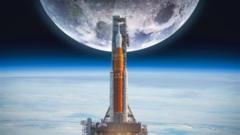
The media is obsessed with the clouds. Every time a countdown clock starts for a major NASA mission, the talking heads start staring at the sky like nervous farmers during a drought. They want to talk about "Anvil Cloud Rules," lightning strike probabilities, and the 45th Weather Squadron’s latest forecast percentages. They ask if the wind will scrub the launch. They wonder if a humid afternoon in Florida will delay our "return to the Moon."
They are asking the wrong questions.
Weather isn't a barrier to Artemis II. Weather is a convenient scapegoat. If you want to understand why we aren't standing on lunar soil yet, stop looking at the barometer and start looking at the plumbing. The "will it launch" drama is a distraction from the systemic fragility of the SLS (Space Launch System) architecture itself.
The Weather Myth: A High-Tech Security Blanket
The "weather scrub" is the most palatable excuse in aerospace. It’s "God’s fault." It’s an act of nature that nobody can blame on a contractor or a project manager.
But here is the reality: The weather constraints for the SLS are restrictive because the vehicle is a Frankenstein’s monster of Space Shuttle-era components pushed to their absolute limits. We are flying a rocket designed by committee, using solid rocket boosters that have to be kept within narrow thermal bands and a liquid oxygen/hydrogen core stage that is notoriously finicky.
When NASA says they can't launch in a light drizzle or if the wind at 30,000 feet is a bit too gusty, they aren't just being "safe." They are admitting that the SLS has a razor-thin margin for error. Contrast this with the older, "less advanced" Soyuz rockets in Russia, which launch in blizzards. Why? Because they were designed for the environment, not for a pristine simulation.
We’ve built a $4 billion-per-launch Ferrari and we’re worried about a puddle. The real story isn't the weather; it's why we built a vehicle so fragile that a cumulonimbus cloud can derail a decade of planning.
The Liquid Hydrogen Nightmare
Let’s talk about the real reason launches get scrubbed: the "Glitch." Usually, the public hears about a "hydrogen leak" and then, minutes later, the weather turns sour, and the scrub is blamed on the clouds.
Liquid Hydrogen ($LH_2$) is the smallest molecule in the universe. It is a nightmare to contain. It leaks through seals that are perfectly tight for any other substance. Because it is stored at $-423°F$, it causes metals to contract and become brittle.
The SLS uses $LH_2$ because it provides high specific impulse—it’s efficient once you’re in the vacuum of space. But on the pad? It’s a liability. Every minute the SLS sits on the pad waiting for a "weather window," those seals are stressed. The "quick disconnects" are freezing and thawing.
I have watched engineers sweat over these seals for years. We saw it with Artemis I—multiple attempts thwarted not by the rain, but by the fundamental physics of trying to keep the universe's most elusive gas inside a giant orange tank. When the weather window closes, it’s often a relief for the ground crew because it gives them an excuse to stop fighting the leaks for a day.
The SLS is a "Single-String" Trap
The competitor articles love to focus on the four astronauts—Reid Wiseman, Victor Glover, Christina Koch, and Jeremy Hansen. They paint a picture of a bold leap forward.
But Artemis II is a "fly-by" mission. It doesn't land. It doesn't dock with a Gateway that doesn't exist yet. It loops around the Moon and comes home. Why? Because we don't trust the hardware yet.
The SLS is not reusable. Every time we "scrub" for weather, we are burning through the lifespan of components that were never meant to sit in the salty, humid air of Cape Canaveral for months at a time. The boosters have "use-by" dates. Once you stack them, the clock starts ticking on the propellant's integrity.
This is the hidden cost of the "Weather Delay." It’s not just a lost day; it’s a degradation of the entire stack. We are currently trapped in a cycle where we wait for "perfect" conditions for a vehicle that is slowly rotting on the pad every time the sun comes up.
The 45th Weather Squadron is the Only One Doing Their Job
People love to moan about the "Weather Officer" who calls the scrub. That person is the only one being honest. Their job is to tell you exactly how much risk is in the air.
The real risk isn't a lightning strike—the SLS is essentially a giant lightning rod designed to channel a strike into the ground via the launch pad's protection system. The risk is Static Discharge.
As a rocket flies through the atmosphere, it builds up a massive electrical charge. If it passes through a cloud with a high enough electric field, it can trigger its own lightning. We learned this the hard way with Apollo 12, which was hit by lightning twice during ascent. Pete Conrad just laughed it off, but that was a different era of electronics. Modern avionics are more sensitive, not less.
By focusing on "Can we launch today?", the media misses the point: "Should we have built a rocket this sensitive?" If a $20 billion program is held hostage by a 20% chance of rain, your program is built on sand.
The False Narrative of "Safety First"
"Safety is our top priority." It’s the mantra of every NASA press briefing. It’s also a shield used to hide technical incompetence or over-engineering.
If safety were truly the only priority, we wouldn't be putting humans on a rocket that has only flown once. We wouldn't be using a capsule (Orion) that had significant heat shield erosion issues during its first uncrewed test.
The weather rules are a quantifiable way to show "safety." You can point to a chart and say, "The wind was 32 knots, the limit is 30, therefore we are being safe." It is much harder to be transparent about the fact that the heat shield might not handle the re-entry skip maneuver or that the life support system hasn't been tested in a deep-space radiation environment with humans on board.
We obsess over the weather because the weather is easy to understand. Thermodynamics and orbital mechanics are hard.
Stop Asking "When," Start Asking "Why"
The public is being conditioned to wait for the "Big Event." We are told Artemis II is the "pathway to Mars."
It isn't.
Artemis II is a political necessity. It is a way to justify the billions spent on the SLS and Orion. If we really wanted to get to the Moon efficiently, we wouldn't be using a heavy-lift expendable rocket that costs as much as a small country's GDP. We would be looking at distributed lift, orbital refueling, and reusable architectures that don't care if it's drizzling in Florida.
SpaceX’s Starship—for all its explosive development "mishaps"—is designed with the intent of being a workhorse. The SLS is designed to be a monument. Monuments are fragile. They need the sun to shine and the wind to be still before they show themselves.
The Brutal Reality of the Florida Launch Site
Why are we even launching from Cape Canaveral in the middle of hurricane season? Because of heritage. Because the infrastructure is there. But if you were starting from scratch, you would never choose a swamp with the highest lightning density in North America as your primary gateway to the stars.
We are fighting the geography of the launch site as much as we are fighting the physics of the rocket. Every weather delay is a reminder that we are tethered to 1960s thinking. We are using 1960s pads, 1960s logistics, and a 1970s shuttle-derivative booster to try to conquer the 2020s.
The Checklist to Nowhere
When you see the next Artemis II countdown, look past the "70% Go" weather forecast. Look at the "People Also Ask" sections on Google:
- Can Artemis II launch in the rain? (Rarely.)
- Is Artemis II safe? (Defined by who's paying.)
- Why is Artemis II delayed? (It’s never just one thing.)
The answer to the last one is the most damning: It's delayed because we’ve built a system that requires perfection. And in the real world, perfection is a myth sold by contractors to Congress.
If Artemis II gets scrubbed due to weather, don't groan at the clouds. Groan at the design. A robust space program doesn't hide from the rain; it builds umbrellas. We didn't build an umbrella. We built a glass house and we're terrified of a pebble.
Stop watching the weather channel. Start watching the manifest. The delays aren't coming from the sky; they’re coming from the blueprints.
Deliver the mission or admit the SLS is a relic. There is no middle ground. There is no "try." There is only the launch or the slow, expensive crawl toward irrelevance.
:max_bytes(150000):strip_icc()/GettyImages-2192014718-e18efe654b3f4b769a45c8692acc5f39.jpg)