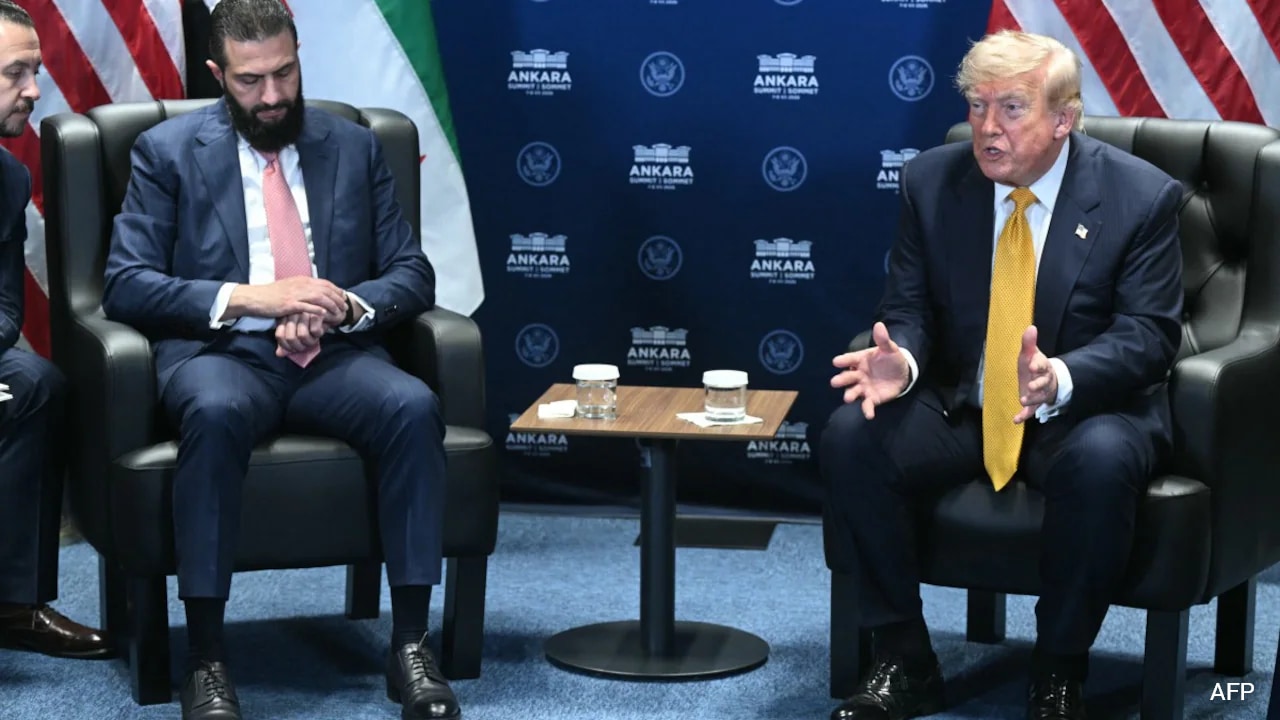
The United States is preparing to remove Syria from its state sponsors of terrorism list. This diplomatic gamble aims to cement ties with the new transitional administration led by Mohammed Ahmed al-Sharaa following the collapse of the Assad regime. By lifting the designation, Washington intends to unlock international aid, clear a path for reconstruction funds, and prevent a collapsed state from becoming an uncontrolled vacuum for extremist groups. However, rushing to clear Damascus ignores deep-seated institutional risks. The move threatens to reward unvetted actors within the new government while stripping the West of its most potent leverage before real political reforms take root.
The State Department’s logic follows a familiar, high-stakes playbook. When a hostile regime falls, the immediate priority shifts from punishment to stabilization. Bureaucrats in Washington argue that keeping Syria on the terrorism blacklist prevents global banks from processing humanitarian transactions, stalls essential infrastructure repairs, and pushes the fragile transitional government into the orbits of rival regional powers. Al-Sharaa, positioning himself as a pragmatic technocrat capable of uniting fractured factions, has made the removal a core demand. He argues his administration cannot secure the country or disarm remnants of hardline militias without immediate economic relief.
This argument oversimplifies a messy reality. The terrorism designation is not merely a political label that can be turned off without consequences. It is tied to a complex web of legal sanctions, asset freezes, and export controls built over decades.
The Illusion of a Clean Slate
Lifting the designation will not magically transform Syria into a safe bet for international capital. Global compliance officers do not just look at government blacklists; they assess on-the-ground reality.
Syria’s financial infrastructure is non-existent. The banking sector remains compromised by years of illicit financing, black-market networks, and weak regulatory oversight. Removing the state sponsor of terrorism label does not erase the fact that various armed factions, many with deep historical ties to designated terrorist organizations, still control local economies, transit routes, and key bureaucratic offices. Western banks will remain highly hesitant to facilitate trade with Damascus, fearing residual sanctions or future legal liability if funds accidentally end up in the hands of rogue commanders.
Washington risks giving away its leverage too early. In diplomatic negotiations, the threat of maintaining sanctions is often more powerful than the act of removing them. By signaling a rapid delisting to boost al-Sharaa, the U.S. abdicates its ability to demand verifiable progress on critical fronts. These include the verifiable dismantling of extremist networks, the protection of ethnic and religious minorities, and the creation of an inclusive, transparent political process. Once the designation is removed, restoring it requires a lengthy, politically difficult bureaucratic process. This leaves the U.S. with few options if al-Sharaa fails to deliver on his promises.
Fractured Factions and the Security Vacuum
The transitional government’s control over Syrian territory is largely theoretical. The capital may be under al-Sharaa’s nominal authority, but the rest of the country remains a patchwork of competing fiefdoms.
In the north, Turkish-backed groups, remnants of hardline Islamist coalitions, and Kurdish-led forces hold distinct zones of control. In the east, remnants of Islamic State cells operate in the desert, waiting to exploit any weakness in the central government. Al-Sharaa’s administration is a fragile coalition held together by shared opposition to the old regime and a desperate need for external funding. Pouring money into this environment without strict conditional oversight is dangerous. It will likely fuel corruption and empower local warlords who command the security forces al-Sharaa relies on to maintain order.
Syrian Factional Dynamics and Risk Areas:
┌───────────────────────────────┐
│  Al-Sharaa Administration     │ ──► Nominally controls Damascus; lacks institutional reach
└───────────────┬───────────────┘
                │
                ▼
┌───────────────────────────────┐
│   Regional Security Gaps      │ ──► North: Turkish-backed groups & Kurdish forces
└───────────────┬───────────────┘ ──► East: Dormant ISIS cells awaiting resurgence
                │
                ▼
┌───────────────────────────────┐
│    Financial Vector Risks     │ ──► Diversion of international aid to local warlords
└───────────────────────────────┘
The administration’s internal security apparatus remains a major concern. Many commanders now integrated into the transitional forces spent years operating in a gray zone, collaborating with or fighting alongside groups blacklisted by the West. Disentangling these individuals from the state structure is an almost impossible task for a weak transitional premier. If Washington proceeds with delisting, it will effectively validate a security apparatus that has not undergone vetting, disarmament, or demobilization.
The Regional Scramble for Influence
Syria does not exist in a vacuum, and the decision to normalize relations with Damascus will trigger immediate reactions from regional powers.
Iran and Russia, the primary architects of the old regime's survival strategy, are fighting to protect their remaining assets and intelligence networks. They view al-Sharaa’s overtures to the West with suspicion but are fully prepared to exploit any influx of international aid. If U.S. sanctions drop, Iranian-linked business fronts and Russian state-backed companies currently operating under pseudonyms will attempt to secure lucrative reconstruction contracts. Washington’s desire to stabilize Syria could accidentally fund the very adversarial networks it has spent years trying to isolate.
Concurrently, Gulf Arab states are watching the situation closely. Countries like Saudi Arabia and the United Arab Emirates view a stabilized, Western-aligned Damascus as a way to curb Iranian influence in the Levant. They are ready to inject billions of dollars into Syrian infrastructure, but they require the political cover that only a U.S. delisting can provide. This creates a distinct policy split. While Gulf capitals prioritize rapid stabilization and business opportunities, Western capitals must weigh the ethical and security implications of embracing a government that has yet to prove its commitment to human rights or democratic norms.
The Compliance Nightmare for Global Trade
For corporate compliance officers and international logistics firms, a sudden shift in U.S. policy creates significant operational confusion rather than clarity.
The U.S. government maintains multiple, overlapping sanctions regimes against Syria. Beyond the state sponsor of terrorism designation, there are secondary sanctions under legislation like the Caesar Act, which targets anyone providing support to the Syrian government or participating in specific economic sectors regardless of nationality. Simply removing the terrorism label does not automatically suspend these statutory sanctions. Companies attempting to ship construction materials, medical equipment, or telecom infrastructure to Damascus will still face a maze of regulatory hurdles.
The risk of over-compliance will continue to paralyze legitimate trade. Major shipping lines and insurance syndicates routinely refuse to service destinations associated with high geopolitical risk, even when specific exemptions exist. To make delisting effective, the U.S. Treasury Department would need to issue broad, explicit general licenses and actively reassure global markets. Doing so for an unproven, volatile administration in Damascus would be a significant political liability for Washington, especially if U.S.-sourced goods are later discovered in the hands of hostile militias.
A History of Premature Normalization
History shows that rushing to delist state sponsors of terrorism rarely produces the desired results without strict, phased conditionality.
Consider the case of Sudan. Washington removed Khartoum from the terrorism blacklist in 2020 after a civilian-led transitional government replaced long-time dictator Omar al-Bashir. The goal was identical to the current strategy in Syria: stabilize the economy, support democratic reformers, and integrate the country into the international community. Yet, the underlying security dynamics remained unaddressed. The military and paramilitary factions retained their economic monopolies and weapons. Within a year, a military coup shattered the democratic transition, and by 2023, the country collapsed into a brutal civil war.
Syria faces an even more precarious situation. Sudan possessed a unified, if corrupt, military structure; Syria is a patchwork of unaccountable armed groups. If the U.S. removes the terrorism designation based on al-Sharaa's promises rather than verified structural reforms, it risks repeating the Sudan mistake on a grander, more volatile scale. The transitional government will pocket the political legitimacy and financial access, while the underlying drivers of conflict, extremism, and instability remain completely untouched.
A prudent approach requires a phased strategy. Instead of a full, immediate removal from the blacklist, Washington should utilize targeted, time-bound waivers. These waivers could unlock specific tranches of humanitarian and reconstruction aid for clearly defined projects, such as restoring water treatment plants or rebuilding civilian hospitals, while keeping the broader designation in place. Each step of relief must be directly tied to verifiable benchmarks: the removal of compromised commanders from the security forces, cooperation with international counter-terrorism initiatives, and transparent auditing of state funds.
The al-Sharaa administration represents a critical pivot point for Syria, but eagerness to secure a diplomatic victory must not override strategic caution. Stabilizing a broken country requires a clear-eyed assessment of its institutional flaws, not a hasty policy shift that ignores the entrenched interests waiting to exploit Western aid.