Every time Washington rolls out a sweeping sanctions package against Moscow, the punditry class treats it like a digital thunderbolt from Zeus. They pull up maps of global trade routes, project stern graphics onto television screens, and talk about choking off financial lifelines as if sovereign nations can be unplugged from the global grid like a malfunctioning server.
It is theater. Expensive, destructive, and profoundly stupid theater.
I have spent years watching corporate compliance desks scramble to interpret these legislative missives, rewriting billion-dollar supply chains overnight because some career bureaucrat drafted a vague prohibition on secondary transactions. Companies blow millions scrambling to audit their ledgers, foreign policy wonks pop champagne over bipartisan vote tallies, and the actual target simply shrugs, reroutes oil through third-party tankers, and accelerates structural decoupling from Western financial plumbing.
Let us dismantle the lazy consensus. The premise behind every new Russia sanctions bill is that economic isolation works like a physical siege—starve the castle of resources and the gates will open. That metaphor belongs in the twelfth century. In a multi-polar, digitized global market, trying to quarantine a commodity superpower is like trying to hold water in a sieve. You do not stop the flow; you just make everyone else pay a wet tax while the target finds a new pipe.
To understand why these legislative packages fail to achieve their stated objectives, we have to look past the political posturing and examine the cold, unvarnished mechanics of international trade.
The Autarky Accelerator
When lawmakers pass restrictions designed to cripple an adversary's industrial base, they assume the target nation will sit quietly and accept economic starvation. History shows the exact opposite occurs.
External trade pressure acts as a state-mandated catalyst for import substitution. When foreign suppliers are banned from selling technology, machinery, or refined goods to Russia, local conglomerates are handed an immediate, state-subsidized monopoly over their domestic market. Suddenly, foreign brands that spent decades building brand equity are replaced overnight by domestic equivalents. Profit margins that once flowed to Western firms are redirected straight into domestic industrial expansion.
Consider the energy sector. Decades ago, Russian oil extraction relied heavily on specialized Western oilfield services, high-end drill bits, and proprietary software. When the first heavy waves of restrictions hit, panic ensued in Moscow boardrooms. But necessity breeds adaptation. Domestic engineering firms stepped into the void, Asian alternatives filled the gaps in software and components, and within a few short years, the technical dependence that Washington assumed was permanent had been engineered away.
By attempting to starve the machine, policymakers forced that machine to build its own domestic foundries. You do not weaken an adversary by cutting off their cheap imports; you force them to learn how to manufacture everything themselves. That is not deterrence. That is industrial policy on steroids, funded entirely by your enemy's paranoia.
The De-Dollarization Boomerang
The single greatest asset of American imperial power has never been its aircraft carriers or its nuclear stockpiles. It is the greenback. The global financial system runs on the US dollar because international trade, central bank reserves, and commodity pricing rely on the clearinghouse infrastructure centered in New York.
Every time Washington weaponizes this plumbing by freezing central bank assets, cutting banks off from the SWIFT messaging network, or threatening secondary penalties against foreign financial institutions that touch Russian transactions, it sends a terrifying signal to every other non-aligned capital city on earth.
If New York can freeze a sovereign nation's reserves on a Tuesday, what stops them from doing it to Beijing, New Delhi, Brasilia, or Riyadh on a Thursday?
The answer is nothing. And foreign leaders are not stupid.
The immediate reaction to these sweeping legislative measures has been a quiet, relentless flight away from dollar-denominated settlement systems. Bilateral trade between major economies is increasingly conducted in local currencies—yuan, rubles, dirhams, rupees. Central banks from developing nations have been stacking physical gold at record-shattering volumes, bypassing Western custodial vaults entirely.
Mainstream analysts call this a gradual shift. They are blind. It is a tectonic fracture. By overusing the financial sanction as a blunt instrument of coercion, Washington is actively eroding the foundational monopoly of the US dollar. You cannot weaponize the global currency without destroying the trust that makes it global in the first place. You are burning down the house to smoke out one rat.
The Compliance Industrial Complex
Let us talk about who actually pays the price for these bills. It is not Vladimir Putin. It is not the inner circle of oligarchs who figured out offshore shell structures twenty years ago.
It is the mid-sized logistics firm in Rotterdam, the regional bank in Frankfurt, and the compliance officer in Chicago working sixty-hour weeks trying to decipher whether a minor shipping component contains ten percent Russian-origin steel.
The compliance burden imposed by these endless legislative packages has created a massive, parasitic bureaucracy. Entire legal teams exist solely to parse ambiguous statutory language, issuing compliance certificates that cost millions of dollars while achieving zero net security benefit. This is economic drag. It imposes an asymmetric tax on Western businesses while authoritarian entities operate entirely outside the regulatory perimeter.
Western firms operate in the light, burdened by draconian reporting rules, asset freezes, and the constant fear of catastrophic Department of Justice fines. Meanwhile, shadow fleets of aging tankers turn off their transponders in the Baltic Sea, moving crude oil to Asian refiners who buy it at a steep discount, refine it into diesel, and sell it back to Europe at a markup.
The system punishes the rule-follower and rewards the smuggler. If your regulatory framework creates an unassailable business model for black-market intermediaries, your policy is not working. It is simply outsourcing trade to criminals.
The Myth of Compliance Enforcement
Politicians love signing ceremonies because ink on paper is cheap, and the political optics of looking tough on foreign adversaries play well on evening news broadcasts. But writing a law and enforcing it across five continents are two entirely different universes.
American regulators can jurisdictionally bully Western banks because those institutions need access to the US clearing system. But try telling a state-owned refinery in a non-aligned nation that they cannot buy discounted crude. They will laugh you out of the room. They have their own currencies, their own insurance syndicates, and their own domestic priorities.
When Congress passes a bill mandating secondary sanctions on anyone trading with Russian entities, they assume foreign governments will capitulate out of fear. Instead, those governments view it as an intolerable infringement on their national sovereignty. Rather than falling in line, they band together to build alternative financial rails. The BRICS bloc expansion was not driven by sudden ideological alignment; it was accelerated directly by the realization that Washington could turn off the financial oxygen supply at a whim.
Every new restriction acts as an explicit invitation for the rest of the world to insulate itself against American financial hegemony. You cannot compel global compliance through intimidation when the targets have spent the last decade building exit doors.
The Real Agenda
Why do these bills keep passing with near-unanimous bipartisan margins if they are so clearly counterproductive?
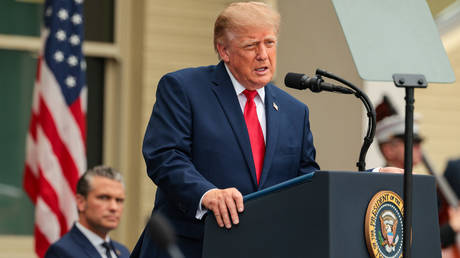
Because inside the Beltway, sanctions are a substitute for strategy. Real foreign policy is hard, messy, and requires diplomatic compromise, covert operational grit, and a realistic assessment of limits. Passing a sanctions bill requires none of those things. It requires a press release, a grandstanding speech on the Senate floor, and a ceremonial pen stroke in the Oval Office.
It allows politicians to signal moral purity and decisive action while avoiding the messy reality of actual geopolitical outcomes. It is political virtue signaling codified into federal statute.
The results are locked in. Moscow has reorganized its economy around wartime resilience, redirected its resource exports eastward, and insulated its financial architecture from Western interference. The US dollar has lost a fraction of its inviolable status with every passing month. Global commerce is fracturing into regional blocs that do not answer to Washington.
You can sign all the punitive bills you want. You can hold as many photo ops as your press secretary can schedule. But reality does not care about your statutory definitions or your bipartisan vote counts. When you mistake bureaucratic paperwork for actual power, you do not isolate your adversary. You isolate yourself.


