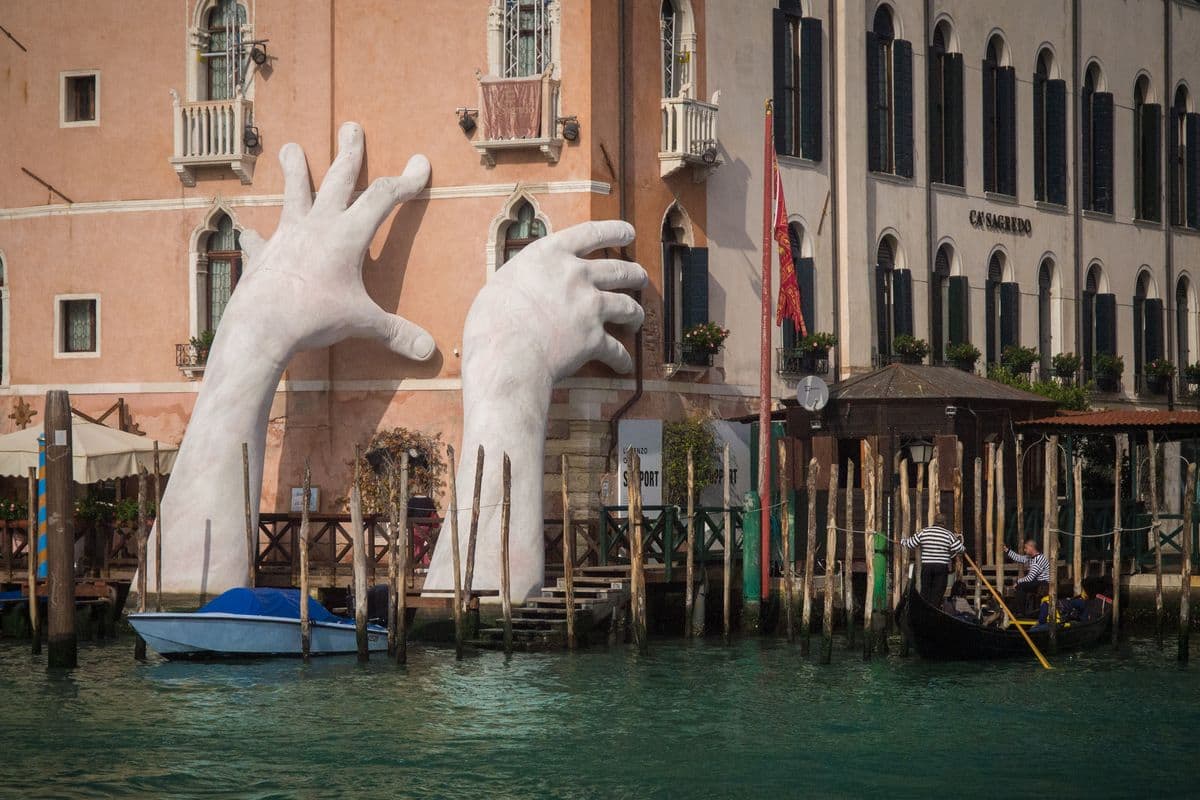
The Venice Biennale is currently a graveyard of good intentions. If you walk through the Arsenale or the Giardini this season, you’ll find yourself submerged in "immersive" blue light, surrounded by high-definition projections of coral reefs, and serenaded by the haunting songs of humpback whales. The critics call it "transformative." The curators call it "urgent."
I call it a vanity project for the carbon-heavy elite.
We’ve reached a point where the art world’s obsession with the ocean has become a substitute for actually saving it. These exhibitions don't spark revolution; they offer an aesthetic sedative. They allow wealthy patrons to sip prosecco while staring at a digital representation of an ecosystem that their private jet flight to Marco Polo Airport helped destroy.
The Myth of Awareness as Action
The fundamental flaw in these "ocean-inspired" spectacles is the belief that awareness is the bottleneck of conservation. It isn't. According to the Pew Research Center, public concern about environmental issues has never been higher. People know the oceans are in trouble. They know about the Great Pacific Garbage Patch. They know about acidification.
The problem isn't a lack of images. The problem is a lack of infrastructure, policy, and systemic accountability.
When an artist spends $500,000 on a massive installation involving non-recyclable resins and thousands of kilowatt-hours to power a VR "underwater experience," they aren't helping the sea. They are creating a luxury product. I have seen galleries spend more on the shipping crates for "eco-conscious" sculptures than they donated to actual marine biology research. It is a closed loop of self-congratulation.
Digital Corals and Real Death
Many of these exhibitions lean heavily on technology to "connect" us to the deep. You put on a headset and swim with a Great White. You walk through a room where motion sensors make digital schools of fish scatter.
This is the gamification of extinction.
By turning the ocean into a curated, digital playground, we strip it of its raw, terrifying, and indifferent reality. The ocean isn't a "tapestry" (a word art critics love to overuse); it is a high-pressure, low-oxygen biological machine. When we sanitize it for an air-conditioned gallery in Venice, we make it something cute. Something we own.
True conservation requires us to respect the ocean’s otherness. It requires us to stop looking at it as a backdrop for our selfies.
The Carbon Cost of "Green" Art
Let’s talk about the math that curators hope you ignore. A major international exhibition in Venice involves:
- Transcontinental Shipping: Tons of art moved via cargo ships or planes.
- Construction Waste: Custom-built walls and plinths that go straight to a landfill after six months.
- Tourism Impact: 20 million visitors a year descending on a city that is literally sinking under the weight of its own fame.
If these exhibitions were truly about the ocean, they wouldn’t be in Venice. They would be a series of localized, low-impact interventions. But a low-impact intervention doesn't get you a write-up in Vogue.
The Pivot From Aesthetics to Accountability
The "lazy consensus" says that art changes hearts, and hearts change laws. In reality, laws change behavior, and behavior changes the world.
If we want to use the Venice platform for the ocean, we need to stop making pretty things. We need to start making uncomfortable things. Imagine a scenario where, instead of a beautiful light show, an artist published the real-time GPS coordinates of illegal fishing trawlers owned by the exhibition’s corporate sponsors. Imagine if the "immersive experience" was simply a dark room filled with the actual stench of a dying mangrove forest.
That wouldn’t be popular. It wouldn't be "Instagrammable." But it would be honest.
Stop Asking "How Does This Make Me Feel?"
The "People Also Ask" section of the internet is filled with queries like "How can art help the environment?" and "What is the best ocean exhibition in Venice?"
You’re asking the wrong questions.
You should be asking: "How much did this cost to produce, and what is the ROI for the actual biosphere?" or "Does this artist have a history of environmental advocacy, or are they just using the 'blue' aesthetic to sell paintings to hedge fund managers?"
Most "ocean art" is just blue-washing. It uses the visual language of nature to mask the consumerist heart of the art market.
The Art World's Obsession with the "Sublime"
Since the 18th century, we’ve been obsessed with the "sublime"—the idea that nature is so big and scary that it’s beautiful. Modern ocean exhibits are just the latest version of this. They frame the ocean as a tragic victim or a vast mystery.
Both perspectives are useless.
The ocean is a resource that is being over-extracted. It is a heat sink that is reaching its limit. It doesn't need our wonder; it needs our restraint. I’ve spent twenty years in the rooms where these deals happen. I’ve watched collectors buy a $2 million "sea-themed" installation and then vote against a local plastic ban because it would affect their manufacturing margins.
The art is a guilt-mitigation strategy.
Direct Action Over Digital Simulation
If you are in Venice and you want to support the ocean, leave the gallery.
Go talk to the local fishermen who are dealing with the loss of biodiversity in the lagoon. Support the engineers working on the MOSE barriers. Or better yet, stop traveling across the globe to look at things you could learn about from a scientific paper.
The most "radical" thing an artist could do for the ocean right now is to refuse to exhibit. To say, "This topic is too important to be turned into a spectacle for tourists."
But that would mean giving up the spotlight. And in the art world, the spotlight is the only thing more valuable than the truth.
Stop looking for the "ocean" in a dark room in Italy. If you want to see the sea, go to the coast. If you want to save it, stop buying the ticket. Every dollar spent on the "experience" of nature is a dollar stolen from the protection of the real thing.
The exhibition isn't an invitation to act. It's a permit to forget.
Burn the blue lights. Shut down the projectors. Go home and lobby your local representatives for marine protected areas. The fish don't care about your aesthetic epiphany.