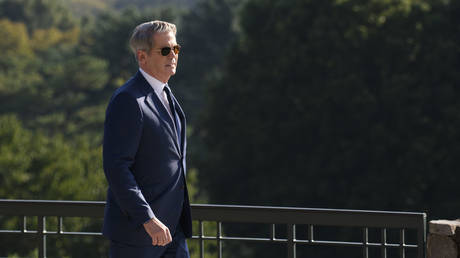
In November 2026, U.S. Treasury Secretary Scott Bessent abandoned his private Washington-area residence and moved onto an undisclosed military installation after intelligence officials flagged credible Iranian assassination threats against him. Surface-level reports frame the relocation as a defensive retreat, a sign that the chief architect of American economic policy is hiding behind perimeter fences. That reading misses the mechanics of modern statecraft. Bessent is not on a military base because Washington is backing down; he is there because the Treasury Department has effectively replaced the aircraft carrier as the primary frontline weapon in the U.S.-Iran conflict, turning a former hedge fund manager into a high-value military target.
For decades, the division of labor in Washington was straightforward. The Pentagon handled kinetic warfare, the State Department managed diplomacy, and the Treasury Department acted as the nation's accountant and debt manager. That boundary dissolved long ago, and by late 2026, it ceased to exist entirely. When a cabinet official whose traditional job involves bond auctions and tax policy requires the same physical force protection as a four-star general in a combat zone, the nature of warfare itself has shifted. You might also find this similar coverage interesting: Why a London Court Just Overturned Trinidad and Tobago’s Anti-Gay Law.
The Architecture of Operation Economic Outcast
To understand why Tehran would put a target on the back of a finance chief, you have to look at the campaign Bessent launched on August 24, 2026. Dubbed Economic D-Day by officials in Washington, Operation Economic Outcast was designed to sever every remaining financial and maritime artery keeping the Islamic Republic solvent.
Traditional sanctions operate like a slow leak. They raise transaction costs, force adversaries onto secondary markets, and gradually erode gross domestic product over years. Operation Economic Outcast was built to act like a tourniquet. Rather than simply blacklisting state-owned banks or issuing symbolic travel bans, the Treasury Department combined aggressive secondary financial penalties with physical naval interdiction. As discussed in latest coverage by NBC News, the results are significant.
By November 2026, two and a half months into the campaign, Bessent claimed that Iranian crude exports had effectively hit zero, stating in televised interviews that Tehran had "no oil in the water" for the first time since the country began commercial production. Whether every barrel of illicit dark-fleet crude was truly halted or merely driven deeper into untraceable overland smuggling routes, the financial shock was immediate. The Treasury followed up in late November with sweeping actions targeting Iran's global shadow banking networks and regime insiders profiting from the energy sector.
Weaponizing the Dollar Clearing System
The mechanics behind this squeeze rely on an asymmetry that Iran cannot match symmetrically. Every major international transaction cleared in U.S. dollars must eventually pass through correspondent banks subject to American jurisdiction. By threatening non-U.S. financial institutions, shipping insurers, and port operators with immediate cutoff from the dollar system, the Treasury Department turned global compliance officers into unpaid enforcement agents.
In previous years, Tehran relied on a complex web of front companies in the Persian Gulf, East Asia, and Europe to launder oil revenues back into hard currency. Operation Economic Outcast shifted the burden of proof. Instead of Washington having to prove a shell company was controlled by the Islamic Revolutionary Guard Corps, foreign banks were forced to prove it was not—or risk losing access to New York clearinghouses overnight.
When a country's central bank is starved of foreign exchange, the domestic consequences cascade rapidly. Currency depreciation accelerates, import costs for basic foodstuffs and industrial components spike, and the state's ability to subsidize loyalist factions—including security forces—begins to fray.
Asymmetric Retaliation on American Soil
Iranian military doctrine has long accounted for conventional inferiority. Following joint U.S. and Israeli strikes against Iranian targets earlier in 2026, and amid ongoing leadership turmoil in Tehran following the assassination of Ayatollah Ali Khamenei, the regime's capacity for direct, large-scale conventional retaliation has been severely degraded.
When an adversary cannot sink an American destroyer or shoot down a stealth bomber, it looks for softer, high-impact targets. Senior civilian policymakers fit that profile.
Bessent is hardly the first U.S. official to face this reality. Throughout the 2020s, federal law enforcement and intelligence agencies disrupted multiple Iranian-backed plots targeting former Trump administration officials, including former Secretary of State Mike Pompeo and former National Security Advisor John Bolton, in retaliation for the 2020 strike on Qasem Soleimani. What makes the 2026 threat environment distinct is the scope and immediacy of the targeting. Bessent joined several other sitting Cabinet officials—including Defense Secretary Pete Hegseth—in relocating to secure military housing.
"If the Iranians are after me, it means that they are being squeezed. We're going to continue squeezing them." — U.S. Treasury Secretary Scott Bessent, November 2026
Tehran's official diplomatic channels have routinely denied plotting assassinations on U.S. soil. Intelligence assessments tell a different story, pointing to the use of criminal proxies, hired hitmen, and transnational organized crime networks to maintain plausible deniability while projecting lethal reach inside the United States.
The Vulnerability of Civilian Infrastructure
The security apparatus surrounding a Treasury Secretary was never designed for wartime counter-insurgency. While the United States Secret Service provides executive protection for the Treasury chief—a historical quirk dating back to the agency's founding in 1865 to combat counterfeit currency—protecting a private residence in a residential Washington neighborhood presents acute tactical vulnerabilities.
Civilian neighborhoods feature public roads, commercial delivery traffic, neighboring properties, and civilian sightlines that cannot be locked down without turning an entire zip code into a militarized zone. In November 2026, Bessent publicly criticized media reports that had exposed details about the location of his private home, arguing that the coverage compromised operational security.
Moving onto a military base solves the perimeter problem overnight. Military installations offer layered physical security, controlled airspace, vetted personnel, and rapid-reaction forces already on site. For the Secret Service and the Pentagon, relocating high-risk principals behind the wire is a rational risk-management decision, not a panic response.
The Cost of Permanent Bunker Governance
Yet the normalization of Cabinet officials living on military bases carries profound institutional consequences that extend far beyond one man's commute. Democracies rely on a visible separation between civilian governance and the military establishment. That separation is not merely aesthetic; it shapes how leaders perceive risk, interact with the public, and exercise power.
When the nation's top economic official wakes up inside a military garrison, travels in an armored motorcade to a hardened federal building, and returns behind armed checkpoints at night, the friction between civilian life and national security disappears. The psychological insulation is total.
Consider the practical realities of governing from a base:
- Erosion of public accessibility: Cabinet secretaries historically participated in routine civic life—dining in local restaurants, attending unscripted public events, and interacting with citizens outside controlled environments. Force protection protocols eliminate those organic touchpoints.
- Escalation of taxpayer security costs: Maintaining round-the-clock tactical security, secure communications infrastructure, and family relocation logistics across multiple Cabinet households diverts millions of dollars and hundreds of specialized personnel from other protective missions.
- Blurring of civilian-military boundaries: Housing the Treasury Secretary alongside military commanders reinforces a wartime mindset across purely economic agencies, making de-escalation politically and psychologically harder to navigate.
Bessent has framed the bounty on his head as a badge of honor, a metric proving that his financial blockade is inflicting maximum pain on Tehran. In the short term, that logic holds. A sanction regime that provokes an assassination plot is clearly hitting sensitive nerves inside the target government.
The Strategic Blind Spot in Maximum Financial Pressure
There is, however, a critical flaw in treating economic warfare as a bloodless substitute for kinetic conflict, or assuming that cornered regimes inevitably capitulate. History offers uncomfortable counter-examples.
In 1941, the United States froze Japanese assets and imposed a total oil embargo, cutting off roughly eighty percent of Japan's petroleum supply. Washington's architects believed the economic chokehold would force Tokyo to negotiate and withdraw from China. Instead, facing total economic suffocation within months, Japan's military leadership concluded that a desperate strike at Pearl Harbor was preferable to slow national strangulation.
Modern Iran is not Imperial Japan, and its conventional military power is a fraction of what Tokyo wielded in the Pacific. Still, the underlying behavioral dynamic remains valid. When a regime's leadership views compliance with American demands as synonymous with political suicide, total economic isolation does not automatically produce moderation. It can accelerate reckless, asymmetric escalation—such as fresh strikes in the Strait of Hormuz, attacks on regional energy infrastructure, or covert operations abroad.
By late November 2026, even voices within the administration and the Pentagon were reportedly warning that pushing Tehran into an existential corner could cause surviving Iranian hardliners to dig in rather than sue for peace. Financial sanctions can bankrupt a treasury, collapse a currency, and dismantle shadow banking networks. What they cannot do on their own is dictate how an adversary chooses to react when it has nothing left to lose.
What the Media Narrative Gets Wrong
Coverage that mocks or sensationalizes a Treasury Secretary "hiding" on a military base reduces a structural shift in global power to tabloid theater. Bessent is continuing to run the Treasury Department, conducting media appearances, and rolling out new tranches of sanctions from behind military gates. His physical relocation has not slowed the pace of American financial warfare by a single day.
The real story is what this arrangement reveals about the future of international conflict. The United States has perfected a form of financial siege warfare capable of paralyzing a major oil-producing nation without landing a single division on its shores. In response, targeted states have concluded that the bureaucrats wielding spreadsheets and sanctions lists are legitimate combatants.
As long as the U.S. dollar remains the primary weapon of American foreign policy, the officials who control its levers will live under the same threat matrix as battlefield commanders. The fence around Scott Bessent's temporary home is not a symbol of weakness; it is the new perimeter of the American financial empire, and it is unlikely to come down anytime soon.


