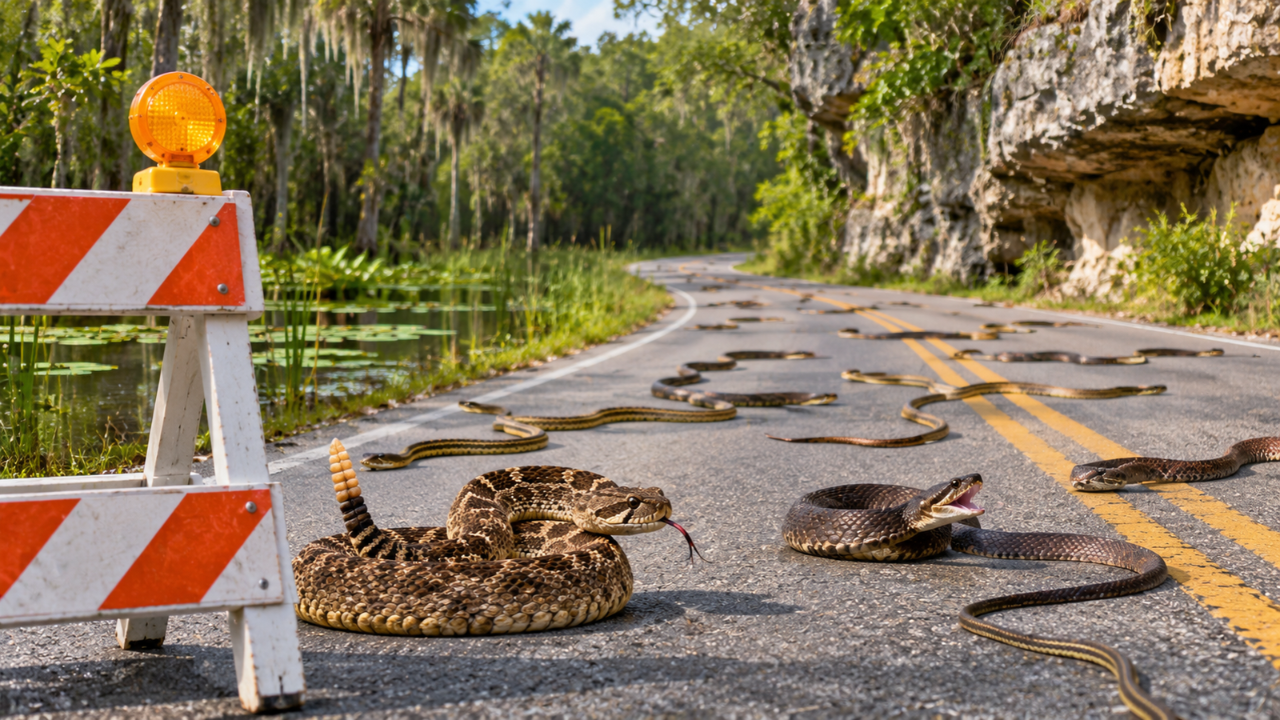
Twice a year, federal land managers lock the gates on a roughly four-kilometer stretch of Forest Service Road 345 in southern Illinois, banning all motorized vehicles for weeks at a time. Known locally as Snake Road, this gravel corridor inside the Shawnee National Forest closes every spring and fall to protect thousands of snakes, amphibians, and reptiles migrating between limestone bluffs and swamp habitats. Without the closure, vehicle traffic would crush slow-moving timber rattlesnakes, cottonmouths, and copperheads as they cross the gravel to reach their seasonal dens and feeding grounds.
Most viral news coverage treats this biannual road closure as a quirky wildlife curiosity. A nice story about forest rangers putting up metal gates for reptiles. That framing misses the real story entirely. The closure of LaRue-Pine Hills Road is not an act of sentimental conservation; it is a calculated biological intervention designed to prevent the localized collapse of apex and mid-level predators in a fragmented ecosystem.
The Geography of a Bottleneck
To understand why a single gravel road demands a total traffic ban, you have to look at the topography of the LaRue-Pine Hills Research Natural Area. On one side of the road rise towering, fractured limestone bluffs. These rock formations are riddled with deep crevices and fissures that drop below the frost line. For cold-blooded reptiles in the Midwest, those crevices are the only thing standing between survival and freezing to death during winter.
On the other side of the road lies the LaRue Swamp, a sprawling wetland fed by springs at the base of the bluffs. In the warmer months, the swamp is an ecological buffet. It teems with frogs, fish, rodents, and birds.
For thousands of years, reptiles and amphibians made the short trek from the bluffs to the swamp in the spring, and back again in the autumn. Then humans built a road directly across the pinch point.
The distance between the bluff base and the water's edge is narrow. In many spots, the gravel roadbed takes up a massive percentage of the transitional zone. When the weather shifts, animals do not trickle across this corridor one by one. Temperature and barometric pressure triggers hit the entire population simultaneously. Suddenly, hundreds of ectotherms are moving across an exposed, flat surface at the exact same time.
Why Asphalt and Gravel Are Lethal to Reptiles
Mammals generally try to avoid oncoming vehicles. Deer bolt, squirrels dart, and raccoons scramble toward the shoulder. Snakes do the exact opposite.
When a snake encounters a warm road surface, two biological instincts work against its survival. First, thermoregulation. Gravel and packed earth retain solar heat long after the air temperature drops in the autumn or before it warms up in the spring. A snake crossing the road feels that radiant warmth on its belly and stops. It stretches out to absorb the thermal energy, turning a quick crossing into a prolonged nap in the middle of a tire track.
Second, defensive freezing. When a multi-ton vehicle approaches, vibrations travel through the ground. A snake’s primary defense against a large, overwhelming threat is camouflage and stillness. Rather than fleeing, venomous species like the timber rattlesnake and northern cottonmouth will coil tightly and hold their ground, relying on their cryptic coloration to blend into the mottled gray and brown gravel.
A driver traveling at even thirty miles per hour has almost zero chance of spotting a coiled timber rattlesnake on a gravel road until it is too late. Even worse, because reptiles have slow metabolisms and low reproductive rates, losing a small percentage of breeding adults each year triggers a steep population decline. A female timber rattlesnake in the Midwest may take seven to ten years just to reach sexual maturity, and she might only reproduce once every three or four years. Kill ten mature females on a single autumn afternoon, and you have wiped out decades of reproductive output for that den.
The History of the Closure
The road was not always closed. Throughout the mid-twentieth century, LaRue-Pine Hills became famous among herpetologists, amateur snake hunters, and curious motorists. Word spread that you could drive down the gravel road in October and see dozens of venomous snakes sunning themselves in plain sight.
That fame nearly destroyed the ecosystem.
Traffic surged during peak migration weeks. Well-meaning sightseers ran over snakes they failed to see. Deliberate vandals swerved to hit venomous species out of fear or malice. Poachers used the easy vehicle access to scoop up rare reptiles for the illegal pet trade. By the late 1960s and early 1970s, biologists watching the area realized the slaughter was unsustainable.
In 1972, the U.S. Forest Service took the unprecedented step of instituting seasonal closures on the 2.5-mile (roughly four-kilometer) stretch of Forest Service Road 345. At the time, shutting down a public thoroughfare for snakes was controversial. Local drivers complained about the detour. Critics argued that wildlife should not take precedence over human convenience.
Decades later, the data has settled the argument. The LaRue-Pine Hills area boasts one of the highest concentrations of biodiversity in Illinois, supporting roughly 60 percent of the state's amphibian and reptile species within a single, compact ecosystem.
What Actually Moves Across the Road
While venomous snakes grab the headlines, they represent only a fraction of the biological traffic using the corridor. A comprehensive look at the migration reveals a complex, multi-species movement that sustains the entire regional food web.
- Venomous Snakes: Timber rattlesnakes, northern cottonmouths, and eastern copperheads are the highest-profile migrants. They use the deep limestone fissures as communal hibernacula, often sharing winter dens with non-venomous species.
- Non-Venomous Snakes: Black rat snakes, speckled kingsnakes, rough green snakes, ribbon snakes, and eastern hognose snakes all make the biannual trek. Many of these species actively hunt the rodents and smaller reptiles that congregate near the swamp edge.
- Amphibians: Bullfrogs, green frogs, leopard frogs, and various salamander species—including the cave salamander and marbled salamander—rely on the moisture of the swamp and the wooded bluff slopes.
- Turtles: Snapping turtles, painted turtles, and eastern box turtles cross the corridor to find suitable nesting soils or overwintering mud.
If you remove the snakes from this equation, the swamp does not become a safer, prettier place. It becomes imbalanced. Snakes are mid-level and apex predators. They keep rodent populations in check, which directly limits the spread of tick-borne illnesses like Lyme disease. They also cull sick and weak amphibians, preventing disease outbreaks within the wetland.
The Economics of Ecological Protection
Cynics often view conservation closures as pure financial drains on public agencies. Maintaining gates, printing signage, and patrolling a closed road costs money. Yet the economic reality of Snake Road tells a different story.
The biannual migration has turned a remote corner of southern Illinois into a global destination for ecotourism. During the spring closure (typically mid-March to mid-May) and the fall closure (typically September 1 through October 30), herpetologists, photographers, university researchers, and wildlife enthusiasts travel from across the United States and overseas to walk the closed gravel path.
Because motorized vehicles are banned, foot traffic is permitted. Visitors park outside the gates and walk the four kilometers on foot. Local hotels, restaurants, gas stations, and outfitters in nearby towns like Wolf Lake, Anna, and Murphysboro see a measurable spike in revenue during shoulder seasons that would otherwise be quiet.
Unlike off-road vehicle trails or timber harvesting, pedestrian wildlife viewing leaves virtually zero infrastructure damage. The Forest Service does not have to constantly regrade the gravel to fix ruts caused by heavy trucks during wet spring thaws. The roadbed lasts longer, maintenance costs drop, and the local economy captures tourist dollars without depleting the natural resource drawing people in.
The Dark Side of Viral Fame
The closure solved the problem of roadkill, but the internet has created a new set of threats. Social media posts, viral videos, and sensationalist news articles have exponentially increased foot traffic on Snake Road over the last decade.
More people walking the road means more pressure on the animals. While the vast majority of visitors respect the rules, a persistent minority causes real harm.
- Harassment for Photos: Visitors frequently step off the gravel road into the leaf litter to get closer shots of coiled rattlesnakes, causing the animals to expend critical energy rattling or fleeing when they need to conserve calories for winter.
- Illegal Handling: Despite strict federal regulations prohibiting the touching, harassing, or collecting of wildlife in the Research Natural Area, people still use snake hooks or sticks to manipulate animals for better camera angles.
- Poaching Pressure: High-resolution photos posted online with geotags act as a treasure map for illegal wildlife traffickers. Rare color morphs or healthy breeding adults are targeted by poachers who slip in after hours.
Forest Service law enforcement officers and volunteer stewards now spend much of their time during the closures managing human behavior rather than just locking gates. The road is safe from tires, but the animals are increasingly stressed by lenses.
Why Other Regions Fail to Replicate It
If closing a short stretch of road works so well in southern Illinois, why isn't it standard practice across North America? Every spring and autumn, millions of salamanders, frogs, turtles, and snakes are slaughtered on roads from Maine to California.
The answer comes down to jurisdiction and commuter dependency.
Forest Service Road 345 is a secondary gravel route inside a federally managed forest. Alternative paved routes exist nearby, meaning the detour adds only a few minutes to a local driver's commute. No school buses, freight trucks, or emergency services rely exclusively on that four-kilometer stretch to reach residential neighborhoods.
Compare that to a state highway cutting through a wetland in Florida or a county road bisecting a salamander breeding ground in New England. In those areas, shutting down the road for two months twice a year is politically and logistically impossible. Commuters will not accept a thirty-minute detour, and municipal governments will not absorb the liability or cost.
Instead, wildlife agencies in high-traffic areas have to rely on expensive engineering workarounds. Wildlife underpasses—concrete culverts buried beneath highways—paired with exclusionary drift fencing can guide reptiles under the traffic. However, a single underpass project can cost hundreds of thousands or even millions of dollars to install and requires constant maintenance to keep fencing clear of fallen branches.
Snake Road works because the infrastructure was minimal enough to simply turn off.
The Timing Problem in a Shifting Climate
The Forest Service sets fixed dates on the calendar for the road closures: March 15 to May 15 in the spring, and September 1 to October 30 in the fall. Historically, those windows captured the overwhelming majority of the migration.
Weather, however, does not read a calendar.
Unseasonably warm spells in late February can coax amphibians and early-moving snakes out of the bluffs weeks before the gates swing shut. Conversely, a prolonged, mild autumn can delay the return migration well into November. When a warm front hits in early November after the gates have reopened, late-migrating timber rattlesnakes suddenly find themselves crossing active gravel in front of pickup trucks.
Land managers face a bureaucratic dilemma. Extending closures dynamically based on real-time weather forecasts makes biological sense, but it creates confusion for the public and logistical headaches for agency staff who have to coordinate signage, press releases, and enforcement patrols. Fixed dates provide predictability for locals and tourists alike, even if they leave the earliest and latest migrants vulnerable to tires.
The Reality of Sharing Space With Venomous Wildlife
Public fear remains the biggest obstacle to reptile conservation worldwide. If the Forest Service closed a road to protect migrating bald eagles or elk, almost nobody would question the expenditure. Closing a road for timber rattlesnakes and cottonmouths triggers a visceral reaction from people conditioned to view venomous snakes as monsters.
Yet the safety record at LaRue-Pine Hills speaks for itself. Thousands of pedestrians—including families with children—walk directly past hundreds of venomous snakes every spring and fall. Bites are extraordinarily rare, and when they do occur, they almost always involve someone illegally picking up or provoking an animal.
Venomous snakes do not chase humans. They do not want to waste biologically expensive venom on a creature far too large to eat. Left alone on the gravel, a cottonmouth or rattlesnake will either sit motionless or slither quietly into the swamp grass.
The simple metal gates at either end of Forest Service Road 345 prove that coexistence does not always require complex technology or massive budgets. Sometimes, protecting a fragile, ancient biological rhythm just requires humans to take a different route for a few weeks and let the locals cross the street.