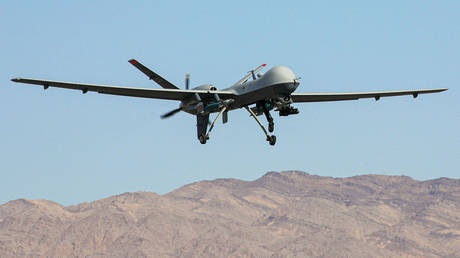
The United States military has lost roughly 20% of its operational MQ-9 Reaper drone fleet to Iranian forces and regional proxies, representing a devastating $1 billion hardware deficit that exposes the structural limits of America’s remote warfare strategy.
For the last two decades, Washington treated the uncrewed aircraft as the ultimate loophole in modern combat. It allowed commanders to project lethal force without the political baggage of body bags. But the recent conflict has shattered that comforting illusion. According to internal Pentagon data and recent congressional disclosures, between 24 and 30 Reapers have been permanently removed from the skies, shot down mid-flight by sophisticated Iranian surface-to-air missile networks or pulverized on the ground during ballistic missile strikes against regional staging bases.
The immediate financial toll of $1 billion is only a symptom of a much deeper, structural crisis. The real emergency lies in the defense industrial supply chain. The U.S. Air Force long ago stopped purchasing new MQ-9A units from the manufacturer, General Atomics, meaning these specialized, intelligence-gathering workhorses are effectively irreplaceable in the short term. The Pentagon is now staring down a strategic vacuum that cannot be filled by simply writing a larger check.
The Myth of the Expendable Machine
Military planners have spent years using the term attritable to describe uncrewed systems. The word is an intentional euphemism. It implies that an aircraft is inexpensive enough to be lost in combat without severely degrading national security capabilities.
The air war over the Persian Gulf has thoroughly debunked this concept. While a single MQ-9 Reaper carries a baseline price tag of roughly $16 million, the advanced electronic warfare suites, synthetic aperture radars, and precision-guided payloads often push the actual cost closer to $30 million per unit. Losing up to 30 of these high-end assets in a single theater does not represent acceptable attrition. It is a catastrophic depletion of a finite inventory.
+-------------------------------------------------------------+
|              MQ-9 REAPER ATTRITION SUMMARY                  |
+------------------------------------+------------------------+
| Estimated Pre-War Active Inventory | ~150 Operational Units |
+------------------------------------+------------------------+
| Confirmed/Suspected Losses         | 24 to 30 Units         |
+------------------------------------+------------------------+
| Estimated Fleet Percentage Lost    | ~20%                   |
+------------------------------------+------------------------+
| Total Replacement Cost Liability   | $1 Billion             |
+------------------------------------+------------------------+
The operational reality is that the Reaper is a propeller-driven, slow-moving platform with a massive 66-foot wingspan. It was originally engineered for permissive environments where the adversary possessed nothing more dangerous than a shoulder-fired missile or an aging anti-aircraft gun. Against a peer or near-peer competitor equipped with layered radar systems and integrated air defense networks, the Reaper becomes a large, glowing target on an adversary's radar screen.
The Production Line Paradox
The Air Force found itself trapped in a logistical corner because it anticipated a completely different kind of war. Years ago, the service shifted its long-term focus toward high-end stealth platforms designed to penetrate Chinese airspace in the Western Pacific. Believing the era of the slow surveillance drone was over, the Pentagon ended its domestic procurement pipeline for the MQ-9.
General Atomics kept its assembly lines running primarily to fulfill export orders for international partners. Now, faced with a sudden, massive deficit in the Middle East, U.S. officials are forced to ask Congress for emergency funding to scavenge remaining airframes and parts.
The alternative options are remarkably bleak. The jet-powered Avenger drone, frequently cited as a potential successor, exists in single-digit quantities within the current military inventory. The highly anticipated Collaborative Combat Aircraft programs—autonomous "loyal wingman" drones designed to fly alongside crewed stealth fighters—are still years away from reaching mass operational scale. The military is caught between a legacy platform that is too vulnerable to survive and a futuristic replacement fleet that does not yet exist.
The Invisible Ground Threat
Public attention naturally gravitates toward dramatic footage of missiles striking aircraft mid-flight. The reality of the recent losses is far more mundane, and far more concerning for the future of forward deployment.
A significant portion of the destroyed Reaper fleet never even made it into the air. Iranian ballistic and cruise missile strikes targeted the specific, well-mapped runways and hangar facilities where these drones are maintained, fueled, and launched. Uncrewed systems require a substantial physical footprint on the ground, including satellite communication terminals and heavy maintenance equipment. By targeting the fixed infrastructure of regional bases, adversaries have demonstrated they can neutralize American air power without ever firing an air-defense missile.
The Problem with Asymmetric Air Defense
The economics of the conflict are completely inverted. In traditional air defense logic, a military uses an expensive missile to protect an invaluable asset, such as a multi-million dollar command center or a crewed fighter jet. In this case, Iranian-aligned forces used relatively inexpensive, indigenous surface-to-air missile systems to consistently knock down platforms that cost the American taxpayer tens of millions of dollars each.
This structural vulnerability was not confined to Iranian airspace alone. Throughout the conflict, Houthi forces in Yemen successfully downed more than a dozen Reapers using modified, thermal-tracking anti-aircraft systems. The widespread availability of these weapon systems means that even non-state actors can now impose a prohibitive financial and material tax on American military operations.
The Unsung Workhorse
Despite the staggering losses, senior military leaders have fiercely defended the drone's record in recent congressional testimonies. Air Force Chief of Staff Gen. Kenneth Wilsbach went so far as to label the MQ-9 the "most valuable player" of the recent campaign.
The strategic justification for this praise reveals the agonizing math governing modern command decisions. During the peak of the air campaign, the Reaper fleet maintained continuous flight orbits over highly contested territory, logging thousands of hours of reconnaissance. They identified and instantly mapped thousands of dynamic targets, including mobile missile launchers, drone manufacturing sites, and hidden radar installations.
More importantly, they did so while keeping American pilots out of harm's way. When an F-15E Strike Eagle or an A-10 Thunderbolt II was lost during the conflict, it triggered a massive, high-risk combat search and rescue operation to recover the downed crew before they could be captured. When a Reaper went down, the crew simply stood up from their control consoles in Nevada, walked out of the ground station, and let a logistical team handle the paperwork.
The Real Cost of Distance Warfare
The Pentagon has spent decades selling the concept of clean, frictionless warfare conducted via satellite links from the comfort of domestic military installations. The smoking wreckage of 30 Reapers scattered across the deserts of the Middle East proves that projecting power from a distance still carries an astronomical price tag.
The U.S. military is now forced to fundamentally rethink how it conducts intelligence gathering in contested regions. If a nation can destroy a fifth of America's primary uncrewed fleet in a matter of weeks using a mix of home-grown missiles and targeted base bombardments, the foundational assumptions of American air superiority are no longer valid. The era of the slow, unarmored drone ruling the skies over asymmetric battlefields has officially come to an end, and the Pentagon is left holding a $1 billion bill for a fleet it cannot easily replace.