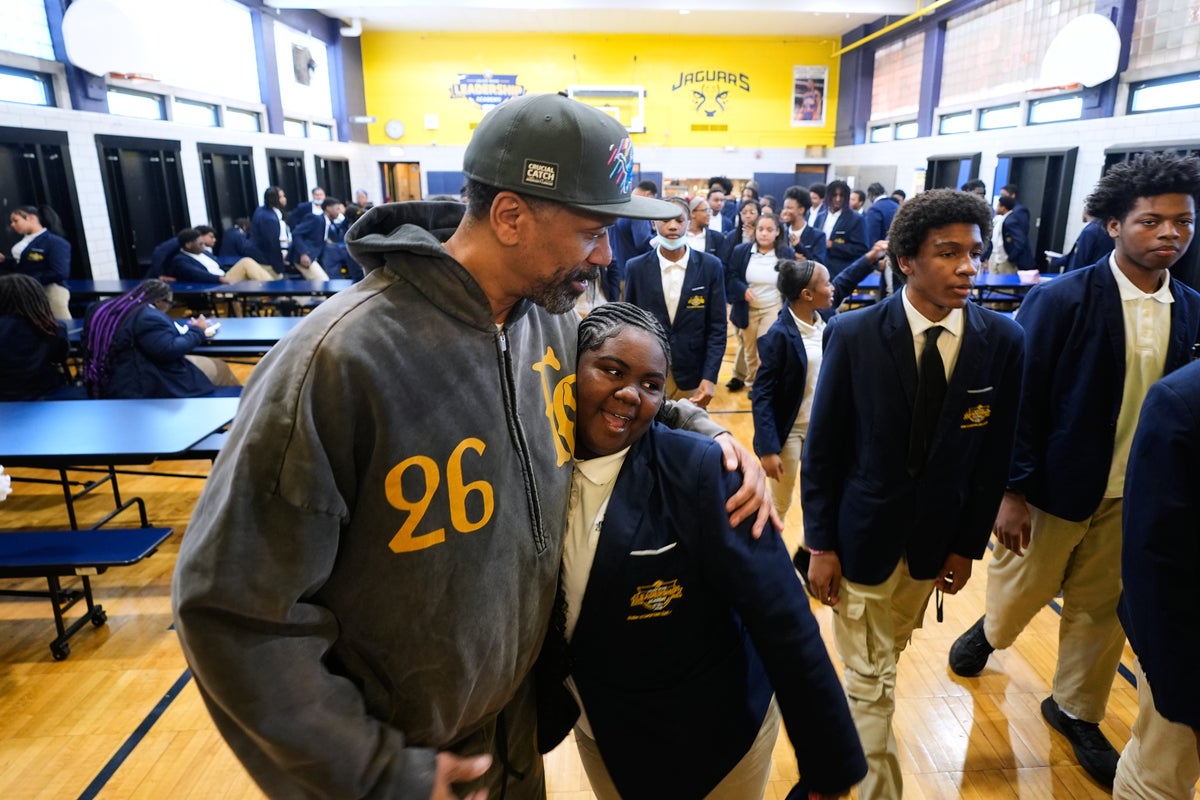
Jalen Rose is not a mascot. In the high-stakes world of urban charter schools, celebrity names usually function as branding exercises—slick logos plastered onto buildings to secure donor checks before the famous founder retreats to a beach in Malibu. But at the Jalen Rose Leadership Academy (JRLA) on the Northwest side of Detroit, the former NBA star and "Fab Five" icon is a constant, physical presence. He isn't just cutting ribbons; he is in the hallways, reviewing budgets, and grappling with the brutal reality of Michigan’s per-pupil funding gaps.
Thirteen years after opening its doors, JRLA has outlasted the typical lifecycle of celebrity-backed passion projects. It survived the initial skepticism of the Detroit educational establishment and the fiscal volatility that shuttered dozens of other charters in the city. The school remains open because Rose treated it less like a vanity project and more like a grueling, long-term turnaround play.
Building on the Northwest Side
The geography of JRLA matters. Located on the site of a former elementary school, the academy sits in a zip code where the promise of a college degree often feels like a statistical impossibility. When Rose founded the school in 2011, he didn't just want a graduation rate that looked good on a flyer. He wanted a "90-90-90" model: 90 percent graduation, 90 percent college enrollment, and 90 percent persistence.
The math of Detroit education is unforgiving. Michigan’s charter schools receive significantly less funding per student than traditional district schools for facilities and infrastructure. This creates a permanent deficit that the founder must bridge personally or through aggressive private fundraising. Rose has poured millions of his own capital into the operation, but money alone doesn't keep the lights on. It requires a relentless operational focus on the "wrap-around" services that many public schools ignore.
We are talking about a student body where the vast majority qualify for free or reduced lunch. In this environment, a school cannot just be a place of instruction. It has to be a social safety net. JRLA provides its students with business attire, intensive SAT prep, and a post-secondary success team that follows graduates for years after they leave the building. This isn't charity. It is a calculated attempt to break the cycle of poverty by treating education as an end-to-end pipeline rather than a four-year stopover.
The Myth of the Celebrity Savior
There is a graveyard of failed schools backed by athletes and entertainers. They fail because the founders underestimate the bureaucratic swamp of state mandates, specialized education requirements, and the sheer exhaustion of managing a revolving door of staff. Rose avoided this trap by acknowledging what he didn't know. He didn't try to be the principal; he became the chief fundraiser and the ultimate accountability officer.
His presence in the building serves a psychological purpose. When a kid from the neighborhood sees a man who reached the pinnacle of the NBA and broadcasting standing in their cafeteria, the "leadership" part of the school's name stops being an abstract noun. It becomes a tangible career path. However, Rose is the first to admit that his name only gets people through the door. Keeping them there requires a level of academic rigor that often clashes with the reality of students coming in several grade levels behind in reading and math.
The academy uses a longer school day and a longer school year. This is a grueling schedule for both students and teachers. It is a design choice aimed at "time on task," a recognition that to catch up, these students must outwork their suburban counterparts. It is an exhausting, unglamorous grind that rarely makes the highlight reels on ESPN.
The Financial Brinkmanship of Detroit Charters
To understand why JRLA is an anomaly, you have to look at the ledger. Most Detroit charters operate on razor-thin margins. If enrollment dips by fifty students, the budget collapses. Rose has utilized his media platform not just for self-promotion, but as a megaphone for the inequities in Michigan’s educational funding.
The Private Funding Gap
While traditional schools can pass bond initiatives to fix a leaking roof or build a new gym, JRLA has to fundraise for every brick. The school’s annual celebrity golf outing and various galas aren't just social events; they are essential capital campaigns.
| Funding Source | District Schools | JRLA (Charter) |
|---|---|---|
| State Per-Pupil Aid | Full Amount | Full Amount |
| Local Property Taxes | Access for Facilities | Zero Access |
| Federal Grants | Available | Available |
| Private Philanthropy | Optional | Mandatory for Survival |
This reliance on private money is the school’s greatest strength and its most glaring vulnerability. If Rose were to step away, the funding pipeline would likely constrict. This is the "founder's trap" that haunts many successful charters. The institution is often inseparable from the individual. To combat this, the academy has spent the last five years building a board and an administrative structure designed to outlive Rose’s active involvement.
Beyond the Graduation Rate
Critics of charter schools often point to "creaming"—the idea that these schools only take the best students, leaving the most difficult cases to the district. JRLA counters this by operating as an open-enrollment school. They don't hand-pick the elite; they take whoever wins the lottery. This means the teachers are dealing with the same trauma, housing instability, and food insecurity found in any other Detroit school.
The real metric of success at JRLA isn't the high school diploma; it’s the "persistence" rate. Getting a kid into Michigan State or Wayne State is one thing. Keeping them there when they run out of tuition money or struggle with the culture shock of a predominantly white institution is another. Rose’s team tracks these graduates, providing a "success coach" who acts as a bridge between high school and the professional world.
This model is expensive. It requires a staff-to-student ratio that most public schools find impossible. But Rose argues that anything less is a half-measure. If you don't support the student until they have a career, you haven't actually solved the problem; you've just delayed it.
The Hard Truth of Educational Reform
Jalen Rose is a veteran of the media wars, so he knows how to frame a narrative. But the narrative of JRLA isn't one of pure, unalloyed triumph. It is a story of incremental gains in a city that has been systematically stripped of its middle class. The school has faced years where test scores didn't meet internal targets. It has dealt with the same teacher burnout that plagues the entire profession.
The "brutal truth" of the academy is that it cannot save everyone. Even with the founder’s millions and a dedicated staff, some students fall through the cracks of Detroit’s broken infrastructure. The school is an island of stability in a sea of volatility. Rose’s commitment isn't about achieving a perfect record; it's about providing a legitimate alternative to a status quo that had written off the kids on the Northwest side decades ago.
He is there because he remembers being one of those kids. He isn't playing a character. He is an owner-operator in a business where the "product" is a human life. That is a weight most celebrities aren't willing to carry once the cameras stop clicking.
If you want to see the future of urban education, don't look at the press releases. Look at the guy in the designer suit sitting in a small office in a renovated Detroit school building at 7:00 PM on a Tuesday. He's looking at a spreadsheet, trying to figure out how to pay for a new set of laptops while the state legislature bickers over pennies. That is the reality of the Jalen Rose Leadership Academy. It is a fight won in the margins, one student at a time, fueled by a founder who refused to just be a name on a sign.


.png)
