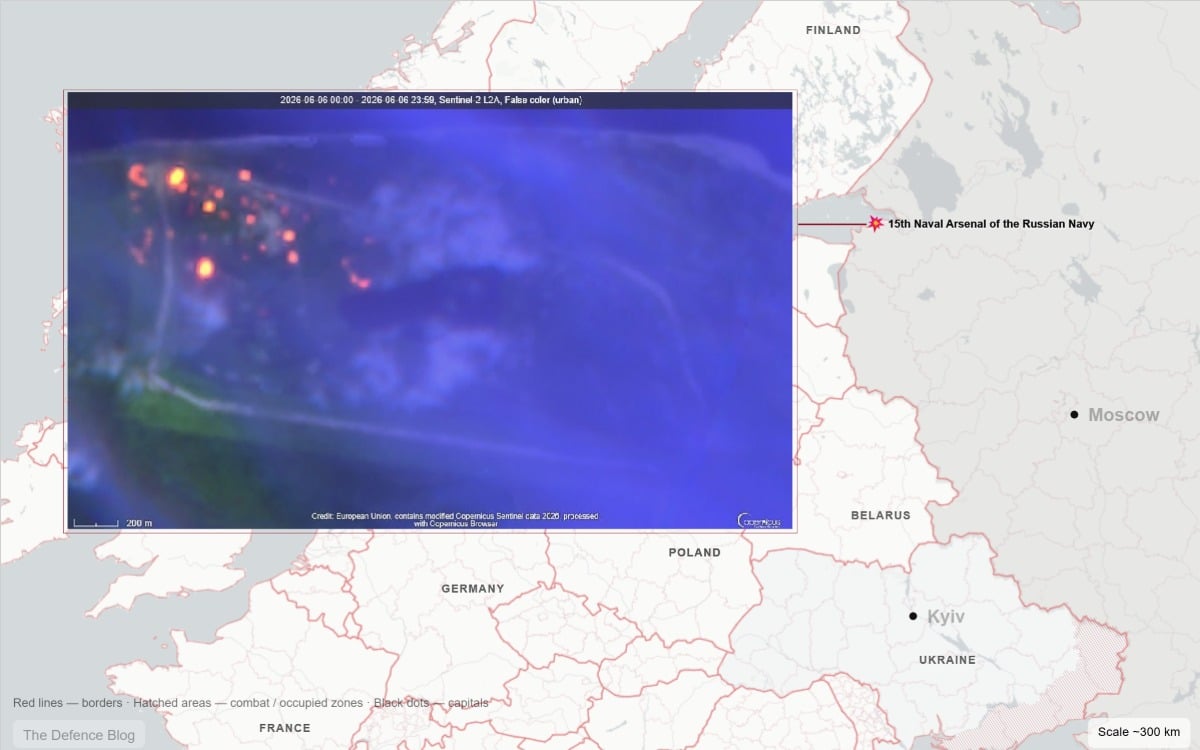
Russia just learned that a thousand kilometers of distance is no longer a shield. Overnight, a wave of Ukrainian strike drones bypassed heavy air defense networks to slam straight into the Russian Navy’s 15th Arsenal in Bolshaya Izhora, right on the doorstep of St. Petersburg.
If you look at the map, this isn't anywhere near the front lines in the Donbas. It's a deep, deliberate punch into Russia's northern strategic flank. Fresh satellite imagery from Planet Labs and reports verified by open-source intelligence groups like Astra show a massive burn scar covering roughly 1.5 square kilometers. The facility wasn't just nicked; it's actively cooking off.
For months, the conversation around Ukraine’s long-range campaign focused heavily on oil refineries and southern Black Sea targets. This latest strike changes the narrative completely. By gutting a major Baltic Fleet naval ammunition depot, Ukraine proved it can systematically dismantle Russia’s logistics hubs regardless of geography.
What the Satellite Images Tell Us About the Damage
Western analysts and satellite monitors caught the blaze from orbit. The 15th Arsenal isn't some temporary field dump. It’s a hardened, historic storage complex built back in the 1930s, complete with reinforced underground bunkers designed to withstand heavy bombardment.
Yet, the imagery reveals that the outer storage areas—where massive stockpiles of naval mines, torpedoes, and missile components sit before being loaded onto warships—bore the brunt of the strike.
Local reports from the Lomonosovsky District confirm that the secondary detonations were loud enough to trigger the evacuation of around 600 residents from surrounding villages. Leningrad Oblast Governor Alexander Drozdenko tried to play down the incident, claiming only a few injuries from "falling debris." But you don't evacuate multiple towns over a few stray pieces of shrapnel. The satellite data shows a continuous, massive thermal signature across the warehouse complex, indicating that the fire burned out of control for hours.
Blunting the Teeth of the Baltic Fleet
To understand why this matters, you have to look at what the 15th Arsenal actually supplies. This depot is the central nervous system for the Russian Baltic Fleet’s ordnance. It feeds the naval bases at Kronstadt and Baltiysk.
When Ukraine blows up a standard artillery depot near the border, it cuts off a few days of shells for a frontline motorized rifle brigade. When it burns down a naval arsenal, it destroys highly specialized, low-production weaponry that takes months, sometimes years, to replace. We are talking about:
- Anti-ship missiles used by surface combatants.
- Advanced acoustic and thermal torpedoes.
- Deep-water naval mines meant to lock down the Baltic Sea against NATO.
Just a few days before this depot strike, Ukrainian drones successfully hit the Project 20380 missile corvette Boykiy while it sat at its mooring in Kronstadt. By hitting the ship first and then vaporizing the weapons storage facility meant to rearm it, Ukraine executed a textbook operational sequence. They aren't just hunting individual hulls anymore; they are destroying the entire maritime ecosystem.
The Secondary Targets That Suffered
The drones didn’t stop at the ammunition bunkers. The geography of the attack shows a coordinated effort to hit Russia's naval military-industrial complex in the region.
Geolocated footage and smoke plumes place additional strikes directly on the Research Institute of Marine Thermal Engineering. Don't let the boring academic name fool you. This facility is Russia's primary development and production hub for the Fizik-1 and Fizik-2 heavy torpedoes, as well as the specialized Paket-E/NK anti-torpedo defensive systems.
At the same time, thick black smoke was filmed rising over the Kronstadt Marine Plant. As the largest ship repair yard in northwestern Russia, this plant handles scheduled maintenance and emergency dry-docking for surface ships and diesel-electric submarines from the Baltic, Northern, and even Black Sea fleets. By forcing these facilities to deal with fire damage and disrupted power grids, Ukraine effectively freezes Russia's naval repair pipeline.
The Air Defense Myth Exploded Again
Every time a strike like this happens, the Russian Ministry of Defense releases a statement claiming they shot down every single incoming threat. This time, they boasted about intercepting 144 drones across the region. But the physical evidence left behind on satellite film tells a completely different story.
If Russian air defenses like the S-400 or the Pantsir-S1 systems were as ironclad as Moscow claims, low-speed, long-range drones wouldn't be able to fly 1,000 kilometers through contested airspace to detonate a highly sensitive military site.
The reality is that Russia’s air defense envelope is stretched to a breaking point. They have pulled radar systems and missile batteries from the far north and the Baltic coast to protect Moscow, oil ports, and the immediate frontline logistics chains. This leaves massive gaps in their domestic radar coverage. Ukraine knows this, maps the blind spots, and sends its low-flying drone swarms right through the front door.
The Strategic Ripple Effect for NATO
This strike has massive implications outside of the immediate Russia-Ukraine war. The Baltic Sea is effectively a NATO lake now, especially with Finland and Sweden in the alliance. Seeing Russia's primary naval stockpiles burn in Leningrad Oblast gives Baltic planners an entirely new data point.
For years, the West feared Russia's ability to deny access to the Baltic Sea using naval mines and coastal anti-ship systems. Now, a country without a functional conventional navy of its own is systematically reducing that exact threat from a thousand kilometers away. It exposes the Russian Baltic Fleet as a force that can't even protect its own backyard, let alone project power or threaten its Nordic neighbors.
What Happens Next
If you are tracking the logistics of this conflict, the immediate aftermath of the Bolshaya Izhora strike gives a clear roadmap of where the pressure goes next. Expect to see several shifts in the coming weeks:
- Forced Dispersion of Ordnance: Russia will have to move its remaining naval munitions out of large, centralized depots like the 15th Arsenal and scatter them across smaller, less efficient civilian or hidden sites. This slows down the rearming process for their ships significantly.
- Resource Realignment: Moscow will be forced to pull scarce air defense assets away from the southern oil terminals or the front lines to shield St. Petersburg's military factories and naval assets.
- Increased Reliance on Northern Ports: With Baltic facilities vulnerable, Russia may shift more critical naval repair and storage tasks further north toward Murmansk, adding massive transit times and logistical headaches to their operations.
Ukraine’s deep strike strategy is no longer experimental. It is a mature, highly calculated campaign designed to break Russia’s military capacity before the weapons ever reach the battlefield.