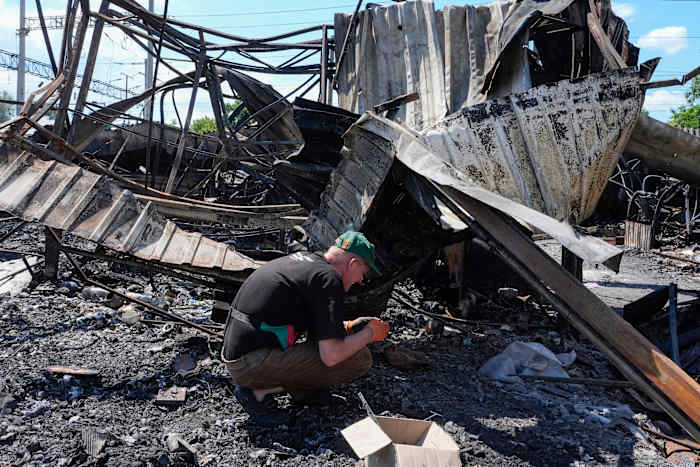
You can't win a war of attrition by only playing defense on your own soil. Kyiv knows this. That's why Ukrainian commanders are shifting their strategy away from the grinding, muddy front lines of the Donbas and launching high-stakes aerial operations hundreds of miles into the Russian heartland.
The latest nighttime operation marks a massive escalation in both distance and strategic intent. Kyiv just bypassed Russian air defenses to strike the Orenburg Gas Processing Plant. This isn't just another energy depot. It's a massive industrial beast located in the southern Urals near the Kazakhstan border—more than 750 miles deep into Russian territory.
At the exact same time, Ukrainian long-range strikes knocked out two of Russia's most critical military satellite communication centers. The message from Kyiv is crystal clear. No matter how deep inside Russia a facility sits, it's no longer safe.
The strategic nightmare at Orenburg
When news breaks about a strike on a Russian gas plant, it's easy to assume it's just about cutting off Vladimir Putin's fuel supply or hitting his wallet. Orenburg is different. This facility, operated by state-owned giant Gazprom, is one of the largest gas chemical complexes on the planet.
More importantly, it houses the only helium plant in all of Russia.
To understand why this matters, you have to look past civilian uses like party balloons and look straight at industrial military manufacturing.
- Liquid-fuel rocket engines: High-grade helium is a non-reactive gas indispensable for pressurizing liquid-fuel rocket engines and stabilizing advanced guidance systems.
- Solid rocket fuel: The complex produces ethane, a foundational component used to manufacture solid rocket fuel and gunpowder.
By setting this specific facility ablaze, Ukraine didn't just disrupt a revenue stream. It threw a massive wrench into the supply chain that builds Russia's precision missiles. When you force a state to scramble for alternative sources of specialized elements like helium, you slow down their factory output. In a war entering its fifth year, industrial bottlenecks are just as deadly as lost battalions.
Blinding the Kremlin satellite network
While the fires were burning in the Urals, another coordinated strike targeted Russia's eyes in the sky. Ukraine's General Staff confirmed successful hits on two primary satellite communications centers used extensively by the Russian military.
The primary target was the Dubna Space Communications Center located just outside Moscow. Dubna is Russia's largest ground-based satellite communications complex. The second strike slammed into a similar military communications hub in the Vladimir region, east of the capital.
Stepping back to analyze the tactical footprint here reveals a brilliant piece of asymmetric warfare. By targeting these ground stations, Ukraine isn't trying to shoot down satellites. They're cutting the cords on earth. Knocking out these hubs degrades the Kremlin's ability to coordinate secure military communications, relay drone telemetry, and manage field commands across vast distances.
Choking the Crimean logistics hub
While long-range assets flew deep north and east, Ukraine kept up a brutal, relentless campaign to isolate the Crimean Peninsula. Overnight drone strikes targeted the local power grid, completely knocking out electricity in the strategic port city of Sevastopol.
This fits perfectly into a broader campaign aimed at turning Crimea into an unsustainable military liability for Moscow. This summer, Ukrainian operations have systematically targeted the peninsula's electrical grid, oil storage depots, and rail lines. Just hours before the Sevastopol blackout, Ukraine's Security Service struck two military airfields and tore up air defense missile systems on the peninsula.
Western military analysts note that this isn't random. Crimea serves as the primary logistical funnel for Russian troops fighting in southern Ukraine. If you cut the rail bridges, blow up the fuel depots, and knock out the power grid during peak summer heat, you break the military supply chain. You also apply massive psychological pressure to the Russian public and leadership by showing that occupied territories cannot be defended.
The changing geometry of the war
Russia's Defense Ministry claimed its air defense teams shot down 323 Ukrainian drones across multiple regions during the raids. Even if that number is accurate, it actually highlights Russia's growing vulnerability. To launch an attack of this scale, Ukraine is utilizing a high-volume saturation strategy. They fly massive swarms of cheap, locally produced long-range attack drones simultaneously.
Russian air defenses simply get overwhelmed. They might intercept 90% of the incoming targets, but the 10% that slip through are hitting high-value, irreplaceable targets like Dubna or Orenburg.
In response to these deep-penetration strikes, President Volodymyr Zelenskyy noted that Moscow has been forced to redeploy precious air defense systems from the front lines back to protect the capital and the vital Kerch Bridge in Crimea. Every surface-to-air missile battery pulled back to protect a factory inside Russia is one less battery protecting Russian troops on the front lines.
To protect your own infrastructure moving forward, you need to monitor how these supply chain disruptions affect battlefield realities over the coming weeks. Watch for fluctuations in Russian missile launch frequencies and track air defense redeployments inside Russia via open-source intelligence mapping. The war is no longer contained within Ukraine's borders, and the industrial pressure inside Russia is only going to mount.
For a deeper visual breakdown of how Ukraine's long-range drone program has evolved to reach these distant targets, watch this analysis on the Evolution of Ukrainian Long Range Drones, which covers the technical shifts allowing Kyiv to strike deep inside the Russian heartland.