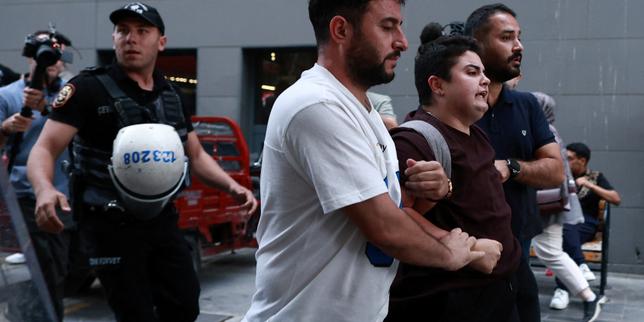
Every western editorial desk loves a simple story. Flashy headlines scream about mass arrests, authoritarian panic, and an inevitable ideological crusade against the LGBT+ community in Turkey. The narrative writes itself: a government cornered by economic anxiety turns its sights inward, picking on a vulnerable minority to shore up conservative votes. It is neat. It is tragic. It is also fundamentally lazy.
If you look at the recurring waves of police detentions, Pride march crackdowns, and state-sponsored moral panic solely as an ideological blood sport, you miss the actual mechanics of political survival in modern Ankara. The consensus view treats these actions as an unstoppable slide toward total social erasure. That is a tactical misread. The reality is far more transactional, far colder, and entirely detached from the grand culture war theater being broadcast to European think tanks.
I have spent years tracking how authoritarian legal frameworks operate under the strain of currency devaluation and municipal fatigue. When you reduce state crackdowns to pure bigotry, you fail to understand what the ruling party is actually managing: an exhaustion of traditional scapegoats and a desperate need to dictate the rhythm of the news cycle.
The Mirage of Ideological Purity
The lazy consensus says that Turkey is executing a coordinated master plan to eradicate queer visibility because of deeply held religious dogma. Let us look at the data without the western moral panic filter.
Turkey’s legal code does not actually criminalize homosexuality. Never has. Sodomy has been legal under the Turkish penal code since the late Ottoman Empire’s modernization reforms in the mid-nineteenth century. Contrast that with much of the Middle East, Sub-Saharan Africa, or even parts of the American southeast, where archaic laws remain active. Istanbul was, for decades, an unlikely safe haven where underground queer culture thrived not despite the state, but in a permissive gray zone of bureaucratic neglect.
The sudden shift from neglect to aggressive disruption is not evidence of a sudden religious awakening. It is a symptom of political inventory exhaustion. For twenty years, the playbook relied on fighting external enemies, crushing military tutelage, or battling economic speculators. When inflation hits rates that make daily survival an exercise in calculus, and when local elections deliver stinging defeats in major urban centers like Istanbul and Ankara, grand geopolitical posturing stops working on the average grocery shopper.
Enter the manufactured culture threat.
By hyper-focusing on Pride banners, student protests, and civil society grants from European foundations, the apparatus achieves two goals simultaneously. First, it signals to the ultra-conservative nationalist coalition partners that their ideological floor is secure. Second, and more importantly, it forces the political opposition onto the defensive. Whenever the opposition is forced to defend human rights declarations, they are not talking about interest rates, housing costs, or systemic corruption.
Follow the Money and the Municipal Loss
To understand why these police actions spike during specific calendar windows, look at municipal budgets and urban gentrification.
For generations, queer communities in neighborhoods like Cihangir, Kadıköy, and Beşiktaş functioned as the ultimate gentrification vanguard. They moved into dilapidated, historically mixed neighborhoods, opened independent coffee shops, reclaimed abandoned spaces, and unintentionally supercharged property values.
Now, look at who controls those municipalities today. The Republican People Party reclaimed Istanbul and major urban hubs. The central government in Ankara retains control over national security apparatuses, police forces, and interior ministry directives. When local municipal councils attempt to fund civil society initiatives, community centers, or cultural spaces that lean progressive, the central government counters by weaponizing public order ordinances.
This is not a grand ideological crusade. It is a turf war over urban identity and administrative dominance. The state does not care about private bedrooms; it cares about public sovereignty. Any independent center of gravity that can mobilize five thousand youth in the heart of Istanbul without permission from the directorate of religious affairs represents an unacceptable parallel power structure.
The Complicity of International Outrage
Western human rights organizations fall into the same trap every single time. They issue sternly worded condemnations, translate reports into English and French, and lobby European Union commissioners for diplomatic censure.
Do you know what that achieves on the ground? Exactly zero.
In fact, it accelerates the very cycle it aims to break. Every time a Brussels-based NGO publishes a scathing report on Turkish domestic policy, it hands the ruling party a ready-made propaganda gift. The narrative writes itself on pro-government evening news: foreign agents trying to dictate domestic morality, western foundations subverting traditional family structures, and local activists acting as fifth-column operatives.
By tying queer liberation to western institutional funding and European liberalism, the opposition inadvertently hands the state a nationalist cudgel. The state does not need to invent a conspiracy; foreign actors practically hand them the blueprint on silver platters.
If you want to protect vulnerable populations in hostile environments, stop turning them into geopolitical footballs. The most effective resistance in Istanbul right now is not happening via high-profile street marches that end in mass detentions for the cameras. It is happening quietly, through decentralized legal defense funds, encrypted digital networks, and economic self-sufficiency that bypasses both state crackdowns and western savior complexes.
The Uncomfortable Truth About State Control
Let us drop the pretense that the Turkish state is an unpredictable monster operating purely on malice. It is a rational, highly institutionalized machine focused entirely on self-preservation.
When activists get detained, released, re-arrested, and put through endless bureaucratic loops, it creates a chilling effect without requiring the political cost of actual mass imprisonment. The goal of the current wave is not extermination; it is exhaustion. An exhausted civil society cannot organize a labor strike. An exhausted student body cannot sustain a housing protest. An exhausted minority community spends all its emotional bandwidth avoiding detention rather than building political coalitions.
The crackdown works because it is calibrated to be just painful enough to disrupt organizing, but not severe enough to trigger total systemic collapse or open civil insurrection.
Stop viewing these events through the lens of a Hollywood dystopian thriller. View them through the lens of cold, calculating realpolitik. The moment you understand that the noise is a deliberate distraction from economic failure, you stop reacting to the theater and start looking at the ledger.
The strategy won't change until the economic fundamentals force a reckoning. Until then, the noise will continue, loud and calculated, designed to keep everyone looking at the street corners while the foundation shifts underneath them.



