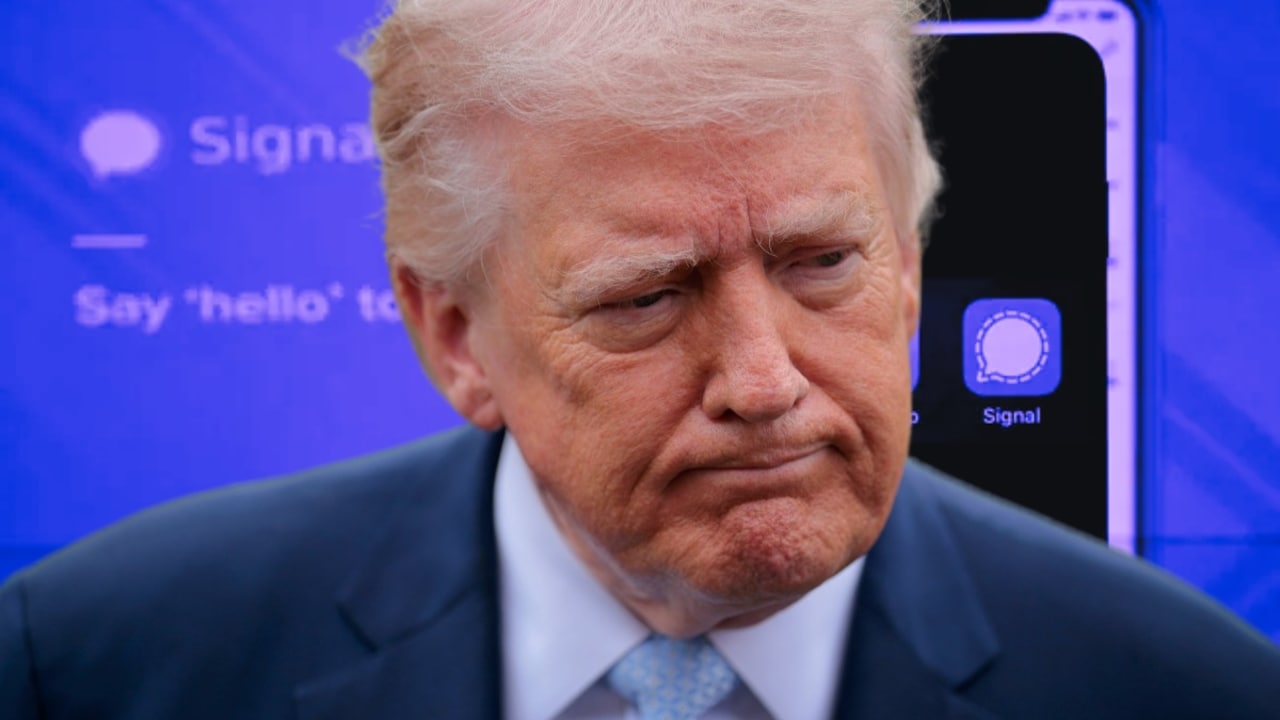
You don't expect a president's inner circle to handle sensitive foreign policy like a group of college kids planning a weekend road trip. Yet, new public records reveal that Donald Trump’s top aides completely ignored his explicit warnings to drop the encrypted messaging app Signal. They kept right on using it, even after one of the most embarrassing security blunders in recent political history.
The real story here isn't just about politicians breaking the rules. It’s about a fundamental cultural shift in how modern power brokers operate. They value speed, secrecy, and the ability to make digital footprints disappear above formal government protocols.
The Houthi PC Small Group Blunder
To understand why Trump told his team to stop using the app, you have to look back at the chaos of March 2025. National Security Advisor Mike Waltz set up a Signal group chat titled "Houthi PC small group" to coordinate an upcoming military operation in Yemen, code-named Operation Rough Rider.
The chat included heavy hitters: Vice President JD Vance, Defense Secretary Pete Hegseth, CIA Director John Ratcliffe, and Secretary of State Marco Rubio. It was a highly secure, end-to-end encrypted space—until Waltz accidentally sent a contact request and added Jeffrey Goldberg, the editor-in-chief of The Atlantic, directly into the group.
Suddenly, a journalist had a front-row seat to active military planning. Goldberg watched as Hegseth texted precise details about weapons packages, targets, and timing. Vance popped into the chat to voice concerns about oil prices spiking. Ratcliffe noted how the CIA was mobilizing assets.
When the leak went public, the political fallout was massive. Democrats screamed about national security violations, while Republicans publicly circled the wagons. Privately, Trump was furious. He dismissed the incident to the press as a minor "glitch," but behind closed doors, he told his team to delete the app and stick to secure, official channels.
Why the Inner Circle Smuggled Signal Back In
They didn’t listen. Newly released Freedom of Information Act (FOIA) records obtained by the watchdog group Democracy Forward reveal that the administration's reliance on Signal didn't stop. Instead, it thrived.
Researchers uncovered 13 previously unreported Signal chats used by senior officials throughout the first half of 2025. Even after the Yemen disaster, group chats with names like "Iran/Ukraine Planning" and "State USAID" remained highly active. Vance, Rubio, and Hegseth were right back at it.
Why risk the boss's wrath? Because official government communication systems are slow, clunky, and permanently archived.
Signal offers an administrative escape hatch. The app features auto-deleting messages, which Trump's team used heavily in these newly exposed chats. When a text vanishes after 24 hours, there’s no paper trail for future congressional investigations, inspector general audits, or adversarial FOIA requests.
For a political team that grew up viewing the permanent bureaucracy—the "Deep State"—with deep suspicion, disappearing text messages aren't a bug. They're the ultimate defense mechanism.
The Hypocrisy Problem
The biggest issue with the continued use of Signal isn't just the tech safety angle; it’s the staggering double standard.
During the 2016 campaign, Donald Trump’s political rise was fueled by his relentless attacks on Hillary Clinton for using a private, unsecured email server to handle state business. Hegseth, Miller, and Rubio spent years on cable news asserting that any official who uses non-sanctioned devices for sensitive government business should be fired or prosecuted.
Yet, when caught doing something remarkably similar, the defense shifted instantly. Hegseth claimed "nobody was texting war plans" and attacked Goldberg as a fraud. Ratcliffe argued his communications were "permissible and lawful" because the technical classification of the data wasn't explicitly marked as secret.
This creates a dangerous precedent. The Pentagon explicitly states that third-party apps are not approved to process or store nonpublic unclassified information. Cybersecurity experts warn that while Signal's encryption is great, the physical phones themselves are prime targets for foreign intelligence agencies like Russia and China.
Moving Past Disappearing Data
If you operate in any compliance-heavy environment—whether it's federal government, corporate finance, or healthcare—the lesson here is clear. You cannot let convenience override record-keeping laws. Federal judges have already ordered participants in these chats to preserve whatever data remains, and inspector general investigations are looming.
If your team is currently cutting corners using encrypted apps for official business, take these steps immediately to avoid your own compliance disaster:
- Audit mobile device policies: Clearly define what platforms are approved for work-related conversations.
- Enforce formal archival systems: If employees must use text-based messaging, deploy mobile compliance software that automatically logs chats to a secure central database.
- De-escalate sensitive topics: Establish a strict rule that any conversation touching on strategic planning, legal risks, or proprietary data must move to a secure, official system immediately.
Relying on disappearing messages might feel safe in the short term, but as the White House just learned, all it takes is one wrong click to put your most sensitive secrets on the front page.


