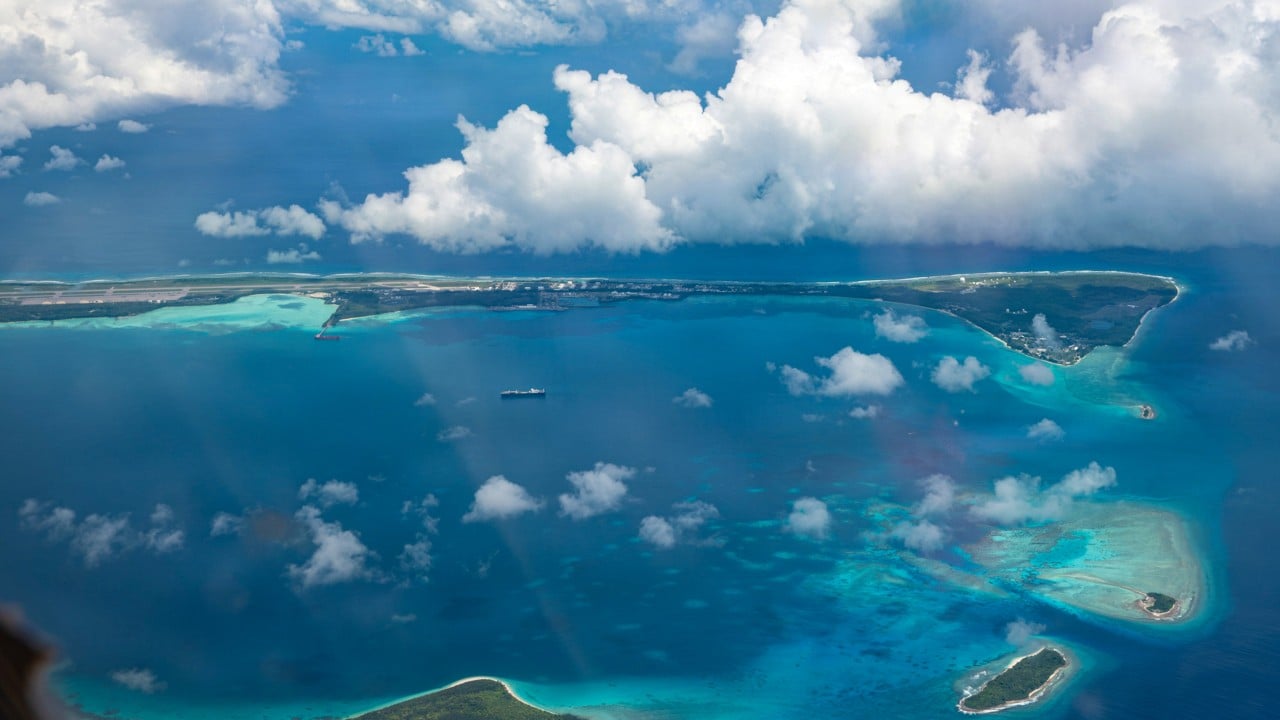
The white sands of Diego Garcia look like a postcard, but the concrete runway cutting through the atoll tells a completely different story. Right now, the Trump administration is holding intense, backroom discussions with British officials about the future of this tiny strip of land in the middle of the Indian Ocean. Reports even suggest the White House is floated a wild idea: bypassing London entirely and buying the Chagos Archipelago outright from Mauritius.
Why is a scattering of coral islands suddenly causing a panic in Washington? It isn’t about real estate. It’s about blocking China from locking down the most critical maritime crossroads on the planet.
For decades, Diego Garcia has served as America’s unsinkable aircraft carrier. It's the place where B-2 bombers fuel up before long-range missions and where the US military keeps a massive footprint to project power across Asia and the Middle East. But a controversial treaty signed last year by the British government threw a wrench into the gears. London agreed to hand sovereignty of the islands over to Mauritius, an African island nation with deep economic ties to Beijing.
Washington watched this play out and realized that handing over the surrounding waters could give Chinese intelligence an open window right next to highly sensitive military hardware. Now, the US is scrambling to rewrite the script before the deal is locked in stone.
The Diego Garcia Vulnerability
To understand why Washington is sweating over this, you have to look at how much the US relies on Diego Garcia. It's not just another base. It’s a highly secure, isolated launchpad that allows the US military to reach conflict zones without needing permission from finicky host governments. When the US launched airstrikes involving B-2 Spirit bombers earlier, those missions relied heavily on the isolation and security that only Diego Garcia provides.
But the strategic isolation is under threat. Under the treaty negotiated by British Prime Minister Keir Starmer's government, Mauritius would gain full sovereignty over the archipelago. While the UK secured a 99-year lease to keep running the joint US-UK base, the surrounding territorial waters and the rest of the islands would fall under Mauritian control.
That’s where the math breaks down for American strategists. Mauritius is a sovereign nation, and like many nations in the region, it has welcomed massive Chinese investment. Critics in the US Senate, like John Kennedy, aren't holding back, calling the British plan "weapons-grade stupid." The fear isn't that Mauritius will host a Chinese naval base on Diego Garcia itself. The fear is everything else:
- Chinese electronic surveillance ships parked just outside the 12-nautical-mile baseline.
- Deep-sea monitoring equipment laid in the surrounding waters to track American submarine movements.
- Diplomatic leverage used to restrict airspace, similar to when Mauritius revoked flight permits for Taiwan's presidential aircraft.
If Beijing can monitor every bomber taking off and every submarine submerging from a few miles away, the base loses its ultimate advantage: secrecy.
The Trump Pivot and the Checkbook Strategy
The British government expected the treaty to glide through ratification this year. But they didn't count on a total shift in the White House. While initial noises out of Washington suggested a reluctant acceptance of the UK-Mauritius deal, the administration flipped the table. The White House labeled the treaty an "act of total weakness" and pressured London to put the brakes on the entire process.
Now, the British parliament has paused the ratification of the bill that would cede the territory. With the deal on ice, American diplomats are trying a more direct, aggressive approach. Reports emerged that the US approached the government of Mauritius with a radical alternative: a direct buyout.
Instead of London paying Mauritius billions of dollars over a 99-year lease while trying to maintain administrative control, Washington wants to see if cold, hard American cash can buy permanent, undisputed ownership of the territory.
Predictably, the government in Port Louis publicly pushed back. Mauritius issued a swift statement claiming it hadn't received a formal proposal and that its sovereignty over the Chagos Archipelago is simply not negotiable.
But public denials are standard protocol in high-stakes diplomacy. Behind closed doors, the financial pressure and security guarantees the US can offer might look very different to a small island economy, especially when compared to the complex, multi-decade lease agreements currently on the table.
Beijing's Quiet Move on the Decolonization Board
Naturally, China isn't staying silent while the US tries to lock down the Indian Ocean. Beijing's embassy in Washington recently issued a calculated statement, noting that it firmly supports the United Nations decolonization process and backs Mauritius's legitimate claims.
It's a clever geopolitical play. By framing the issue purely around decolonization, China gets to look like the champion of international law and developing nations. At the same time, it scores points against Western military power.
The history here is messy, and Beijing knows how to exploit it. Between 1967 and 1973, the British government forcibly removed around 2,000 native Chagossians from their homes to clear the way for the American military base. The displaced islanders were sent to Mauritius and the Seychelles, where many fell into poverty.
In 2019, the International Court of Justice ruled that Britain's continued occupation of the islands was illegal, stating that the decolonization of Mauritius was never properly finished.
By backing Mauritius, China aligns itself with the UN and international courts, making the US and the UK look like colonial relics trying to hold onto stolen land. If the UK-Mauritius treaty collapses entirely because of American pressure, Beijing wins a massive propaganda victory across the Global South. If the treaty goes through, Beijing gets a friendly government managing the waters right next to America's most critical military asset.
The Messy Road Forward
The current situation is a massive headache for everyone involved. The UK is stuck in the middle. London wants to honor international legal pressure and settle the historical dispute with Mauritius, but it can't afford to alienate its most important security ally in Washington. Prime Minister Starmer's government already irritated the White House by restricting the use of Diego Garcia during earlier regional friction, and pushing through a treaty against explicit American wishes could fracture the special relationship.
For the US, the next moves require balancing raw power with smart diplomacy. You can't just buy a disputed archipelago without triggering a massive international backlash, but you also can't let a vital security node get compromised by maritime surveillance.
Expect Washington to keep squeezing London to delay ratification indefinitely while dangling massive economic carrots in front of Mauritius to see if their "non-negotiable" stance has a price tag. The battle for the Indian Ocean won't be fought with missiles; it's being fought right now with leases, treaties, and backroom pressure.


:max_bytes(150000):strip_icc():focal(665x0:667x2)/gettyimages-50733149-2000-8b129a2475974982a915418ce92a73d8.jpg)