Donald Trump didn't just break the mold of American foreign policy. He shattered it. When he signed a presidential proclamation on March 25, 2019, recognizing Israel's sovereignty over the Golan Heights, he drew a line in the sand that no other global leader has crossed.
Seven years later, the geopolitical map hasn't shifted an inch in his direction. Walk into any foreign ministry in Europe, Asia, or the Middle East, and the answer remains exactly the same. The Golan Heights is legally viewed as occupied Syrian territory. Trump remains the only world leader to formally validate Israel’s de facto annexation. This lone-wolf diplomatic stance isn't just a historical footnote. It completely changed the rules of how nations claim territory, and the ripple effects are still causing friction in 2026.
The Reality Behind the Real Estate
Understanding the obsession over this 690-square-mile volcanic plateau requires looking at a map. Captured by Israel from Syria during the 1967 Six-Day War, the Golan Heights isn't just empty rock. It commands a towering view over northern Israel, southern Lebanon, and the plains leading directly to Damascus.
During the first few decades of the conflict, the debate was mostly about military buffer zones and water rights, specifically control over the tributaries feeding the Sea of Galilee. If you hold the high ground, you control the valley below.
The Syrian civil war changed everything. The collapse of absolute state control in Damascus allowed Iran’s Quds Force and Hezbollah militants to set up shop right on Israel's doorstep. For Israeli security planners, giving up the heights became an absolute non-starter.
Israel passsed the Golan Heights Law in 1981, extending its civil administration and laws over the territory. The international community collectively gasped. The United Nations Security Council passed Resolution 497, declaring the Israeli annexation null, void, and without international legal effect. For nearly four decades, Washington quietly aligned with the UN, treating the region as occupied territory whose ultimate fate had to be settled through peace talks.
Why Trump Made the Move Alone
The 2019 proclamation wasn't born out of a sudden reading of international law textbooks. It was a calculated political move that served two immediate purposes.
First, Benjamin Netanyahu was facing a brutal reelection campaign and a mountain of corruption indictments back home. Trump's sudden announcement, delivered via a tweet before being formalized at the White House, gave Netanyahu an unprecedented political gift. It proved to the Israeli electorate that "Bibi" could deliver results from Washington that no previous prime minister dreamed of.
Second, the decision fit perfectly into the broader Trump strategy of upending traditional diplomatic protocol. It followed the relocation of the US Embassy to Jerusalem and preceded the brokering of the Abraham Accords. By abandoning the traditional "land for peace" formula established under UN Resolution 242, the White House essentially declared that decades of diplomatic gridlock required radical new facts on the ground.
The rest of the world refused to follow the script. The European Union immediately issued statements affirming that its member states didn't recognize Israeli sovereignty over the region. The Arab League called it a blatant violation of international law. Even close American allies like the United Kingdom and France stood firm on the 1967 borders.
The major concern for global legal experts wasn't just about the Middle East. It was the precedent. By recognizing territory acquired through military conflict, Washington was seen as undermining the fundamental UN Charter rule against the acquisition of land by force.
The View from the Ground in 2026
The diplomatic isolation hasn't slowed down developments on the plateau. Today, roughly 63,000 people live in the Israeli-controlled portion of the Golan Heights. The population is split almost down the middle between Israeli settlers and the local Druze community, most of whom still hold Syrian citizenship papers despite decades of living under Israeli law.
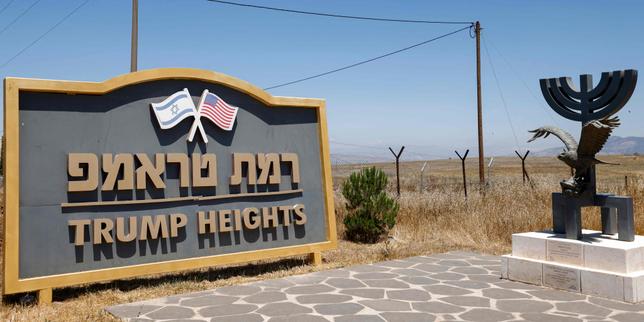
The physical footprint of Trump's decision is literally carved into the landscape. Shortly after the 2019 declaration, the Israeli government approved the establishment of a new settlement named "Ramat Trump"—Trump Heights.
Recent updates from the region show how strange this geopolitical bubble has become. Local residents in Trump Heights still praise the former president for his historic recognition. Yet, local dynamics remain incredibly tense. Recent US-brokered diplomatic arrangements involving Iran and regional security have left many residents feeling exposed, proving that a signature on a piece of paper in Washington doesn't automatically erase the realities of being surrounded by hostile territory.
The Biden administration didn't reverse Trump's decision, knowing that pulling back the recognition would cause a catastrophic rupture with Jerusalem without gaining anything from Damascus. But they haven't aggressively pushed other nations to follow suit either. It remains a uniquely American exception.
If you want to understand where this leaves global diplomacy, look at how other superpowers use the example. When Western nations criticize territorial land grabs in other parts of the world, rivals quickly point to the Golan Heights proclamation as evidence of American double standards.
Don't expect a sudden wave of international recognition anytime soon. No major European or Asian power is going to risk alienating the wider Arab world or breaking with UN resolutions just to validate a policy shift that Trump executed on a whim. The plateau remains frozen in a legal gray zone—administered by Israel, claimed by Syria, validated by Washington, and rejected by everyone else.