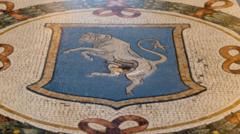
Step into the center of Milan's Galleria Vittorio Emanuele II, and you'll always see a crowd gathered around a specific floor mosaic. They aren't admiring the soaring 19th-century iron and glass architecture. Instead, they're watching person after person place their right heel firmly down on the testicles of a mosaic bull and spin backward in a full circle.
This bizarre ritual is one of Italy's most famous superstitions. Spin three times on the bull's genitals, and local lore promises you'll get good luck and guarantee a return trip to Milan.
The problem? Human shoes are incredibly destructive. By May 2026, the sheer volume of tourists executing this quick heel-spin ground down the pink stone tiles into a visible crater. The damage got so bad that the city had to step in, setting up a mini construction zone right in the middle of the shopping arcade to completely rebuild the bull's missing anatomy.
The High Cost of Superstition
This isn't a simple cleanup job. On May 27, 2026, Milan's public works and state property officials announced a meticulous, hand-crafted restoration project to fix the damage. When thousands of people grind their heels into the exact same spot every single day, the physical friction acts like heavy-duty sandpaper.
Artisans have to chop out the ruined section to a depth of at least two and a half centimeters. From there, they rebuild the base and carefully set new, hand-cut stone tiles into place, matching the exact colors of the original heraldic design.
If you think this sounds familiar, you're right. The city had to perform this exact same emergency surgery on the bull back in 2017. It only took less than a decade for social media and increased global tourism to completely erase the previous repair work.
What makes this latest restoration interesting is that the city didn't hide the work behind giant plastic tarps. They set up a transparent workstation so passersby could watch mosaic expert Gianluca Galli hand-cut each tiny stone tile. It turned a maintenance headache into a live performance of historic Italian craftsmanship.
Why a Bull in Milan Represents Turin
Most people doing the spin don't actually know what the mosaic stands for. The Galleria features four distinct floor mosaics at its center, representing the early capitals of the Kingdom of Italy, along with Milan itself.
- Rome: The classic she-wolf feeding Romulus and Remus.
- Florence: The elegant lily flower.
- Milan: The red cross on a white background.
- Turin: The rampant bull.
The word for a little bull in Italian is torino, which is exactly why the animal serves as the symbol for the city of Turin. The intense rivalry between Milan and Turin is likely where the whole spinning tradition started back in the late 1800s. Milanese locals began stepping on the symbol of their rival city as a cheeky insult or a bit of local mockery. Over the decades, that petty local joke morphed into a global tourist ritual for good fortune.
How Social Media Changes Historic Preservation
The underlying issue isn't the ritual itself—it's the sheer scale of modern travel. A superstition that used to be a quirky local secret passed down by word of mouth is now a viral TikTok and Instagram obligation.
When a travel trend goes viral, the physical site suffers. We see this worldwide, from people chipping away at the Great Wall of China to tourists rubbing the bronze gate of Edinburgh’s Greyfriars Bobby until the metal turns bright yellow. The human body carries oils, weight, and friction that historic materials simply weren't built to handle at scale.
Milanese officials Emmanuel Conte and Marco Granelli noted that the Galleria is a living heritage site. It wears out because it's actively used and loved by the public. But loving a piece of art shouldn't mean grinding it into dust.
How to Visit the Galleria Without Wrecking It
If you're planning a trip to Milan, you can absolutely still visit the Octagon in the center of the Galleria to see the newly restored artwork. You don't need to skip the site, but you should change how you interact with it.
- Admire the Craftsmanship: Look closely at the borders of the mosaic. The hand-cut tiles show a level of detail that modern machine-cut stones can't replicate.
- Take a Photo, Skip the Spin: Get your picture with the bull without putting your full body weight into a grinding heel-turn on the fresh grout.
- Look Up: Don't get so focused on the floor that you miss the massive glass dome overhead, which was an engineering marvel when Giuseppe Mengoni designed it in the 1860s.
The new tiles are set, the grout is dry, and the bull is whole again. If you want to ensure you return to Milan, try buying a shot of espresso at Camparino in Galleria instead of boring a hole into the historic floor. Your coffee purchase supports the local economy, and it keeps Italy's cultural heritage intact for the next generation of travelers.