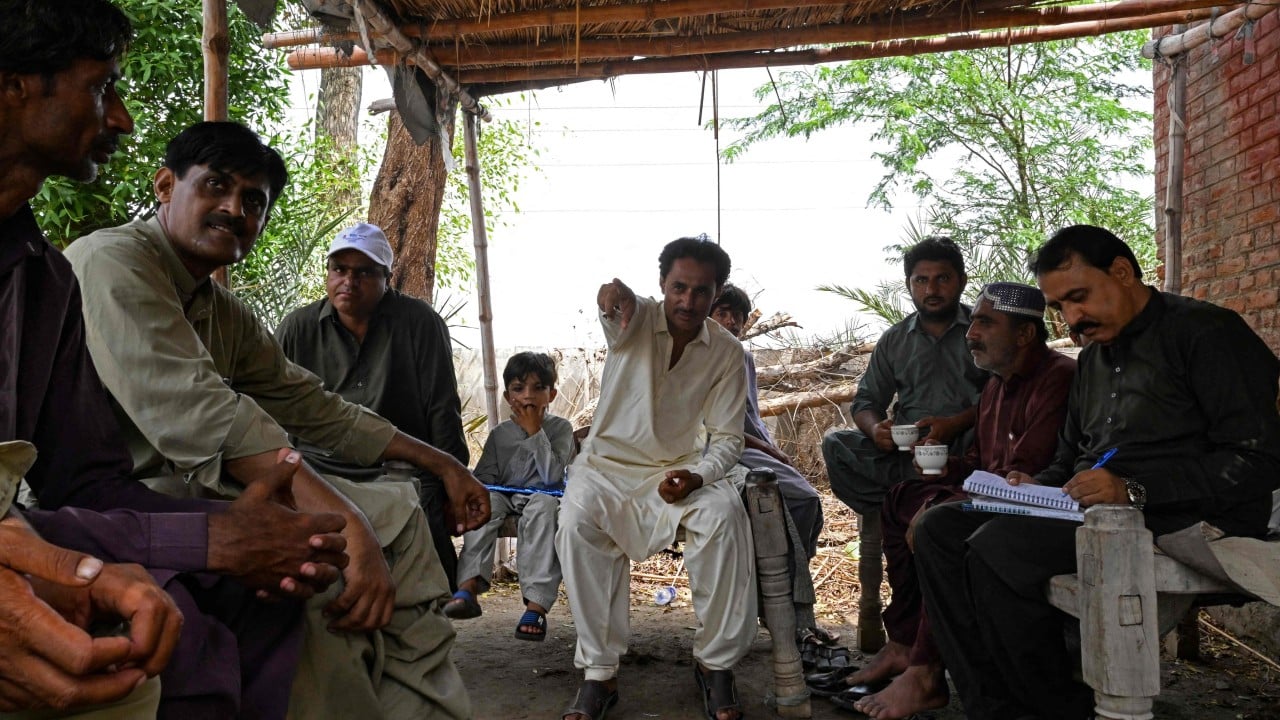
Transboundary climate litigation represents a structural repricing of industrial externalities, shifting carbon emissions from an unpriced atmospheric commons into a quantifiable balance-sheet liability across sovereign borders. The legal action initiated by Pakistani agricultural workers against major German industrial emitters—specifically targeting utility giant RWE and cement manufacturer Heidelberg Materials—tests whether domestic civil tort law can bridge a 5,000-kilometer geographic divide between emission source and physical climate impact. For corporate strategists, risk officers, and institutional investors, this litigation is not an isolated activist gesture; it is the operationalization of attribution science within European civil courts, establishing a framework where historical emissions directly correlate to proportional financial restitution for localized climate disasters.
The central thesis of the plaintiffs relies on a straightforward physical reality: greenhouse gases mix uniformly in the upper atmosphere, meaning a metric ton of carbon dioxide released in North Rhine-Westphalia exerts the exact same radiative forcing over the Indus River Basin as a ton emitted locally. By invoking the German Civil Code (BGB), specifically Section 1004 governing property interference and nuisance, the claimants argue that corporate emitters are partially responsible for the catastrophic 2022 monsoon floods in Pakistan, which submerged one-third of the country, displaced 33 million people, and inflicted an estimated $30 billion in economic damages. The legal mechanism bypasses international treaties, which bind states rather than private entities, and instead treats atmospheric carbon accumulation as a continuous physical interference with foreign private property. You might also find this similar story useful: Structural Failure in British Media Governance.
The Architecture of Transboundary Tort Liability
Traditional environmental litigation fails when applied to climate change due to the "drop in the ocean" defense. Historically, defendants argued that because global emissions come from billions of sources, no single actor can be held legally responsible for a specific weather event. The Pakistani litigation dismantles this defense by replacing binary causation with proportional attribution.
To execute this legal strategy, plaintiffs must establish four sequential links in a causal chain: As highlighted in detailed articles by CNBC, the results are widespread.
- Historical Emissions Accounting: Quantifying the exact cumulative greenhouse gas output of specific corporate entities from the industrial revolution to the present, utilizing peer-reviewed "Carbon Majors" datasets.
- Global Radiative Forcing: Demonstrating how that specific percentage of cumulative global emissions altered the Earth's energy balance and increased average global surface temperatures.
- Regional Event Attribution: Utilizing extreme event attribution science—comparing climate models with and without anthropogenic emissions—to prove that elevated temperatures intensified the specific meteorological event, such as the extreme precipitation and glacial melt in Pakistan's Sindh and Balochistan provinces.
- Proportional Financial Restitution: Calculating the localized economic damage to agricultural land, infrastructure, and livelihoods, and multiplying that figure by the defendant's exact historical share of global industrial emissions.
If a corporation is responsible for 0.4% of global industrial emissions, the plaintiffs demand 0.4% of the verified adaptation and recovery costs. This transforms an intractable global tragedy into a standard actuarial calculation.
The Precedent of Lliuya v. RWE
The Pakistani farmers' suit is not built in a vacuum; it is the direct procedural descendant of Lliuya v. RWE, filed in 2015 by Peruvian farmer Saúl Luciano Lliuya. Lliuya sued RWE in the Higher Regional Court of Hamm, demanding approximately €17,000—representing 0.47% of the cost to build flood defenses for his home below a melting glacial lake in the Andes.
In 2017, the Hamm court issued a landmark evidentiary ruling, declaring the claim legally admissible and moving the case into the evidentiary phase to determine whether RWE's emissions measurably contributed to the flood risk. The court explicitly rejected the argument that multiple emitters neutralize individual liability, ruling that partial causation is sufficient under German nuisance law. The Pakistani litigation scales this exact legal blueprint from a single preventative infrastructure project in Peru to retrospective disaster compensation for entire agricultural communities in South Asia.
The Mechanics of Extreme Event Attribution
The viability of transboundary climate litigation rests entirely on the maturation of extreme event attribution science. Two decades ago, climatologists maintained that individual weather events could not be linked to climate change. Today, probabilistic event attribution isolates the human fingerprint on specific disasters through coupled ocean-atmosphere general circulation models.
The operational methodology involves running thousands of climate simulations under two distinct boundary conditions:
- The Factual World: Simulations incorporating observed historical greenhouse gas concentrations, aerosol levels, and solar radiation.
- The Counterfactual World: Simulations stripping out anthropogenic greenhouse gas emissions, modeling a pre-industrial atmospheric baseline.
By comparing the frequency and intensity of extreme precipitation events in the Indus Basin across both simulation sets, scientists calculate the Fraction of Attributable Risk (FAR). Thermodynamic principles dictate that for every 1 degree Celsius of warming, the atmosphere holds approximately 7% more water vapor—a physical law defined by the Clausius-Clapeyron relation. During the 2022 Pakistan monsoon, warmer sea surface temperatures in the Arabian Sea supercharged atmospheric moisture transport, while accelerated thermal expansion melted northern glaciers simultaneously. Attribution studies conducted by the World Weather Attribution network concluded that climate change increased the intensity of the heaviest five-day rainfall events in the region by up to 50% to 75%.
In a courtroom, these meteorological probabilities are translated into legal standards of proof. While civil courts typically require a "preponderance of the evidence" or "high degree of probability," defense attorneys attack the confidence intervals inherent in climate modeling. The friction between scientific probability and legal certainty forms the primary battleground of the litigation.
Economic Asymmetry and the Externalization Matrix
The friction driving this litigation stems from a severe geographic and economic mismatch between carbon accumulation and physical vulnerability. Industrialized nations and their legacy corporations captured the economic surplus of fossil fuel combustion over 150 years, building high-income economies and resilient infrastructure. Conversely, agrarian economies in the Global South contributed negligible amounts to historical atmospheric carbon concentrations while absorbing disproportionate physical damages.
Pakistan accounts for less than 1% of global greenhouse gas emissions, yet it consistently ranks among the ten countries most vulnerable to climate volatility. The 2022 floods wiped out approximately 4.4 million acres of agricultural crops, including cotton, rice, and wheat, destroying the primary capital assets of smallholder farmers. Because agricultural insurance penetration in rural Pakistan is near zero, the financial shock falls entirely on household balance sheets and a debt-distressed sovereign state.
When sovereign mechanisms fail to deliver capital, private litigation emerges as an alternative capital-transfer mechanism. The United Nations Loss and Damage fund, operationalized during recent COP negotiations, relies on voluntary sovereign pledges that remain orders of magnitude below the hundreds of billions required annually for climate adaptation in developing nations. By targeting private balance sheets in jurisdictions with strong rule-of-law traditions, plaintiffs bypass political gridlock at the diplomatic level and pursue enforceable judicial remedies.
Jurisdictional Friction and Corporate Defense Vectors
Bringing a foreign tort claim into German civil courts introduces complex procedural and substantive hurdles that corporate defense teams exploit to delay or dismiss proceedings. Understanding these defense vectors is essential for assessing the true probability of an adverse judgment.
1. The Choice of Law Dilemma (Rome II Regulation)
Under European Union law, specifically the Rome II Regulation governing non-contractual obligations, the applicable law in an environmental damage case is generally the law of the country in which the damage occurs—in this instance, Pakistani tort law. However, Article 7 of Rome II grants the plaintiff a critical strategic advantage: the right to choose the law of the country in which the event giving rise to the damage occurred. This allows Pakistani farmers to invoke German civil law against German corporations, utilizing a legal framework with well-defined property protection statutes and strict enforcement mechanisms.
2. The Political Question Doctrine and Separation of Powers
Corporate defendants consistently argue that climate policy is the exclusive domain of the legislature and executive branch, not the judiciary. The defense posits that because RWE and Heidelberg Materials operated in full compliance with German and European environmental permits, emission trading schemes (EU ETS), and statutory regulations, their conduct cannot simultaneously be classified as an unlawful interference under civil tort law.
Plaintiffs counter this by distinguishing between administrative legality and civil liability. Under German nuisance law, holding a valid administrative permit does not automatically immunize an operator from compensating neighbors for physical property damage caused by lawful industrial activity. If a factory's legal emissions destroy a neighboring farm's crops, the factory must pay compensation, even if it violated no regulatory limits. The court must decide whether this localized neighbor-law principle scales to planetary atmospheric boundaries.
3. The Indeterminacy of Cumulative Causation
Defense counsel attacks the proportional liability model by arguing that climate impacts are non-linear. Removing 0.4% of global emissions would not have prevented the 2022 Pakistan floods, nor would it have reduced the floodwaters by precisely 0.4%. Climate systems exhibit tipping points and threshold behaviors. Defense economists argue that assigning linear financial liability to non-linear physical systems violates fundamental principles of causation in tort law.
Systemic Balance-Sheet Implications for High-Emitting Sectors
For executive leadership in energy, utilities, cement, steel, and extraction industries, the immediate financial demand of a single lawsuit is secondary to the precedent it establishes. If a German court validates the proportional attribution model, the exposure of major emitters scales exponentially.
Consider the mathematical reality of unpriced liability:
- Discovery and Disclosure Risk: Litigation forces corporations to open internal archives regarding historical knowledge of climate science, lobbying activities, and emission trajectories, creating reputational and securities fraud exposure alongside tort liability.
- Credit Rating and Cost of Capital: Credit rating agencies evaluate litigation risk as a governance and financial stability metric. An adverse evidentiary ruling introduces tail-risk uncertainty, increasing the cost of debt and compressing valuation multiples for carbon-intensive assets.
- Insurance Retraction: Directors and Officers (D&O) liability insurers and commercial general liability providers actively monitor transboundary tort cases. Precedent-setting rulings trigger policy exclusions for climate-related claims, leaving corporate balance sheets self-insured against multi-billion-dollar class actions.
- Supply Chain Contagion: While initial suits target primary "Carbon Majors," secondary litigation inevitably targets financial institutions that underwrite fossil fuel expansion and downstream industrial consumers.
The strategic vulnerability is highest for legacy European and North American corporations with substantial physical assets domiciled in jurisdictions where courts recognize extraterritorial environmental claims. State-owned enterprises in non-democratic jurisdictions emit massive volumes of carbon, yet they remain largely insulated from foreign civil judgments due to sovereign immunity doctrines and the lack of enforceable asset seizure mechanisms. This creates a competitive asymmetry: Western publicly traded corporations bear the full brunt of legal internalization while state-backed competitors operate without tort exposure.
Operational Limitations of Litigation as Climate Policy
While transboundary litigation forces a market correction on corporate externalities, relying on civil courts to resolve systemic climate finance deficits carries severe operational limitations:
- Transaction Cost Inefficiency: Multi-year cross-border litigation consumes tens of millions of dollars in legal fees, expert witness retainers, and procedural delays before a single dollar reaches affected communities.
- Retrospective vs. Proactive Allocation: Tort law compensates for past damage or mitigates imminent, localized threats. It cannot efficiently allocate capital for macro-level infrastructure transformation across developing economies.
- Fragmented Precedent: A favorable ruling in Germany does not automatically bind courts in the United States, the United Kingdom, or Japan, leading to a patchwork of conflicting legal standards and forum-shopping by plaintiffs.
Strategic Mandate for Corporate Risk and Legal Teams
Corporations operating in high-emission sectors can no longer treat climate litigation as a peripheral public relations issue managed by sustainability departments. The convergence of attribution science and extraterritorial tort law requires immediate integration into enterprise risk management and capital allocation frameworks.
Executive teams and boards must execute three concrete structural adjustments:
- Quantify Proportional Tort Exposure: Audit cumulative historical Scope 1 and Scope 3 emissions from corporate inception, including acquired subsidiaries. Model potential balance-sheet exposure by applying proportional attribution percentages against projected global climate adaptation costs in vulnerable jurisdictions where the company holds enforceable assets.
- Ring-Fence Legacy Liabilities: Restructure corporate entities to isolate high-emitting legacy operations from transition-focused capital investments, ensuring that emerging clean-energy assets are legally insulated from historical tort claims.
- Accelerate Absolute Scope 1 Reductions: Offset mechanisms and carbon credits do not alter the physical radiative forcing of emitted molecules and offer zero defense against physical nuisance claims under civil law. Capital expenditure must prioritize absolute physical decarbonization of industrial processes—such as carbon capture and storage in cement production and rapid phase-out of thermal coal—to cap the growth of the corporation's historical attribution share.
The era of treating the atmosphere as a zero-cost waste sink is closing through judicial enforcement. Corporations that fail to price proportional climate liability into their current capital structures will face forced, disorderly wealth transfers mandated by foreign courts.