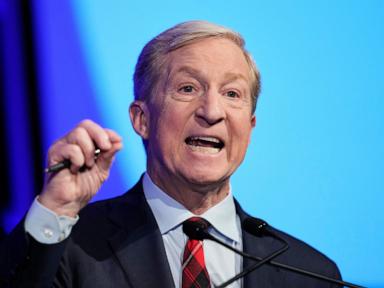
The media is having another collective meltdown over a billionaire trying to "buy" an election.
Open any major news outlet right now, and you will see the same lazy narrative plastered across the headlines: Tom Steyer is smashing records by dumping over $195 million into the California gubernatorial primary, and democracy is supposedly crying uncle. His rivals, like Xavier Becerra and Katie Porter, are whining to reporters that a massive personal fortune is distorting the democratic process.
They are wrong. They are missing the actual story because they are trapped in a political framework that died a decade ago.
The real takeaway from Steyer’s historic, eye-watering ad blitz isn't that money conquers all in politics. The real takeaway is that traditional political advertising has become an incredibly inefficient black hole for capital. Burning nearly $200 million just to hover at 15% to 19% in the polls ahead of the June 2 primary is not a showcase of structural power. It is a confession of marketing bankruptcy.
I have watched corporate entities and political campaigns torch fortunes on legacy media plays for twenty years. The mechanics are always identical: a candidate gets nervous, the consultants get greedy, and everyone agrees to flood the airwaves with generic, focus-grouped television ads that voters actively mute, skip, or ignore.
Steyer’s current campaign is the ultimate case study in the declining marginal returns of raw ad spend. If cash equaled compliance, he wouldn't be locked in a dead heat for second place with a Republican media personality and trailing a former Biden cabinet secretary who has spent a mere fraction of that amount.
The Illusion of the Megaphone
Political consultants love to measure campaigns by metrics that do not matter to the modern consumer. They talk about "gross rating points" and "media market saturation." They treat the electorate like a captive audience from 1994, assuming that if you run an ad enough times during the local evening news, the viewer will eventually capitulate.
Imagine a scenario where a consumer brand launches a new product. They buy up every billboard in Los Angeles, run commercials on every network, and pay off mid-tier internet personalities to hawk their goods. If that brand spends $195 million in a few months and only secures a meager 15% market share while its competitor spends $9 million and takes the lead, the CMO gets fired on the spot. Investors would call the strategy an unmitigated disaster.
Yet, when a political campaign does this, the press frames it as an existential threat to the republic.
The structural flaw in this logic is that airtime no longer equals attention. We live in a fragmented, hyper-skeptical media environment. When Steyer’s face pops up for the tenth time during a commercial break, it doesn't persuade a voter; it calcifies their annoyance. In fact, Becerra’s campaign launched an ad that perfectly captured this exhaustion, showing peaceful images of redwoods and ocean waves with a simple tagline: “You can stop the endless Tom Steyer ads. Vote Xavier Becerra.” That is a brilliant jujitsu move that turns an opponent's massive capital advantage into a psychological liability.
The Influencer Grift and the Death of Authenticity
Recognizing that legacy television ads are a dying medium, Steyer’s campaign tried to pivot to digital platforms. The campaign poured hundreds of thousands of dollars into paying social media influencers—including a reported $100,000 to a Texas-based creator with millions of TikTok followers—to manufacture organic-looking grassroots enthusiasm.
This strategy blew up in their faces. Why? Because the internet detects forced astroturfing instantly.
When a content creator who usually posts about daily life suddenly drops a highly polished endorsement for a billionaire running for office in a state the creator doesn't even live in, the audience's internal alarm bells ring. Regulatory bodies step in, videos get deleted due to lack of financial disclosure, and the entire endeavor ends up looking cheap, deceptive, and desperate.
The downside to this critique is obvious: yes, digital outreach is necessary. You cannot win a modern campaign exclusively through town halls and paper flyers. But buying influencer compliance like you are trying to move units of a new energy drink fundamentally misunderstands why people trust digital creators in the first place. Trust is non-transactional. The second a transaction is exposed, the utility of the message drops to zero.
The Meg Whitman Playbook Everyone Forgot
This isn't the first time California has seen this movie. In 2010, former eBay executive Meg Whitman burned through $178.5 million—mostly her own money—in a legendary bid for the governor’s mansion. When adjusted for inflation, Whitman’s spending still holds records, but the outcome is etched in political history: she lost by double digits to Jerry Brown, a career politician who ran a bare-bones, highly cynical, but deeply authentic campaign.
Steyer is running the exact same play, seemingly expecting a different result. In 2020, he spent over $253 million on a presidential primary run that netted him zero pledged delegates before he dropped out. Now, his gubernatorial campaign has outspent his nearest rivals twenty- to thirty-fold.
Let's look at the hard data from the recent polling cycles:
| Candidate | Estimated Ad/Campaign Spend (To Date) | Average Polling Support (May 2026) |
|---|---|---|
| Tom Steyer | ~$195,000,000 | 15% - 19% |
| Xavier Becerra | ~$9,000,000 | 19% - 20% |
| Steve Hilton | Minimal Legacy Spend | 17% - 18% |
Look at those numbers without the political bias. If this were an enterprise software rollout, the efficiency metrics would be horrific. Steyer is spending roughly $10 million for every percentage point of polling data, while his competitors are achieving identical or superior resonance through name recognition, clear messaging, and targeted earned media.
Stop Blaming the Money, Start Blaming the Message
The lazy consensus screams that money corrupts the process. The reality is far more embarrassing for the people spending it: money in modern politics is often just a substitute for a compelling message.
When a candidate possesses a clear, resonant theory of the case, they do not need to buy up every ad slot on the evening news to tell people who they are. They don’t need to pay eight different TikTok accounts $10,000 a pop to pretend to like them. The spending itself is a lagging indicator of a campaign that cannot generate organic momentum.
Steyer has attempted to position himself as a progressive outsider who wants to take on corporate monopolies and utility giants. But that message clashes violently with the structural reality of his campaign, which is being driven entirely by a massive, concentrated injection of private wealth. Voters are hypocrites about a lot of things, but they possess an acute sense for cognitive dissonance. You cannot successfully pitch yourself as the champion of the working class when your primary method of communication is a multi-million-dollar corporate-style carpet-bombing of the airwaves.
The industrial-political complex wants you to believe that a massive bank account is an unstoppable force in American elections. They want this because the consultants take a percentage of the media buy, the television networks rely on the ad revenue, and the losing candidates need a convenient excuse for why they got beat.
Steyer’s $195 million blitz hasn't broken the system. It has exposed its obsolescence. He has proved that in an era of absolute media fragmentation, saturation is no longer synonymous with persuasion. You can buy all the airtime in the world, but you still cannot buy an authentic connection with an exhausted electorate.