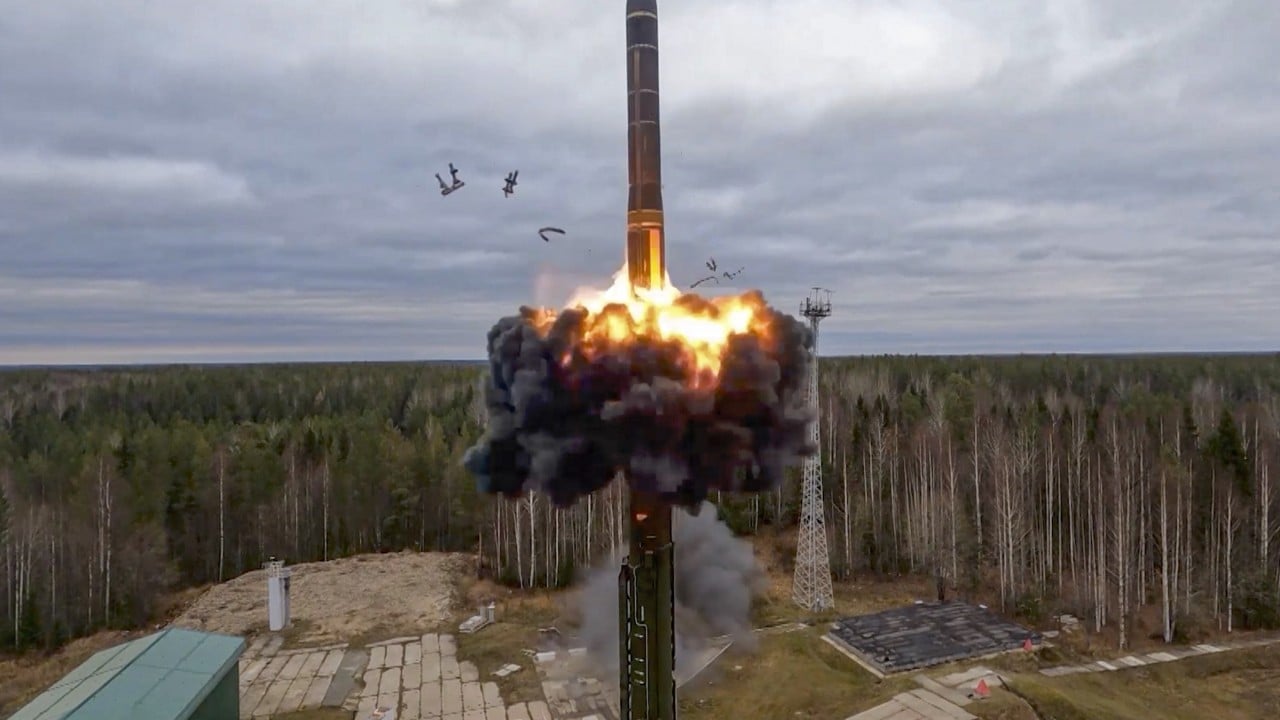
The fluorescent lights in an underground command bunker do not flicker, yet your eyes still ache from staring at the amber glow of a radar screen.
You are watching a blip. Just one. A speck of phosphor moving across the dark glass at twenty-four thousand kilometers per hour.
To understand what is currently unfolding behind closed doors in diplomatic suites from Washington to Beijing and Moscow, you have to step inside a hypothetical room like that one. Meet Elena. She is a fictional radar duty officer, a composite of the real men and women who have sat in windowless concrete vaults since the 1960s, holding the fate of the northern hemisphere on the bridge of their noses.
Elena’s coffee has gone cold. Her pulse is hammering against her collar. The radar array in northern Greenland has just flagged an incoming trajectory—a cluster of objects arcing over the polar cap.
In the old world, the world of 1983, Elena had roughly twenty minutes to decide if the world was ending. Twenty minutes to check the satellite infrared sensors, call the radar technicians to ask if solar glare was bouncing off high-altitude clouds, and wake a four-star general who would, in turn, wake a president. Twenty minutes is an eternity when you are sweating through your uniform, yet it was just enough time for human doubt to save the species.
In 1983, a Soviet lieutenant colonel named Stanislav Petrov sat in a similar bunker outside Moscow when an early-warning satellite screamed that five American Minuteman missiles were inbound. Petrov had a gut feeling. He knew the system was new, knew the angles of the autumn sun could trick the sensors, and refused to pass the warning up the chain of command. He waited. Nothing exploded. Because a human being hesitated, you are alive to read these words.
Now, strip away Elena’s twenty minutes.
Hypersonic glide vehicles do not follow predictable ballistic arcs; they skim the upper atmosphere at five times the speed of sound, maneuvering like fighter jets. Cyber intrusions can blind satellites before a single rocket leaves its silo. And sitting between the sensor and the launch key is a new kind of watch officer—an artificial intelligence trained on millions of war-game simulations, capable of processing telemetry, calculating blast radii, and recommending a retaliatory strike in four hundred milliseconds.
Blink. That was four hundred milliseconds.
This is the invisible terror driving an urgent, quiet scramble among the world's three largest nuclear powers ahead of the Asia-Pacific Economic Cooperation—APEC—summit. On paper, the diplomatic cables sound dry, almost bureaucratic. Officials from the United States, China, and Russia are attempting to hammer out a shared framework on artificial intelligence and nuclear command-and-control systems before their leaders meet face-to-face.
Strip away the diplomatic varnish, and you find three superpowers staring at the same nightmare: they have built machines that think too fast for human survival.
The Speed Trap
We tend to think of nuclear deterrence as a game of chess. Two grandmasters sitting across a mahogany board, calculating moves, bluffing, weighing the horrifying cost of knocking over the king.
That metaphor is dead.
Integrating artificial intelligence into early-warning systems and nuclear command networks turns chess into a knife fight in a pitch-black closet. Consider what happens when a machine is tasked with protecting a nation's second-strike capability—the guarantee that if you hit me, I will still have enough functioning warheads left to turn your cities into glass.
If an AI algorithm detects anomalies in enemy submarine communications, simultaneous power grid fluctuations, and strange thermal signatures at a distant launch site, it does not feel dread. It does not think about the elementary schools in Chicago, the night markets in Taipei, or the crowded metro stations in St. Petersburg. It calculates probability distributions. If the algorithm determines there is an eighty-seven percent chance a decapitating first strike is already underway, waiting even three minutes to wake a human president could mean losing the ability to retaliate at all.
The machine will scream now.
And if the adversary across the ocean is running a similar algorithmic defense network, their machine will see our machine preparing to fire, conclude with ninety-nine percent certainty that an attack is imminent, and launch first.
Flash.
Nobody pressed a button out of malice. Nobody lost their temper in a cabinet meeting. Two pieces of software simply out-calculated each other into extinction while the human leaders were still reaching for their reading glasses.
I spent years covering defense policy and sitting across from systems engineers who build autonomous defense architecture, and the thing that keeps them awake at night isn't a rogue terminator waking up and deciding it hates humanity. That is Hollywood nonsense. What terrifies the people who actually write the code is brittleness.
An AI system is like a brilliant, hyper-literal savant who has read every book in the library twice but has never stepped outside to feel the rain. Show a military image-recognition model a satellite photo of a convoy in cloudy weather, or feed it spoofed radar data injected by a clever hacker, and it can hallucinate a phantom invasion with absolute mathematical confidence. It cannot look out the window. It cannot call a technician in Greenland to ask if the sun is shining weirdly on the clouds.
Ghosts in the Diplomatic Machine
Why now? Why is the scramble to nail down an AI-nuclear agenda suddenly pressing right before the APEC talks?
Because the old guardrails have rotted away, and the new ones haven't been poured yet.
For decades, nuclear stability between Washington and Moscow rested on a thick stack of treaties—arms control agreements with painstaking verification protocols, hotline teletype machines, and regular inspections where American officers stood inside Russian missile silos with measuring tapes, and Russian inspectors did the same in Montana. Most of those treaties have collapsed into dust over the past decade. New START, the last remaining pillar of bilateral nuclear limits between the US and Russia, has been hanging by a frayed thread, crippled by suspended inspections and geopolitical hostility over the war in Ukraine.
Meanwhile, China has quietly, relentlessly transformed its nuclear posture. For half a century, Beijing maintained a small, minimalist nuclear arsenal designed purely to deter an attack—a "no first use" doctrine backed by a few hundred warheads kept separate from their missiles. That era is over. Pentagon assessments and independent satellite imagery show hundreds of new missile silos rising out of the desert floor in western China, putting Beijing on a trajectory to field over a thousand operational warheads by the end of the decade.
For the first time in human history, nuclear deterrence is no longer a two-player standoff. It is a three-body problem.
Physicists will tell you that while you can easily predict the gravitational dance of two celestial bodies orbiting each other, adding a third body introduces mathematical chaos. The orbits become wildly unpredictable. A tiny nudge in one direction sends the whole system spiraling.
In diplomacy, the three-body problem looks like this: Washington refuses to accept limits on its missile defenses if Beijing is rapidly expanding its arsenal. Beijing refuses to join formal arms-reduction talks while its stockpile is still a fraction of the size of America’s or Russia’s. And Moscow insists that British and French nuclear forces must be counted in any future math, while simultaneously threatening nuclear escalation on the borders of Europe.
Amidst this gridlock, artificial intelligence has emerged as the one terror all three capitals privately recognize, even if they struggle to agree on the wording of a press release.
Think back to the late autumn of 2023, when President Joe Biden and Chinese President Xi Jinping met at the Filoli estate outside San Francisco—on the sidelines of that year’s APEC summit. Behind closed doors, amid the manicured gardens and towering redwoods, the two leaders broached a subject that had been taboo for years: the intersection of AI and nuclear weapons. By May 2024, American and Chinese officials actually sat down in Geneva for their first formal intergovernmental dialogue on AI risks.
Later that year, in Lima, Peru, during the 2024 APEC gathering, Biden and Xi took a rare, concrete step forward. They issued a joint affirmation declaring that human beings—never artificial intelligence—must maintain absolute control over the decision to use nuclear weapons.
It was a start. A fragile, paper-thin promise whispered over a precipice.
Yet a promise between Washington and Beijing leaves a glaring, nuclear-armed elephant sitting in the room. Without Moscow at the table, any pledge to keep AI away from the nuclear trigger is like two neighbors agreeing not to store gasoline in their basements while the guy living between them stacks dynamite against the shared wall.
The Architecture of Trust
If you listen closely to the diplomats trying to stitch this agenda together ahead of the upcoming APEC meetings, you will hear a lot of dry phrases: confidence-building measures, crisis communication protocols, human-in-the-loop verification.
Let’s translate that diplomatic code into plain English, because the mechanics here are surprisingly personal.
Imagine you are trying to buy a house from someone you deeply distrust. You don't take their word that the roof doesn't leak; you hire an inspector. Now imagine the house is a nuclear command network, and the "leak" is an autonomous algorithm wired into a launch sequence.
How do you prove to an adversary that a human is truly in the loop without handing over the secret source code to your entire military defense network?
This is the puzzle driving negotiators crazy right now. Nobody in Washington is going to let a Russian engineer inspect the server racks beneath Offutt Air Force Base. Beijing is certainly not going to hand over the architectural blueprints of its Strategic Support Force to the Pentagon.
Instead, diplomats are trying to build behavioral guardrails. They are attempting to define what "human control" actually means in practice before the technology outpaces our vocabulary.
Does "human-in-the-loop" mean a four-star general has to type a twelve-digit launch code? What if an AI presents that general with a screen flashing red, tells him he has ninety seconds to live, and hides all the ambiguous sensor data that might make him hesitate? Technically, a human pressed the button. Practically, the machine made the decision.
Real human control requires friction. It requires designing command systems that deliberately slow down the tempo of a crisis, forcing military commanders to verify intelligence across multiple independent channels before an alert status can ever be escalated. It means keeping AI strictly quarantined in logistics, maintenance, and raw data sorting—never allowing an algorithm to recommend a strike option, and never connecting automated threat-detection systems directly to launch electronics.
Even harder is establishing crisis hotlines that actually work at machine speed. During the Cuban Missile Crisis in October 1962, it took hours for messages between John F. Kennedy and Nikita Khrushchev to be encoded, transmitted via Western Union telegraph, decoded, and translated. Those agonizing delays nearly triggered World War III.
Today, diplomats at the APEC preparatory talks are pushing for direct, encrypted, multi-channel military-to-military communication links specifically dedicated to cyber and AI anomalies. If a Chinese early-warning radar suddenly goes haywire due to a software glitch, or if an American satellite suffers an unexplained telemetry drop, a general in Beijing needs to be able to pick up a secure line and tell a general in the Pentagon: Our screens are screaming, we know it’s a bug, stand down.
Without that phone call, silence fills the vacuum. And in nuclear strategy, silence is always interpreted as preparation for a strike.
The Quiet Cost of Speed
There is a temptation, whenever we read about nuclear strategy or military AI, to treat it like weather—something vast, atmospheric, and entirely beyond the reach of ordinary people buying groceries or driving their kids to soccer practice.
That detachment is a defense mechanism. Who wants to spend their Tuesday afternoon thinking about megaton yields and algorithmic latency?
Yet I think back often to Stanislav Petrov, the Soviet officer who refused to trust his computer screen in 1983. Years after the Cold War ended, when the story was finally declassified and journalists tracked him down to a modest apartment outside Moscow, Petrov was asked how he knew the incoming missile warning was a false alarm.
He didn't have a mathematical proof. He didn't have a secondary satellite feed.
"I had a funny feeling in my gut," Petrov told the reporters. "I didn't want to make a mistake. I made a decision, and that was it."
Think about that phrase. I didn't want to make a mistake.
We spend billions of dollars every year trying to engineer human fallibility out of our lives. We want cars that don't swerve, trading algorithms that don't panic, medical diagnostics that don't miss a shadow on an X-ray, and defense networks that don't blink. We worship speed and certainty because human hesitation looks, on a spreadsheet, like inefficiency.
In the quiet conference rooms where American, Chinese, and Russian negotiators are arguing over comma placements in an APEC declaration, they are confronting a truth that Silicon Valley and the defense contractors rarely admit out loud: when the stakes are total annihilation, inefficiency is the only thing keeping us alive.
Doubt is a safety feature. Fear is a circuit breaker. The trembling hand of a duty officer reaching for a cold cup of coffee at three in the morning is not a bug in the system; it is the system's finest, most irreplaceable component.
If the negotiators succeed in anchoring a binding, trilateral commitment to keep AI away from the nuclear trigger, there will be no ticker-tape parades. No statues will be erected for the mid-level diplomats who spent eighteen-hour days arguing over verification protocols in windowless rooms. The headlines will run for a single news cycle, tucked between stock market updates and celebrity gossip, and then vanish.
The victory will look like nothing at all. Just another ordinary morning. Sunlight hitting high-altitude clouds over Greenland, a radar officer rubbing tired eyes in an underground bunker, and a three-minute silence where nothing happens, and the world keeps turning.


