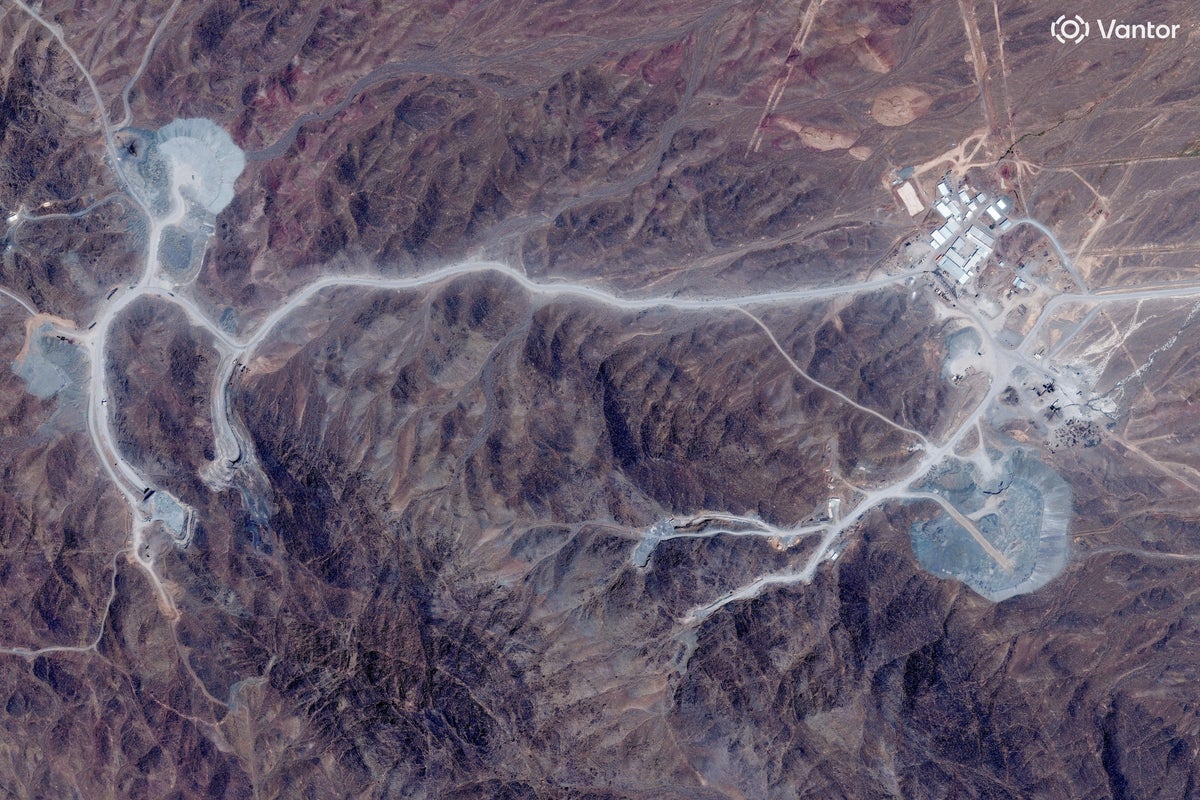
The media cycle loves a bunker-buster narrative.
Mention a super-fortified underground complex, drop a high-profile threat to flatten it, and headlines practically write themselves. The collective commentary instantly zeroes in on the physics: How deep is the bedrock? How many feet of reinforced concrete protect the centrifuges? Which specific bomb in the Western arsenal can penetrate Pickaxe Mountain—or Fordow, or whatever name top brass attaches to the latest subterranean facility?
This entire focus is fundamentally flawed.
By fixating on whether a specific airframe can drop a heavy precision-guided weapon deep enough into a mountain to crack a bunker, analysts fall for a classic military distraction. Bombing Pickaxe Mountain isn't a silver bullet. In fact, treating physical destruction as a total solution misunderstands how modern nuclear proliferation, regional strategy, and hardened infrastructure actually operate.
The Depth Fallacy: Stop Counting Meters of Granite
The conventional debate treats hardened facilities like medieval castles. The assumption goes: build a deep enough wall, and you are safe; build a big enough catapult, and you break through.
Military engineers and defense analysts know this logic breaks down quickly in practice.
A site built deep under a mountain isn't just designed to survive a direct kinetic strike on its main halls. It's built as an integrated system. Even if a heavy warhead fails to collapse the central centrifuge hall, a targeted strike doesn't need to pulverize every single piece of equipment inside to render a facility totally useless.
- Ventilation and Power: Centrifuges rely on precise environmental controls and uninterrupted electrical feeds. Sever the high-voltage connections, destroy the external cooling arrays, or collapse the air intake shafts, and the operational capability inside halts regardless of whether the ceiling holds.
- Access and Logistics: A facility buried under hundreds of feet of solid rock still requires roads, portals, and support infrastructure. Seal the entrances with precise strikes, and you convert a high-tech enrichment site into a sealed subterranean tomb for delicate equipment.
- Redundancy and Dispersal: Real proliferation programs do not rely on single points of failure. While the public fixates on one high-profile mountain facility, the critical elements—knowledge, software, raw materials, and assembly lines—are distributed across dozens of unglamorous, low-profile sites nationwide.
Focusing exclusively on whether an air strike can completely obliterate a mountain bunker misses the operational reality. You don't need to turn a mountain into dust to neutralize a threat, nor does cratering a tunnel entrance permanently eliminate a nation's technical know-how.
The Dispersal Reality: Knowledge Outlives Concrete
Having spent years analyzing defense posture and strategic infrastructure, one pattern becomes brutally clear: heavy kinetic options create an illusion of a definitive fix.
They offer a dramatic, countable outcome for strategic planners. But physical structures are merely containers. The real capability lies in human capital, supply chains, and industrial supply lines.
When a state commits to underground enrichment, the physical plant is the final stage of a massive, distributed network. Destroying a primary site simply accelerates the shift toward smaller, more covert facilities.
Consider what happens the day after a major strike on a site like Pickaxe Mountain:
- Strategic Shift: The targeted nation moves remaining assets into smaller, less detectable civilian or urban locations, making future monitoring exponentially harder for international inspectors.
- Breakdown of Oversight: International monitoring regimes and safeguards vanish instantly once active kinetic strikes begin, leaving intelligence agencies blind to covert activities.
- Escalation Drivers: A direct attack on hardened sovereign infrastructure forces a military response, transforming a containment effort into an uncontained regional conflict.
The hard truth is that kinetic strikes against hardened facilities buy brief operational pauses, not permanent solutions. They trade long-term visibility for short-term political theater.
Addressing the Flawed Questions
Public discussions around deep-underground nuclear sites usually revolve around three main questions. Every single one of them asks the wrong thing.
Can bunker-buster munitions destroy a facility built under a mountain?
This question assumes a binary outcome: total destruction or total failure. In modern warfare, total physical destruction isn't the metric for success. Disruption is. Disabling access, severing power grids, and destroying key surface support structures render a facility inoperable without needing to collapse the bedrock.
Does building underground prove a program is purely military?
Hardening a site underground proves a country expects to be attacked; it doesn't automatically reveal the ultimate political or strategic use of the material being processed inside. Relying on facility depth alone as a substitute for hard intelligence regarding intent leads to massive strategic miscalculations.
Will destroying a primary enrichment site end nuclear risk?
No. Physical infrastructure can be rebuilt. Centrifuges can be manufactured again. The technical expertise, software models, and engineering blueprints cannot be erased with gravity bombs. Strike a central site, and you simply scatter the expertise into harder-to-track, smaller operations.
The Uncomfortable Trade-Off
Challenging the standard "just bomb the mountain" stance doesn't mean ignoring the threat posed by unmonitored enrichment. Hardened underground sites present genuine security challenges.
However, pretending that a single operational campaign solves a complex geopolitical and technological challenge is dangerous.
The downside to a purely non-kinetic, containment-focused strategy is obvious: it requires constant, grinding intelligence work, aggressive supply-chain interdiction, severe economic pressure, and endless diplomatic maneuvering. It lacks the clear, decisive image of a smoke plume rising over a target. It demands patience in an environment that craves instant resolution.
Planners must choose between two outcomes: the visual satisfaction of a cratered tunnel portal that leaves the underlying expertise intact and driven underground, or the tedious work of supply-chain disruption and intelligence saturation that keeps the threat contained over decades.
Stop staring at the mountain. Watch the supply lines, the university labs, and the procurement networks instead. That is where proliferation actually happens.