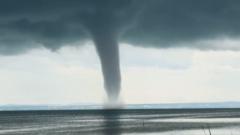
The generation of a high-aspect-ratio waterspout over an inland lake is frequently reported in popular media as an isolated, spectacular anomaly. This qualitative framing obscures the deterministic fluid dynamics and thermodynamic gradients that govern the phenomenon. A waterspout is not a random atmospheric event; it is a highly localized, buoyant convective plume driven by a critical imbalance between surface water temperatures and the overlying air mass. When cold, post-frontal air moves across a warm, inland body of water, it establishes a state of extreme thermal instability confined to the lowest hundreds of meters of the atmosphere.
To systematically evaluate the formation, structural maintenance, and eventual decay of these non-mesocyclonic vortices, the phenomenon must be deconstructed into three interdependent phases: boundary layer destabilization, vorticity convergence, and frictional dissipation.
The Thermodynamic Driver: Boundary Layer Destabilization
The primary engine of a fair-weather waterspout is the localized vertical temperature gradient directly above the water surface. Unlike land-based tornadoes that depend on deep, rotating supercell thunderstorms driven by vertical wind shear, lake-surface waterspouts emerge from shallow convective clouds, typically cumulus congestus.
The process initiates when a continental polar or maritime arctic air mass advects over an inland lake that has retained significant thermal energy from solar radiation. This creates a stark temperature differential. The water heats the immediate, touching layer of air via conduction, saturating it with water vapor. This ultra-thin boundary layer becomes significantly warmer and less dense than the dry, cold air immediately above it.
This configuration triggers a high rate of sensible and latent heat flux, generating a state of absolute instability within the lowest 100 to 1000 meters of the atmosphere. The convective available potential energy ($CAPE$) in these scenarios does not need to be massive in total volume, but it must be concentrated entirely within this shallow boundary layer. This localized, high-density buoyancy forces rapid, narrow parcels of air to accelerate vertically.
The Kinematic Mechanism: Vortex Stretching and Convergence
Buoyancy alone cannot produce a organized, rotating column. The transition from a simple convective updraft to a high-velocity vortex requires a pre-existing source of horizontal spin near the surface, which is then concentrated through mass convergence.
Boundary Layer Convergence Lines
Inland lakes feature distinct microclimatic boundaries. Land breezes, caused by the rapid nocturnal cooling of the surrounding terrain relative to the water, push cool air outward from the shores toward the center of the lake. Where these localized winds meet from opposing shores, or where they intersect the prevailing synoptic-scale wind flow, a sharp line of surface convergence forms. Along this convergence line, the air has nowhere to go but upward.
Microscale Vorticity Centers
The collision of these opposing air currents creates horizontal shear zones, forming a series of small, spinning eddies along the boundary line. These microscopic rotations are initially disorganized and possess low rotational velocity.
Vertical Elongation
As a developing cumulus cloud moves directly over this convergence zone, its main updraft acts as a powerful atmospheric vacuum. The upward acceleration of air forces the horizontal spinning eddies to tilt vertically. As the air parcels are drawn upward into the narrow convective throat of the cloud, conservation of angular momentum dictates that the radius of the rotating column must decrease.
$$L = I\omega$$
Where $L$ is angular momentum, $I$ is the moment of inertia, and $\omega$ is angular velocity. Because the radius shrinks drastically as air converges toward the central core, the rotational velocity ($\omega$) must spike exponentially to maintain the conservation of $L$. This intense stretching concentrates the diffuse vorticity into a visible, tightly bound column: the waterspout funnel.
Structural Anatomy and Condensed Core Dynamics
The visible funnel of a waterspout is not made of liquid water drawn upward from the lake surface. Instead, it is a cloud of droplets formed by pressure-induced condensation.
The rapid rotation of the air column creates a strong centrifugal force that flings air particles outward from the rotational axis. This creates an extreme low-pressure core at the center of the vortex. As air is sucked into this central low-pressure zone, it experiences rapid adiabatic expansion, which causes the temperature within the core to drop instantly below the dew point. The moisture in the air condenses, making the spinning column visible to observers.
While the primary structure consists of condensed atmospheric vapor, the extreme wind speeds at the immediate base of the vortex create a secondary feature: the spray ring or cascade. When the vortex core makes contact with the water surface, the sheer stress breaks the surface tension of the lake, lifting a localized mist of liquid lake water into a rotating collar around the base of the funnel.
Operational Constraints and Decay Vectors
The lifecycle of an inland waterspout is remarkably short, typically spanning between 5 and 20 minutes, due to its vulnerability to minor environmental shifts. The system operates on a fragile equilibrium that is broken by two primary vectors:
- Thermal Exhaustion: The intense updraft required to maintain the vortex relies on a continuous supply of warm, moist air from the lake surface. As the waterspout moves, or as the cold air mass thoroughly mixes with the warm surface skin layer of the water, the local temperature gradient flattens. Without the buoyancy differential, vertical acceleration stalls, and the vortex loses its structural integrity.
- Kinematic Disconnection: A waterspout requires precise vertical alignment between the surface convergence pool and the overhead cloud base updraft. If upper-level winds exhibit even moderate horizontal shear, the top of the convective cloud will be pushed horizontally away from the surface origin point. This tilts the vortex column, stretching it until the frictional drag from the surrounding air destroys the rotational momentum.
Predicting these localized phenomena requires deploying high-resolution microclimatic monitoring networks along vulnerable inland lake basins. Standard regional forecasting models lack the spatial resolution to capture the sub-kilometer convergence lines that trigger vortex stretching. Operational meteorology must prioritize real-time Doppler radar analysis of low-level velocity anomalies and automated lake-buoy thermal sensors to identify when the water-to-air temperature differential crosses the critical threshold for spontaneous localized cyclogenesis.