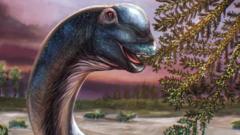
The headlines are predictable. They scream about "Giant New Dinosaurs" and "Titanosaurs" discovered in Thailand's Phu Noy site as if size is the only metric of evolutionary success. It is the clickbait of the Mesozoic. We have been conditioned to believe that if a fossil doesn't rival a Boeing 737 in length, it is merely background noise in the fossil record. This obsession with the "biggest" and the "newest" is blinding us to a much more uncomfortable reality about how evolution actually functions.
Paleontology is currently stuck in a cycle of trophy hunting. When researchers announce Minimocursor phunoyensis or similar finds, the press immediately pivots to how big its cousins were or how it "dominates" the landscape. This is a fundamental misunderstanding of biological fitness. We are celebrating the outliers while ignoring the mechanics of the system.
The Myth of the Evolutionary Ladder
The common narrative suggests that dinosaurs were on a linear path toward becoming giants, culminating in the massive sauropods of the Late Cretaceous. This is nonsense. Evolution is not an escalator; it is a chaotic bush.
Smaller ornithischians, like those being pulled from the dust in Kalasin province, are not "lesser" versions of the giants. They are the high-performance sports cars of their era—efficient, agile, and arguably more successful in their specific niches than the lumbering behemoths that required literal tons of vegetation just to survive a Tuesday.
When we focus solely on the "Giant" tag, we miss the data on resource scarcity and climate adaptation. Thailand’s fossil beds are significant not because they produce monsters, but because they provide a window into a specific, high-stress ecosystem. The real story isn't the size of the bone; it is the bone histology that tells us how fast these animals grew and how they survived a environment that would have killed a less specialized creature in a week.
Stop Asking if it is the Biggest
"Is it the largest dinosaur ever found in Southeast Asia?"
This is the wrong question. It is a vanity metric. I have watched academic departments pour funding into "big bone" digs while ignoring micro-fossil sites that contain the actual keys to understanding biodiversity. Finding a massive femur is like finding a discarded engine block in a junkyard. It’s impressive, but it tells you very little about how the traffic flowed.
We should be asking about the basal characteristics. Why did these lineages persist in Southeast Asia while their counterparts elsewhere were being outcompeted?
The Phu Noy finds suggest a refugium—a place where "primitive" lineages didn't just survive, but thrived. That challenges the status quo of "progressive" evolution. It suggests that if the environment is stable, there is zero pressure to change. The "giant" dinosaurs were likely evolutionary dead-ends that required hyper-specific conditions to exist. The smaller, "uninteresting" finds are the ones that actually carried the genetic torch.
The Problem with Fossil Inflation
There is a dirty secret in paleontology: species inflation. There is a massive professional incentive to declare every new find a "new species" or a "new genus."
If you find a slightly different vertebrae in the Khorat Plateau, you can either call it a regional variation of an existing animal or you can "identify" a brand-new giant. The latter gets you a cover story and more grant money. The former gets you a footnote.
I’ve seen researchers agonize over millimeters of bone growth just to justify a new name. This creates a cluttered taxonomy that serves human egos more than scientific clarity. We are likely looking at a far smaller number of species with much higher levels of individual variation. Think about the skeletal difference between a Great Dane and a Chihuahua. If a paleontologist found those 60 million years from now without context, they would claim they were entirely different families.
We are doing the same thing with Thai dinosaurs. We are mistaking ontogeny—the growth stages of an animal—for phylogeny.
Data Over Drama
The tech we use to analyze these fossils is where the real disruption is happening, yet it gets sidelined for artist’s renderings of roaring lizards. Synchrotron radiation and high-resolution CT scanning are revealing internal vascular structures that prove these animals were far more metabolically active than we previously assumed.
We are no longer just looking at rocks. We are looking at biological blueprints.
The fossils from Thailand are rich in silica, preserving microscopic details. Instead of focusing on the "giant" scale, look at the osteocytes. The density of these cells suggests that these dinosaurs had growth rates that would make modern mammals look sluggish.
Why the "Tropical Giant" Theory is Flawed
The competitor article likely leans on the idea that Thailand’s lush, tropical Mesozoic environment was a "paradise" for giants. This is a lazy assumption. Tropical environments are often nutrient-poor because high rainfall leaches minerals from the soil.
Giantism in these regions isn't a sign of plenty; it is often a desperate adaptation to a low-quality diet. You need a massive gut to ferment the low-energy fibrous plants found in these prehistoric jungles. The "Giant" isn't a king; it’s a biological trash compactor.
The Actionable Truth for the Enthusiast
If you want to actually understand what is happening in Thailand, stop looking at the size charts.
- Follow the teeth: The wear patterns on the teeth found in the Phu Noy site tell us more about the shifting climate than a thousand giant ribcages. They show a shift from soft ferns to tougher, drought-resistant flora.
- Ignore the "Missing Link" labels: Nothing is a missing link. Everything is a transitional form. Labeling a Thai dinosaur as a "link" between two other species is a narrative device, not a scientific fact.
- Watch the sediment: The geography of the Khorat Group tells us these animals were living in a high-energy river system. Their "giant" size might just be a byproduct of taphonomic bias—meaning only the big, heavy bones survived the rushing water to be fossilized, while the smaller, more important species were washed away or crushed.
We have a massive selection bias in what we find and what we choose to celebrate. We are looking at a fragmented puzzle and pretending the biggest piece is the most important one just because it’s the easiest to see.
The giants of Thailand aren't a breakthrough because they are big. They are a warning that our current methods of categorizing life are obsessed with the superlative at the expense of the systemic. If we don't start valuing the "small" data, we will continue to miss the forest for the sauropods.
The next time you see a headline about a "Giant New Dinosaur," remember that size is often just a mask for biological desperation. Stop worshipping the scale and start looking at the survival.