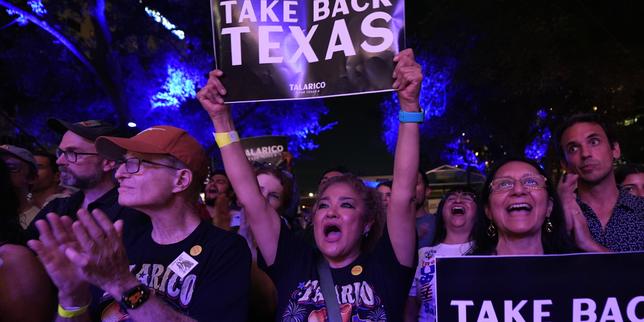
Every two years, political observers stare at demographic spreadsheets from Austin, Dallas, and Houston and declare that Texas is finally turning blue. For the 2026 midterms, the narrative has returned with familiar intensity, fueled by rapid suburban expansion, shifting voter registration numbers, and national headwinds against the party in power. Yet the actual electoral math on the ground tells a far more complicated story. While Democrats have steadily narrowed margins in major metropolitan counties over the last decade, structural barriers, persistent turnout gaps, and shifting allegiances among working-class border voters continue to keep a statewide political flip out of easy reach.
The hype never really dies. It just hibernates between November cycles.
To understand why the "blue Texas" thesis repeatedly stalls at the finish line, you have to look past raw population growth and examine who actually shows up to cast a ballot when the presidency is not on the line. Midterm electorates in Texas are historically older, whiter, and significantly more conservative than presidential electorates. Even as millions of new residents have poured into the state from California, New York, and the Midwest over the past decade, exit polling and voter file analyses consistently reveal that domestic transplants to Texas are often more conservative than native-born Texans. The assumption that urban sprawl automatically translates into progressive votes is one of the most expensive miscalculations in modern American campaign history.
The Anatomy of the Texas Electorate
Texas is not a monolithic red state, nor is it a dormant blue giant waiting to wake up. It is a non-voting state. For decades, Texas has ranked near the bottom nationally in voter turnout, creating a massive pool of unregistered or sporadic voters that national strategists view as untapped potential. The problem is that converting non-voters into reliable midterm participants requires sustained, year-round organizational infrastructure rather than last-minute television ad blitzes.
Consider the geographic distribution of the state's 254 counties. Roughly two-thirds of the entire population resides within the Texas Triangle, the massive megaregion anchored by Dallas-Fort Worth, Houston, San Antonio, and Austin. Inside the urban cores of Harris, Dallas, Travis, and Bexar counties, Democratic margins are overwhelming. However, elections are won on net vote totals, not county maps.
To win statewide, a Democratic candidate must run up astronomical margins in those four urban anchors while holding their losses down in the surrounding exurban ring counties like Collin, Denton, Montgomery, and Fort Bend. In recent cycles, suburban counties have indeed drifted toward the center, driven largely by college-educated voters alienated by hardline social policies. Yet that suburban gain has been repeatedly offset by two countervailing forces that national commentators routinely underestimate: astronomical Republican turnout in rural counties and a dramatic realignment along the Texas-Mexico border.
The Rio Grande Valley Realignment
For more than a century, South Texas was an impenetrable Democratic fortress. Counties stretching from El Paso down to Brownsville delivered lopsided margins that reliably cushioned Democratic candidates against rural losses in East and West Texas. That historical firewall cracked in 2020 and fractured further in subsequent cycles.
In the Rio Grande Valley, economic anxiety, cultural conservatism, and deep frustration over federal border enforcement have reshaped local politics. Voters in counties like Hidalgo, Cameron, and Starr—many of whom work in oil and gas, agriculture, law enforcement, or logistics—have increasingly gravitated toward Republican messaging on energy independence, inflation, and border security. When a party loses twenty to thirty points of margin in a region it once took for granted, the math required to win statewide becomes almost impossible to assemble elsewhere.
Structural Friction and Legislative Maps
Even if demographic trends were moving exclusively in one direction, political power in Texas is insulated by aggressive structural engineering. Following the 2020 census, the Republican-controlled Texas Legislature redrew congressional and state legislative districts to maximize partisan durability. Rather than creating competitive swing districts that force candidates to appeal to the political center, mapmakers packed Democratic voters into overwhelmingly safe urban districts while carving suburban growth into sprawling rural-dominated seats.
The result is a political ecosystem where the decisive election is almost always the March primary, not the November general election.
When lawmakers only fear a challenge from their own ideological flank, governance shifts sharply away from the median voter. In Texas, low-turnout Republican primaries—often decided by fewer than ten percent of registered voters—dictate the policy agenda on everything from public education funding and property taxes to reproductive rights and energy regulation. Moderate incumbents who deviate from party orthodoxy face well-funded primary challengers backed by billionaire-funded political action committees, creating a powerful incentive for ideological conformity.
The Money Trap and National Narratives
Every cycle, hundreds of millions of dollars flow into Texas campaigns from out-of-state donors eager to deliver a symbolic knockout blow to conservative dominance. High-profile Senate and gubernatorial races routinely shatter fundraising records, turning local contests into national media spectacles.
Money buys airtime. It does not buy trust.
Campaigns flush with national cash frequently fall into the trap of running nationalized messaging strategies designed to appeal to coastal donors rather than local swing voters. In Texas, a winning statewide coalition requires speaking fluently to suburban moderates concerned about public school funding and healthcare access, while simultaneously reassuring energy workers in the Permian Basin and small business owners in the suburbs that their livelihoods are not under threat. When campaigns rely on national talking points, they alienate the exact cross-pressured voters needed to bridge the statewide deficit.
Furthermore, the sheer size of the state makes traditional retail campaigning nearly impossible. Texas spans twenty media markets. Running a competitive statewide television campaign requires buying expensive ad inventory simultaneously in Dallas, Houston, Austin, San Antonio, El Paso, McAllen, and Midland-Odessa. A candidate can spend fifty million dollars on television and still struggle to achieve basic name recognition among infrequent voters in outlying regions.
What Actually Moves the Needle in a Midterm
If a genuine political shift is going to materialize in Texas during a midterm cycle, it will not happen because of a sudden demographic miracle. It will happen only if specific, measurable conditions align simultaneously.
First, midterm turnout dynamics must break historical precedent. Historically, the party that holds the White House suffers significant enthusiasm drop-offs in midterm elections, while the opposition party surges. For Texas Democrats to capitalize on national midterm headwinds, they cannot merely rely on angry partisans showing up; they must substantially narrow the turnout gap among voters under thirty-five and infrequent voters in major metropolitan areas.
Second, the issue environment must center on kitchen-table economics and state-level governance rather than abstract cultural battles. Texas voters across the political spectrum are acutely sensitive to rising property taxes, homeowners insurance spikes, grid reliability, and public school funding. When the political conversation focuses on tangible quality-of-life issues—such as whether the state electrical grid can withstand extreme weather or why local school districts are facing budget deficits—suburban independents become far more willing to split their tickets or cross party lines.
Third, candidate quality remains non-negotiable. Texas voters have demonstrated a willingness to punish candidates perceived as extreme or unprepared, even within the dominant party. A statewide contender capable of flipping the script must possess deep local credibility, a disciplined economic message, and the ability to survive a grueling primary without taking positions that become fatal liabilities in November.
The Reality Behind the Headlines
Observing Texas politics from afar invites sweeping generalizations. From a distance, the state looks like a powder keg of demographic change ready to detonate at any moment. Up close, the picture is defined by inertia, institutional power, and deep regional divides.
The suburbs are undeniably changing, and the long-term trajectory of Texas politics remains contested ground. Major cities continue to grow faster than rural counties, and younger generations hold markedly different views on social and environmental issues than their parents. Yet political eras do not end simply because a spreadsheet predicts they should. Until opposition organizers solve the chronic turnout deficit in urban cores, stem their losses along the southern border, and build permanent local infrastructure that survives between election years, predictions of an imminent Texas flip will remain what they have been for two decades: a compelling headline in search of actual votes.