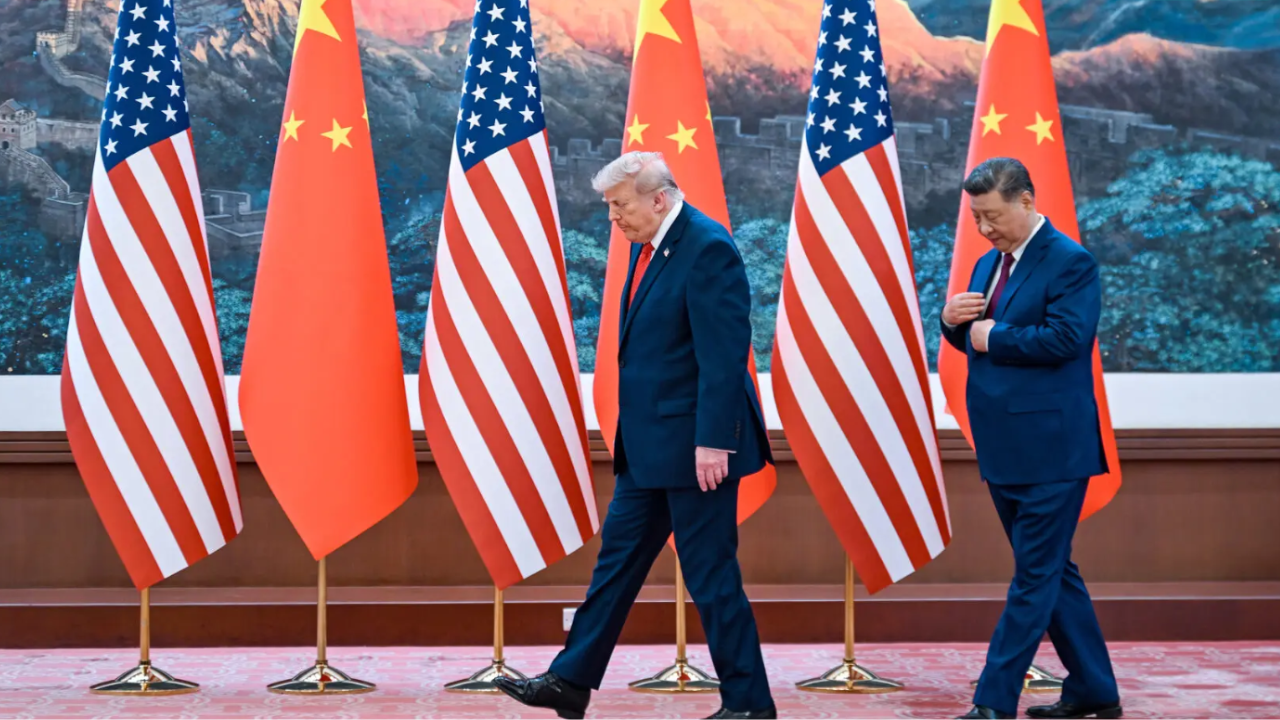
The official recap of a high-stakes presidential meeting usually tells you what happened. Sometimes, what it leaves out is a lot more interesting.
The White House just released its official summary of Donald Trump’s intense two-day summit with Chinese President Xi Jinping in Beijing. If you scan the document, you will see plenty of bragging about massive commercial wins. You will read about agricultural commitments, plane orders, and rare earth minerals. You will even see a surprising alignment on the geopolitical crisis in the Middle East.
What you won't see is the word Taiwan.
It is completely missing. Not a single mention.
This omission is jarring because we know from both delegations that the self-governed island was a central topic during the two-and-a-half-hour face-to-face meeting. Xi Jinping went as far as warning Trump directly that mishandling Taiwan could drag the world's two largest economies straight into an open military conflict.
Yet, on paper, Washington chose to behave as if the flashpoint didn't exist. This isn't an administrative oversight. It's a calculated diplomatic erasure that tells us exactly how the administration intends to handle Beijing moving forward. It's a strategy that treats existential geopolitical security as a transactional bargaining chip.
The Massive Corporate Checkbook and the Missing Flashpoint
Instead of addressing the security architecture of the Indo-Pacific, the official White House summary reads like a corporate earnings report. The administration used the document to showcase major transactional wins designed to appeal directly to voters back home.
Look at the actual numbers secured during the Beijing trip. China committed to buying at least $17 billion worth of American agricultural products annually through 2028. Beijing also agreed to restore market access for over 400 U.S. beef facilities and lifted restrictions on poultry imports that had been tied to bird flu fears.
Then came the crown jewel of the trade package: an initial purchase of 200 Boeing aircraft for Chinese airlines. It's the first major, multi-billion-dollar commitment for American-made Boeing planes from China since 2017.
To top it off, Trump secured promises from Xi to address critical supply chain vulnerabilities. China promised to help resolve American shortages of essential rare earth minerals, specifically naming critical materials like yttrium, scandium, neodymium, and indium. These elements are vital for everything from defense tech to smartphone manufacturing.
To manage all these new arrangements, the two leaders established two brand-new bureaucratic entities: the U.S.-China Board of Trade and the U.S.-China Board of Investment.
On the surface, it looks like an old-school trade victory. But by packing the official summary with beef, planes, and minerals, the administration purposely crowded out the tense, underlying reality of the security discussions. Taipei was benched so Boeing could fly.
Using Weapons as a Negotiating Chip
Behind closed doors, the conversation about Taiwan wasn't just ignored; it was used as leverage.
Before landing in Beijing, the administration quietly delayed notifying Congress about a planned $14 billion arms package for Taiwan. The delay was meant to avoid irritating Xi before the cameras started rolling.
Once the summit wrapped up, Trump didn't hide the fact that Taiwan's defense needs were being factored into broader trade negotiations. In post-summit interviews, he openly acknowledged that he and Xi "talked a lot about Taiwan." He then admitted he was reconsidering that multi-billion-dollar weapons package because of Xi's intense objections.
Worse for Taipei, Trump explicitly referred to the approved defensive arms sale as a "negotiating chip."
This language sent shockwaves through Taipei. For decades, U.S. support for Taiwan has been framed around shared democratic values and regional stability. Treating defensive military aid as a fungible asset that can be traded away for plane orders or agricultural quotas changes the game entirely. It signals to Beijing that everything, including regional defense commitments, has a price tag.
While Taiwan's Ministry of Foreign Affairs quickly issued a statement calling U.S. arms sales a "cornerstone of regional peace," the reality is clear. The administration is willing to pause or scale back concrete security commitments to keep a fragile economic peace alive.
The Secret Accord on Iran and Global Energy
The other reason Taiwan was left out of the public paperwork is that the administration needed China's cooperation on a much more immediate global fire: Iran.
The ongoing war in Iran and the constant threat of shipping disruptions in the Middle East have driven global economic anxiety to dangerous levels. Washington needed Beijing to blink, and according to the summit readouts, they found some rare common ground.
The White House summary notes that Trump and Xi agreed on two major points regarding the Middle East:
- Iran absolutely cannot be allowed to possess a nuclear weapon.
- The strategic Strait of Hormuz must be reopened immediately, with both leaders agreeing that "no country or organisation can be allowed to charge tolls" on maritime shipping.
This is a significant diplomatic development. China is Iran’s biggest oil customer and a major economic lifeline for Tehran. Getting Xi to sign off on a public statement defending freedom of navigation in the strait is a clear win for Washington's pressure campaign.
But don't confuse a shared statement for a shared foreign policy. Independent analysts at the Council on Foreign Relations point out that China is playing a delicate double game. While Xi agreed that the strait must stay open to protect China's own energy imports, Chinese diplomats at the United Nations are simultaneously criticizing U.S.-backed resolutions aimed at pressuring Iran.
Furthermore, intelligence reports show that Chinese firms continue to supply Iran with dual-use components used in missile and drone programs. Trump hinted that he might offer flexibility on sanctions targeting smaller Chinese "teapot" refineries that process Iranian crude, potentially swapping sanctions enforcement relief for Chinese purchases of U.S. crude oil.
By focusing the public narrative on Middle Eastern stability and energy security, the White House successfully shifted the global conversation away from East Asia, where the risk of long-term conflict remains far higher.
Xi's Three Year Truce
What did Beijing get out of this narrative shift? They got time.
Chinese officials are calling the new diplomatic framework a "constructive relationship of strategic stability." According to readouts from the Chinese Foreign Ministry, Beijing views this framework as a new model to manage relations over the next three years.
Xi Jinping’s main goal wasn't to solve every dispute with Washington. It was to lock in a predictable truce that keeps American tariffs and export controls predictable, establishing a post-trade war détente as the new baseline.
If Beijing can convince Washington to view the relationship through this new framework of "strategic stability," any future U.S. efforts to counter Chinese industrial overcapacity or deter aggression in the South China Sea can be framed by Beijing as a violation of the summit's agreements.
Xi offered big-ticket commercial purchases and helpful rhetoric on Iran to buy a multi-year window of stability. Trump accepted those terms because they offer immediate, headline-ready economic victories.
Reading Between the Diplomatic Lines
If you want to know what the near future of U.S.-China relations looks like, ignore the warm words about a "G-2 moment" or the announcement that Xi will visit Washington later this year. Look at what happens on the water.
Right after Trump’s delegation departed Beijing, Taiwan’s defense ministry detected eight Chinese naval vessels and an additional military ship operating directly inside or near its territorial waters. The military pressure on the island hasn't stopped; it has simply been decoupled from the public-facing diplomatic relationship.
For corporate executives, agricultural exporters, and aerospace manufacturers, the summit is an immediate win. New trade boards are being built, and billions of dollars in orders are moving forward.
But for security planners in the Pacific, the White House fact sheet is a warning. If you aren't mentioned in the summary, you're on the table as a concession.
Watch the delayed Taiwan arms package over the coming weeks. If the administration quietly scales back the $14 billion deal, or continues to delay congressional notification, it will confirm that the erasure of Taiwan from the summit paperwork wasn't a temporary diplomatic courtesy. It will prove that Washington’s long-standing security commitments are now actively for sale.