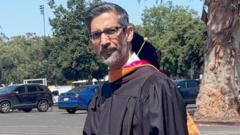
Graduation day at Stanford is usually famous for its "Wacky Walk"—a decades-long tradition where students march into the stadium riding inflatable horses, wearing cardboard replicas of Caltrain, or sporting nothing but red briefs and sunglasses under their gowns. But yesterday, the whimsical atmosphere evaporated the moment Stanford President Jonathan Levin introduced the keynote speaker.
As Google CEO Sundar Pichai took the stage, the celebratory mood clashed with raw political protest. Around 200 graduating students stood up, turned their backs, and walked right out of Stanford Stadium. They waved Palestinian flags, blew whistles, and hoisted banners reading "Genocide Runs on Google" and "ICE spies with Google AI."
For Pichai, a Stanford alumnus who earned his master's degree here in 1995, it was a rocky homecoming. The mass exit wasn't an organic outburst. It was a highly coordinated demonstration organized by groups like Students for Justice in Palestine (SJP) and No Tech for Apartheid.
If you think this was just another campus protest about geopolitical conflict, you're missing the bigger picture. This walkout signals a deepening rift between Big Tech executives and the next generation of engineering talent.
The $1.2 Billion Reason Behind the Stanford Protest
The anger directed at Pichai stems from a specific corporate contract. Activists are targeting Project Nimbus, a $1.2 billion cloud-computing agreement signed in 2021 between Google, Amazon, and the Israeli government.
Protesters argue that Google's cloud infrastructure and artificial intelligence tools support state operations and military logistics. While Google has stated that Project Nimbus isn't used for highly sensitive, classified, or military workloads involving weapons or intelligence services, that assurance hasn't satisfied critics. Internal documents leaked to the New York Times revealed that even Google’s own executives previously worried the deal could lead to human rights violations and damage the company's reputation.
The Stanford walkout didn't just target overseas defense contracts. Banners at the stadium also called out Google’s work with U.S. Immigration and Customs Enforcement (ICE) and the Department of Homeland Security. For these graduating engineers, the line between writing software and weaponizing technology has become dangerously thin.
How Pichai Handled the Chaos on Stage
Despite the chanting and the sight of hundreds of empty seats in the front sections, Pichai didn't stop speaking. He chose to ignore the disruption completely, maintaining a calm, corporate composure.
"What I see in front of me is how graduation should be," Pichai said at the start of his speech, speaking over the distant chants of "Free, free Palestine" echoing from the stadium exits. "Graduates celebrating together with the people you love who have supported you on your journey."
He even tried to inject some self-deprecating humor into the tense atmosphere. "I must warn you all, this is only the second commencement speech that I have ever given. The first was literally in my backyard," he joked, referencing a pandemic-era address.
But the real strategy in Pichai’s speech lay in what he didn't say.
The Tactical AI Silence
This graduation season has been brutal for tech executives. Last month, former Google CEO Eric Schmidt was aggressively booed by graduates at the University of Arizona when he started hyping up the rise of artificial intelligence. Students are furious about entering a job market where entry-level roles are actively shrinking due to automation. Executives like OpenAI's Sam Altman and Anthropic's Dario Amodei have openly admitted that entry-level tech roles are facing extreme pressure.
Pichai clearly learned from Schmidt's mistake. He completely sidestepped the AI debate.
He even acknowledged the pressure to stay quiet on the topic. "People have been giving me a lot of advice on what to say," Pichai told the crowd. "Actually, it's been the same advice, and it's about what not to say. People thought it would be really difficult for me. It is the last two letters of my last name, after all."
Instead of talking about neural networks or corporate productivity, Pichai stuck to a safe, tech-agnostic script. He told stories about immigrating from India to California in the 1990s and shared standard graduation platitudes about "choosing optimism" and saying yes to hard challenges.
The Fallout and the Silicon Valley Backlash
The protest didn't end inside the stadium. The students who walked out immediately gathered under the oak trees outside for a "People’s Commencement." They set up an alternative stage, played Marvin Gaye and Nina Simone tracks, and listened to a keynote by Mahmoud Khalil, a prominent pro-Palestinian campus activist.
"The people here have worked so hard to achieve this, and we want to celebrate the radical possibility of education rather than listen to an advertisement by Stanford and its corporate benefactors," said Eva Jones, a master's graduate who helped coordinate the alternative event.
The tech elite didn't take the snub lightly. Venture capitalist Vinod Khosla blasted the protesting students on social media, calling them "idiotic, short-sighted, and very selfish." Khosla argued that the students were letting political bias blind them to how tech can lift up the poorest billions of people on the planet.
When BBC journalist Lily Jamali caught up with Pichai outside the stadium and asked for his reaction to the walkout, the Google CEO stayed silent and walked away.
What This Means for Future Tech Recruitment
If you are a tech leader, you should watch the footage of this walkout with a sense of urgency. The old playbook of assuming top talent will overlook ethical concerns for a high starting salary is broken.
Silicon Valley relies on a steady pipeline from elite institutions like Stanford. But today's engineering grads are increasingly willing to walk away from the world's most powerful companies if they feel the tech they build harms people.
To navigate this changing landscape, tech companies and future employees need to adjust their expectations.
- Define your ethical boundaries early: If you are a graduate entering the tech sector, don't wait until you're on the job to look at a company's defense contracts. Research their government ties during the interview phase.
- Expect internal dissent: Tech companies must realize that top-tier talent now demands transparency. Silencing workers or ignoring internal protests over controversial projects will only lead to public embarrassments and a brain drain to competitors with cleaner track records.
- Look past corporate PR: Relying on vague executive statements about safe tech usage isn't enough anymore. Look at where the money flows—contracts like Project Nimbus tell you exactly what a company values.