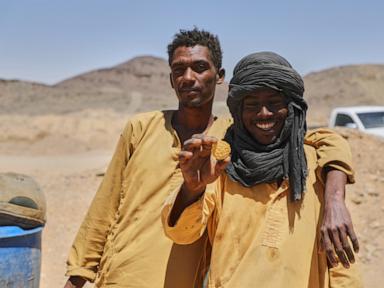
A young man stands at the edge of a jagged, unreinforced trench in Dalgo Mahas, a mountainous district in northern Sudan. He doesn't look at the sky, where the sun beats down at 40°C, nor does he listen to the distant political noise from Port Sudan or Khartoum. He looks at a handful of gray dirt. He is searching for gold. He has a cheap metal detector in one hand and a bottle of liquid mercury in the other. He knows the pit could cave in and bury him alive at any moment. He knows the chemical fumes are slowly rotting his nervous system.
He digs anyway. In fact, millions like him are digging faster than ever.
Sudan is currently trapped in one of the most devastating civil wars on earth. Yet, while the formal economy has collapsed, banks have closed, and fields lie fallow, the country's gold trade is booming. It's not happening despite the war. It's happening because of it.
If you want to understand how a country can endure a multi-year conflict that has displaced over 11 million people and pushed millions to the brink of famine, you don't look at military strategy. You look at the supply chain of artisanal gold. The metal flowing through the scarred hands of remote desert miners is the literal currency fueling the front lines.
The Oil Loss That Changed Everything
To understand how Sudan became so dependent on informal mining, you have to go back to 2011. When South Sudan seceded, Khartoum lost roughly 75% of its oil revenues overnight. It was a catastrophic blow to the national treasury.
The government needed an emergency lifesaver, and they found it under the desert sand. Sudan sits on top of some of the largest gold reserves in Africa. The state didn't build massive, high-tech corporate infrastructure to get it out. Instead, they let the citizens do the heavy lifting.
Today, a staggering 80% to 90% of Sudan's gold production doesn't come from formal corporate enterprises. It comes from the informal sector—known as Artisanal and Small-scale Gold Mining (ASGM). Roughly two million everyday citizens work in these informal pits, and their labor supports an estimated 13% of the population.
When the war between the Sudanese Armed Forces (SAF) and the Rapid Support Forces (RSF) erupted in April 2023, this massive, decentralized mining network became the ultimate prize.
How Gold Winds Up as Weapons
Gold has completely replaced traditional currency in the wartime economy. It is highly liquid, untraceable once melted, and immune to international banking sanctions. Both warring factions have split the country into distinct mining fiefdoms to fund their operations.
The RSF, led by General Mohamed Hamdan Dagalo (better known as Hemedti), laid the groundwork for this long ago. Years before the war, Hemedti's family enterprise, Al-Gunade, controlled the infamous Jebel Amer mines in Darfur. Now, the RSF dominates the mining fields across the west and southwest, including parts of Darfur and Kordofan. They move raw gold across porous borders into Chad, Central African Republic, and South Sudan.
From there, the metal is flown to regional trading hubs, primarily Dubai in the United Arab Emirates. It gets melted down, refined, and recast. Once it hits the international market, its origin is effectively erased. In return, advanced weaponry, drones, and fuel flow right back to the RSF.
On the flip side, the regular army (the SAF), led by General Abdel Fattah al-Burhan, commands the eastern and northern regions, including the River Nile and Northern states. They run their own parallel extraction economy. Much of the gold mined in SAF territory is trucked north through the desert into Egypt or exported out of Port Sudan. The state-backed mining company processes the residue from artisanal sites to guarantee immediate hard currency for the military treasury.
The global surge in gold prices has only accelerated this cycle. Every time the global price of gold hits a new historic high, the incentive to prolong the war increases. The conflict has become a self-sustaining corporate enterprise.
The Brutal Price Paid in the Pits
While generals exchange gold bars for high-tech drones, the people extracting the wealth live in an absolute nightmare. Artisanal miners operate with zero safety regulations, driven by sheer desperation in an economy where traditional jobs no longer exist.
Underground Collapses
Miners dig vertical shafts and horizontal trenches by hand, often exceeding depths of 20 meters. They don't use wood beams or concrete steel to reinforce the walls. They follow a vein of gold ore until the earth gives way. Mine collapses happen constantly, often burying dozens of men at a time in remote areas where rescue equipment is nonexistent.
Mercury Poisoning
To separate the gold from the crushed rock, miners mix the raw ore with liquid mercury using bare hands. They create an amalgam, which they then heat with a blowtorch to vaporize the mercury, leaving behind raw gold.
The toxic vapors go straight into the lungs of the miners and anyone standing nearby. Field studies in mining towns like El-Ebeidiya show that mercury levels in local drinking water are dangerously high. The chemical seeps into the soil and the food chain. Local medical workers report spikes in miscarriages, kidney failure, permanent blindness, and severe neurological disorders among children living near the processing sites.
Cyanide and Karta
Once the miners finish with the primary extraction, the leftover waste—locally called karta—still contains trace amounts of gold. Industrial processors use highly toxic cyanide pools to leach out the remaining metal. Flash floods regularly submerge these open-air chemical operations, washing a toxic cocktail of mercury and cyanide directly into agricultural land and underground water reserves that feed the Nile River.
What Happens to the Global Supply Chain
The reality of Sudan's gold rush is that it isn't isolated to Northeast Africa. The gold dug by an impoverished teenager in a toxic pit in Northern State eventually finds its way into global consumer markets.
Because the vast majority of the trade is smuggled, it easily blends into the legitimate global supply chain. Smugglers mix conflict gold with clean gold in regional refineries. By the time it is manufactured into a smartphone component or a wedding ring sold in Europe or North America, it looks perfectly legal on paper.
International watchdog groups have repeatedly called for stricter supply-chain transparency and targeted sanctions on the aviation networks moving the metal out of Africa. But as long as regional neighbors benefit from the cheap inflow of raw gold, enforcement remains a pipe dream.
Real Next Steps for Responsible Sourcing
If you are an investor, jeweler, or consumer who wants to avoid complicity in this system, standard "conflict-free" labels aren't enough. Here is what actually works to ensure you aren't funding the crisis.
- Demand Closed-Loop Sourcing: Avoid buying gold from ambiguous regional hubs in the Middle East or East Africa that cannot provide verifiable origins for their raw bullion.
- Support Certified Fairmined Initiatives: Look for gold sourced from verified artisanal cooperatives in regions like South America, where miners use mercury-free extraction methods and receive fair wages.
- Enforce Independent Audits: If you operate within a corporate supply chain, mandate third-party, unannounced forensic accounting of your metal suppliers, rather than relying on self-reported documentation.
Sudan's gold will keep flowing as long as the war requires funding and the global market rewards untraceable commodities. Until the financial arteries connecting desert trenches to international refineries are cut, the real price of gold will continue to be paid in Sudanese lives.