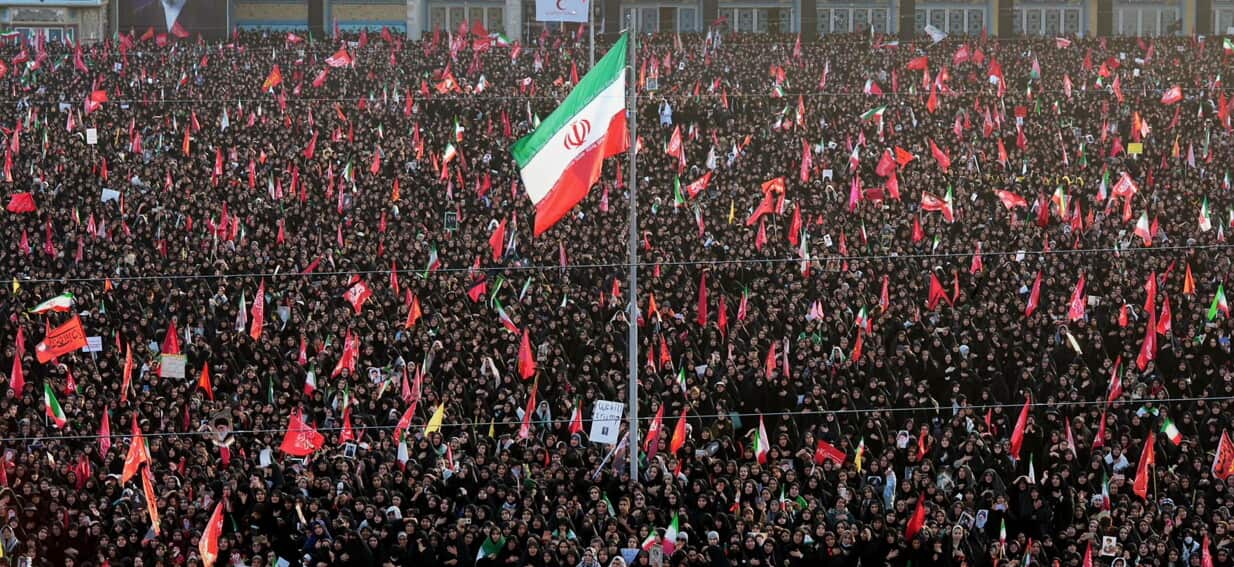
The physical journey of Ali Khamenei’s body from the Iranian sanctuary of Qom to its final resting place in Iraq marks more than a state funeral. It represents the closing of an era and the immediate opening of a volatile geopolitical vacuum. While Western observers frequently focus on the immediate street protests or the visible grief of crowds lining the streets, the real story is unfolding behind closed doors in Tehran, Najaf, and Qom. The institutional framework that sustained Iran's absolute clerical rule for decades is facing its most severe stress test since 1989.
The transition of power within a system built on the concept of Velayat-e Faqih (Guardianship of the Islamic Jurist) is never purely political. It is deeply theological, financial, and military.
The Battle for the Mantle of Qom
The mass gatherings in Qom provided a useful backdrop for state media eager to project an image of seamless continuity and monolithic devotion. The reality inside the seminaries is fractured. Qom is not merely a center of learning; it is an economic engine and the theological anchor of the Islamic Republic's legitimacy. For decades, the ruling elite in Tehran relied on a delicate consensus among senior grand ayatollahs to legitimize the Supreme Leader's political decrees.
That consensus has eroded. A younger generation of clerics, heavily subsidized by state institutions and vetted by the Islamic Revolutionary Guard Corps (IRGC), views the office of the Supreme Leader as a vehicle for national security and economic survival. Conversely, the traditionalist factions within Qom harbor deep anxieties about the total subordination of Shia theology to the immediate tactical needs of the security apparatus.
By moving the funeral processions through Qom before transferring the remains to Iraq, the regime attempted to force a public display of unity from senior clerics who have otherwise remained quietly critical of the state's economic mismanagement and iron-fisted domestic policies. The silence of certain high-ranking marjas (sources of emulation) during the procession speaks louder than the organized chants of the crowds. They recognize that the next selection process will likely strip away the last vestiges of theological independence, transforming the clergy into a literal bureaucratic arm of the state.
The Iraqi Destination and the Shadow of Najaf
Transporting Khamenei’s body to Iraq for burial carries immense symbolic weight, yet it exposes the deep geopolitical fault lines between the two major centers of Shia religious authority. Najaf, the historical heart of Shia jurisprudence, has long championed a quietist approach to politics. This philosophy, historically personified by Grand Ayatollah Ali al-Sistani, rejects the Iranian model of direct clerical rule, arguing instead that religious authorities should advise state rulers rather than govern directly.
The burial on Iraqi soil is an aggressive reassertion of transnational influence by Tehran. It aims to bind the religious identity of Iraq's Shia majority inextricably to the legacy of the Iranian Islamic Republic.
This move complicates life for Iraqi politicians and clerics alike. For years, Baghdad has attempted to maintain a precarious balancing act between Washington and Tehran. The influx of Iranian officials, security personnel, and paramilitary commanders into Iraq under the guise of funeral logistics effectively turns Iraqi territory into a staging ground for Iranian domestic consolidation. Iraqi nationalist factions, even those within the Shia community, view this overt display of Iranian spiritual and political ownership with deep suspicion. They fear that the institutional mechanisms used to control Iranian society will now be exported more aggressively to Baghdad.
The IRGC Enforces the Status Quo
While the Assembly of Experts holds the constitutional mandate to select the next Supreme Leader, the true kingmaker is the Islamic Revolutionary Guard Corps. The military apparatus has spent the last two decades systematically expanding its control over the Iranian economy, from telecommunications and construction to oil smuggling and banking. For the IRGC, the succession is not a matter of divine right or jurisprudential excellence. It is a matter of asset protection.
The military needs a figurehead who will not challenge their economic monopoly or question their regional proxy strategies. A weak, pliable Supreme Leader suits the high command perfectly.
The Securitization of Faith
Under this blueprint, the traditional requirements of high theological standing are being discarded. The regime has spent years positioning candidates who possess impeccable security credentials but lack the genuine religious authority required to command spontaneous respect from the faithful. This shift alters the very nature of the state.
- The Eclipse of Traditional Clerics: Senior jurists who spent decades studying in the seminaries are being sidelined in favor of political bureaucrats.
- The Rise of the Security Cleric: New appointees to key religious foundations are chosen primarily for their loyalty to the intelligence services.
- Economic Consolidation: Billion-dollar religious endowments (Bonyads) are being integrated directly into IRGC-controlled holding companies.
This transformation creates an unstable equilibrium. The original legitimacy of the Islamic Republic rested on the dual pillars of ideological fervor and religious authority. With the fervor long since extinguished among the younger demographic and religious authority being openly hollowed out by military necessity, the regime must rely increasingly on brute force to maintain order.
The Regional Shockwaves
The consequences of this transition extend far beyond the borders of Iran and Iraq. The network of regional proxies collectively known as the Axis of Resistance was built on personal loyalty to both absolute leadership and specific military commanders. The loss of the central ideological figurehead tests the cohesion of these groups.
Syria, Lebanon, and Yemen are watching Tehran with intense scrutiny. Damascus depends on Iranian financial lifelines and military backing to sustain its fragile post-war reality. Hezbollah in Lebanon, facing its own structural challenges, requires a predictable and decisive patron in Tehran to maintain its domestic dominance. If the succession process in Tehran turns bloody or protracted, these regional outposts will find themselves isolated, forced to navigate local conflicts without the guarantee of immediate Iranian intervention.
The Gulf states are responding with cautious mobilization. Sensing a period of potential vulnerability, regional rivals are calibrating their diplomatic and military postures. They understand that an insecure regime in Tehran is often more dangerous than a stable one; a divided leadership cadre might orchestrate a foreign policy crisis to distract from domestic instability and unite competing factions behind a nationalist banner.
The Illusion of Continuity
The state-orchestrated choreography of the funeral procession is designed to project strength, but it cannot mask the structural decay beneath the surface. The economic reality facing ordinary Iranians—skyrocketing inflation, a collapsed currency, and systemic corruption—has alienated the vast majority of the population from the religious elite. The crowds on the streets of Qom represent a shrinking core of state dependents and ideologues, not the broader sentiment of a nation weary of isolation.
The transition process will not end when the body is lowered into the ground. The true struggle begins when the cameras turn off and the competing factions within the security apparatus, the clerical establishment, and the financial elite begin the brutal process of dividing the spoils of an empire. They are fighting for survival in a system that has run out of ideological currency.
The elite understand that any sign of weakness at the top could trigger a cascade of domestic unrest that the security forces might struggle to contain. Therefore, the immediate aftermath will likely see an intensification of domestic repression, internet blackouts, and preemptive arrests of potential dissidents. The regime is gambling that absolute ruthlessness can substitute for genuine legitimacy.
This calculation overlooks the fundamental law of authoritarian transitions. When a state relies entirely on the authority of a single individual for decades, the removal of that individual shifts the foundation of every institution simultaneously. The structures designed to protect the state can quickly turn against one another when the ultimate arbiter is gone.