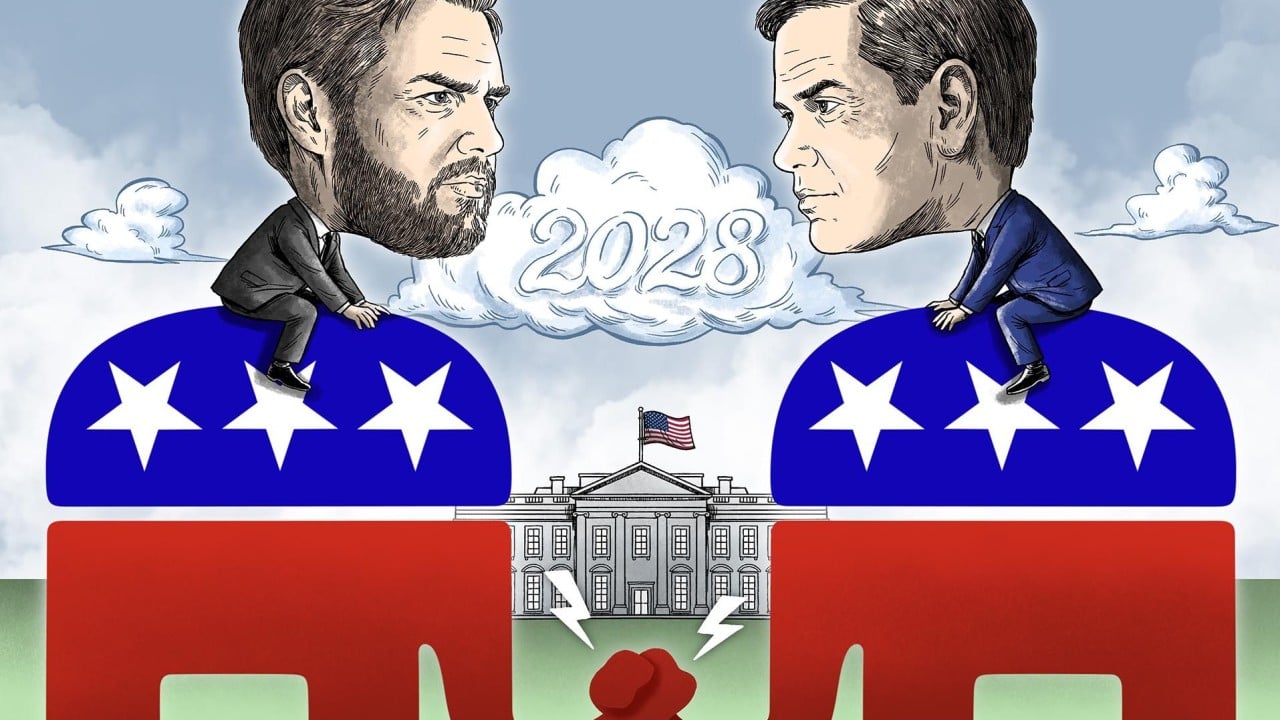
The restriction imposed by the Twenty-Second Amendment ensures that the institutional control of the Republican Party will undergo a structural transition ahead of the 2028 presidential election. While conventional political reporting treats the early maneuvering of Vice President JD Vance and Secretary of State Marco Rubio as a standard personality conflict, an analytical view reveals a deeper systemic shift. The upcoming primary is not merely a competition for voter popularity; it is an optimization problem centered on two distinct vectors of political capital: pure ideological inheritance versus institutional execution.
To understand how the post-Trump GOP will consolidate, analysts must decouple the emotional rhetoric of the populist movement from its structural mechanics. The candidate who successfully inherits the coalition must solve for a complex equation: maximizing alignment with the existing working-class base while minimizing the electoral penalties associated with tariff-driven economic friction and executive administration liabilities.
The Strategic Matrix: Lineage vs. Execution
The competition between Vance and Rubio defines the two primary pathways available for institutional succession. These pathways can be modeled across three core operational pillars: base mobilization efficiency, executive execution track records, and demographic coalition elasticity.
                  [Vance: Populist Lineage Pathway]
                                 │
             ┌───────────────────┴───────────────────┐
             ▼                                       ▼
[Working-Class Mobilization]              [Rust Belt Electoral Premium]
             │                                       │
             └───────────────────┬───────────────────┘
                                 ▼
                    [Target: National Populism]

                                 vs.

                  [Rubio: Institutional Execution Pathway]
                                 │
             ┌───────────────────┴───────────────────┐
             ▼                                       ▼
[Sun Belt Electoral Coalition]           [Geopolitical Risk Management]
             │                                       │
             └───────────────────┬───────────────────┘
                                 ▼
                 [Target: Multi-Ethnic Realignment]
1. Base Mobilization Efficiency
The first variable is the cost of voter acquisition within the core Republican electorate. Data from early 2026 primary polling establishes a stark baseline: Vance commands approximately 40% to 45% of core partisan support, while Rubio registers at 14%. This variance is a function of ideological positioning.
Vance operates on a lineage strategy, positioning himself as the direct intellectual successor to national populism. His public communication focuses heavily on cultural protectionism and anti-globalist economics, which maps precisely onto the preferences of the modern GOP base.
Rubio operates on an execution strategy. His position as Secretary of State leverages structural authority rather than grassroots ideological combat. This choice reduces his immediate friction with the administrative apparatus of the government but increases his voter acquisition cost among the populist vanguard, who view institutional compliance with skepticism.
2. Executive Execution Track Records
The two contenders have adopted opposing operational models within the current administration:
- The Domestic Advocacy Model (Vance): As Vice President, Vance functions as an ideological anchor. He deploys directly to critical swing states like Iowa and Pennsylvania to reinforce the administration's tariff policies and industrial protectionism. His focus is on maximizing loyalty among low-propensity, working-class voters.
- The Consolidated Portfolios Model (Rubio): Rubio has built an unprecedented administrative footprint by managing critical foreign policy and national security apparatuses, serving as Secretary of State while temporarily executing duties linked to the National Security Advisor framework and oversight of foreign assistance via USAID. This centralization makes him the primary architect of the administration's international actions, such as January's U.S.-backed operations in Venezuela and hawkish positioning regarding the Chinese Communist Party.
3. Demographic Coalition Elasticity
The final primary variable is general election conversion efficiency. The Republican party's long-term growth depends on expanding its share of working-class minority voters, particularly Hispanic demographics in the Sun Belt.
Rubio possesses an established track record of high-margin victories in diverse electorates, demonstrated by his landslide re-election in Florida in 2022. Vance offers a different electoral premium: structural appeal within the deindustrialized Rust Belt, a geographic reality that remains mathematically vital for any Republican Electoral College victory.
The Cost Function of Ideological Continuity
The primary strategic bottleneck for Vance lies in his absolute dependency on the economic performance of the current administration. Because his political brand is tied to the executive branch's platform, any erosion in macroeconomic indicators acts as a direct tax on his political capital.
[Tariff & Industrial Interventions] ──> [Macroeconomic Friction / Inflation]
                                              │
                                              ▼
[Vance: Direct Brand Depreciation] <── [Erosion of Executive Approval]
This dynamic creates a specific vulnerability. When tariff interventions lead to corporate hiring freezes or localized inflationary pressures, the electoral penalty hits the sitting Vice President first. Vance faces an asymmetric risk profile: he inherits the full blame for administration missteps but must share the credit for its successes with the President.
Furthermore, Vance’s structural weakness remains his unscripted retail execution. Operational data from past campaign cycles—including highly publicized, rigid interactions with voters during routine campaign stops—indicates a lack of comfort with traditional retail politics. In a highly competitive primary environment, where candidates are subjected to intense media scrutiny and spontaneous public exposure, these friction points lower his defensive capability against agile challengers.
The Institutional Alternative and the Sun Belt Blueprint
Rubio’s strategy relies on a multi-ethnic, working-class realignment that does not depend exclusively on Rust Belt populism. By focusing on foreign policy execution and international risk mitigation, Rubio insulates himself from domestic economic volatility.
The structural advantages of this approach include:
- Insulation from Domestic Policy Friction: By managing external statecraft, Rubio avoids direct accountability for complex domestic economic outcomes like inflation or industrial labor disputes.
- Institutional Credibility: His extensive legislative background in the Senate, combined with high-level executive statecraft, positions him as a stabilizing option for donor networks and moderate Republicans concerned with administrative stability.
- Sun Belt Dominance: His ability to appeal to suburban moderates and Hispanic working-class voters simultaneously provides an alternative mathematical path to 270 electoral votes—one that goes through the South and Southwest rather than relying entirely on the industrial Midwest.
The second limitation of Rubio’s strategy, however, is the deficit in baseline enthusiasm. Populist primary electorates rarely reward geopolitical competence over domestic cultural alignment. By presenting himself as an efficient institutional operator, Rubio risks being outflanked by rivals who use high-conflict cultural rhetoric to drive grassroots media coverage.
Strategic Playbook for the 2028 Primary Transition
As the 2026 midterm elections approach, the competition will shift from quiet bureaucratic positioning to open structural confrontation. The outcome will be determined by how both candidates manage their structural constraints over the next twenty-four months.
The Vance Optimization Directives
To secure his frontrunner status, the Vice President must transition from an ideological surrogate to an independent political force.
- Decouple from Policy Liabilities: Vance must develop distinct policy sub-portfolios—such as technology antitrust enforcement or domestic supply chain reshoring—that allow him to claim specialized economic wins independent of broader inflationary indicators.
- Mitigate Retail Friction: His team must run tightly controlled, small-scale town halls designed to minimize unscripted public relations vulnerabilities, focusing instead on high-production digital media assets where his intellectual baseline is an asset rather than a liability.
- Form Institutional Alliances: He must systematically court state-level party chairs and governors to build an organizational firewall that prevents second-tier insurgencies from gaining early state momentum.
The Rubio Optimization Directives
To bridge the 30-point polling gap, the Secretary of State must convert his foreign policy achievements into domestic political leverage.
- Monetize Geopolitical Capital: Rubio must explicitly link international actions to domestic working-class security. For example, framing hawkish trade maneuvers against China or security operations in Latin America as direct protections for American industrial jobs and domestic border stability.
- Exploit Executive Vulnerabilities: Without openly opposing the administration, Rubio must position himself as a corrective force capable of offering administrative competence where the current executive branch experiences operational friction.
- Leverage Non-Aligned Factions: He must unify the remaining institutional wings of the party, combining elite donor backing with Sun Belt grassroots organizations to construct a fundraising apparatus that can match the Vice President's media dominance.
The eventual configuration of the 2028 Republican ticket depends entirely on these adjustments. If Vance stabilizes his retail execution and insulates his brand from domestic economic shocks, his structural advantage with the populist base will likely make him impossible to displace. If domestic economic conditions deteriorate significantly, the party’s internal selection mechanisms will naturally favor Rubio’s institutional execution model, shifting the strategic center of gravity away from the Rust Belt and toward a Sun Belt coalition framework.